Clinically AI vs Upheal: documentation, compliance and data rights compared
Clinically AI and Upheal are both built only for behavioral health, which makes this a closer comparison than most on this site. Both also sit alongside the EHR you already use. Only one of them can also become it.
Clinically AI, formerly Clinical Notes AI, is a documentation and compliance platform that works with any EHR through a Chrome extension or a custom integration. Upheal can be used exactly the same way, as a documentation layer beside your current system, and it can also replace the EHR when you want it to. Most of what follows comes back to that.
There is also a difference in what each company may do with the data your sessions produce, and it is written into the terms rather than the marketing. That section is worth reading before you sign up to either.
Clinically AI vs Upheal at a glance
| Feature | Upheal | Clinically AI |
|---|---|---|
| AI notes plan | $39/moUpheal AI Notes, alongside any EHR | $0–$60/moForever Free, Dictation $20, Plus $40, Pro $60, Enterprise custom |
| EHR plan | $1/sessionAI notes included; no seat fee$99/mo unlimitedAssistant Pro included | No EHRWorks alongside your existing EHR |
| Built for | Behavioral health only | Behavioral health only |
| AI progress notes | Unlimited on the paid plan | Unlimited dictation from $20Free tier is 10 dictation credits a week |
| Live session recording | Included at any volumeBrowser, mobile and desktop apps | Metered below Pro20/mo on Dictation, 40/mo on Plus, unlimited on Pro |
| Notes linked to treatment plans | Golden ThreadAuto-links to every session note | Golden thread supportComply aligns treatment plans, interventions and progress notes |
| Compliance | Compliance CheckerAetna and Optum criteria before you sign; also checks PDFs from other systems | ComplyReal-time chart auditing, fidelity scoring, CARF and Joint Commission prep |
| Supervision workflows | No | Supervision and group note audit workflows |
| AI assistant | YesPrep, drafting, scheduling, invoices, messages | No |
| Scheduling | Included | NoWorks alongside your EHR |
| Telehealth | Yes, free built-in | No |
| Billing and insurance claims | LiveClaims, ERAs, eligibility checks | No |
| Client portal and messaging | YesAI drafts from the record | No |
| Client records | Full client chart | NoChart-aware, but the chart stays in your EHR |
| EHR integration | Chrome extension | Chrome extension or custom integration |
| Free plan | YesUnlimited notes from typed summaries, dictation and uploads, plus telehealth | Forever Free10 dictation credits a week; 10 live session and 2 document credits with no period stated |
| Jurisdictions covered | HIPAA, PHIPA and PIPEDA, GDPR and DPA | HIPAAPlus FERPA alignment for school-based care, as named by Clinically AI |
| Independent attestation | SOC 2 Type IIContinuously externally tested | SOC 2Report type not stated by Clinically AI |
| Session data retention | Recordings deleted after the note by defaultOr kept if you choose | ConfigurableStrictest option removes PHI within 14 days; de-identified data may be retained after deletion |
| Rights over de-identified data | Client opt-in requiredRevocable with deletion; therapists on paid plans can disable for all clients; not shared with business partners | Owned by the vendorTerms permit publishing and sharing for any lawful purpose; no opt-out described |
What Clinically AI is
It calls itself the Intelligence Platform for Behavioral Health, and it ships two products.
Clinical Notes AI is the scribe. Live and post-session transcription, clinical templates including SOAP, DAP and BIRP, DSM-5 and ICD-10 aligned language, and what their own solutions page calls "contextual note intelligence (golden thread support)". It works with any EHR through their Chrome extension or a custom integration.
Comply is the compliance product. Their page lists real-time chart auditing and fidelity scoring, supervision and group note audit workflows, "Golden Thread alignment (treatment plans, interventions, progress notes)", customizable audit flags by agency, modality or program, and preparation for internal QA, payer audits and CARF or Joint Commission surveys.
Neither makes it an EHR. There is no scheduling, no billing, no claims, no telehealth and no client portal, because the chart stays in whatever system you already run. That is a deliberate design choice on their part, not an oversight.
Where Clinically AI wins
Compliance, if audits are your pressure point
This is the closest fight on the page and the two products are aimed at different problems.
Upheal's Compliance Checker audits a finished note against Aetna and Optum documentation criteria before you sign it, and can check PDF notes exported from another system. It is built for a therapist who bills commercial insurance and wants to catch a medical necessity gap before the claim goes out.
Comply audits charts in real time with fidelity scoring, supports supervision and group note review, and is built for accreditation surveys. It is aimed at an agency with supervisees, program standards and a CARF or Joint Commission cycle.
If you are a solo therapist billing Aetna, ours is the more direct tool. If you run a CCBHC or a group practice with clinicians to supervise, theirs does things we do not do at all. That is not a close call in either direction; they are different products.
Supervision workflows
Supervision and group note audit workflows are a first-class feature for them. Upheal has no supervision workflow, and for a practice with associates or trainees that is a real gap on our side.
FERPA alignment for school-based care
They state FERPA alignment for school-based care. If you work in schools, that is a specific reason to look at them and we make no equivalent claim.
Where Upheal goes further
Two ways to run it, not one
Clinically AI is designed to sit beside your existing system, and it does that well. The limit is that it is the only mode available. The notes live in one place, the schedule and the money live in another, and an extension carries text between them.
Upheal runs either way. Keep SimplePractice or TherapyNotes and use Upheal for notes alone, capturing sessions from any browser tab, your video calls or the mobile app, and pushing the finished note back with the Chrome extension. Or switch on scheduling, telehealth, the client portal, forms, messaging, payments and insurance claims and let it replace the EHR, at which point the AI is working from the whole record rather than the transcript. You do not have to decide on day one.
An assistant that does practice work
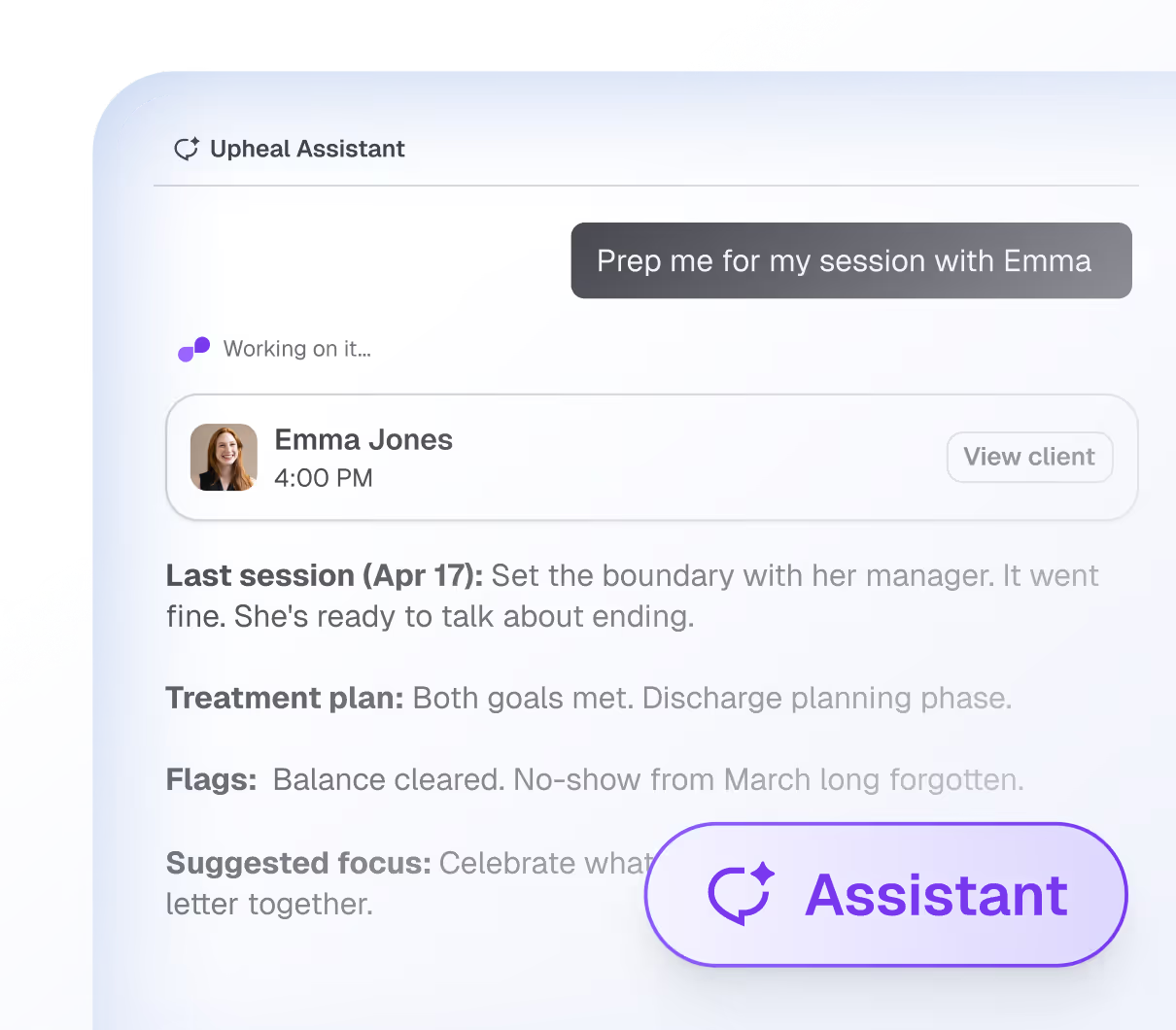
Upheal's AI Assistant reads the whole client record. It can prep you for the next session from history and open goals, draft discharge summaries and referral letters, reschedule appointments, generate invoices and superbills, chase outstanding balances, send forms and draft client messages, showing you what it is about to do and waiting for your approval. That makes it conversational and agentic. Its free tier comes with every plan, and Assistant Pro, $39 a month or included in the $99 plan, removes the usage limits, including on routines that run on their own, and adds custom reports. Clinically AI publishes no assistant across its homepage, solutions overview, pricing page or practice-type pages.
Live capture is not metered
Recording a session costs a credit on every Clinically AI tier below Pro: twenty a month on Dictation, forty on Plus. A therapist seeing fifteen clients a week passes forty in the third week. On Upheal, live capture is included on the paid plan at any volume, and the free plan generates notes from typed summaries, dictation and uploaded recordings.
Everything else a practice runs on
Scheduling, telehealth, a client portal, intake forms with AI import from PDF, secure client messaging, payments, and insurance claims with ERA processing and eligibility checks are all in Upheal. A therapist using Clinically AI keeps paying for those somewhere else.
Data rights: read the terms, not the homepage
Both platforms are HIPAA compliant, both are SOC 2, both sign a BAA. The difference is what each company may do with what your sessions produce, and on their side the marketing and the contract do not say the same thing.
What Clinically AI's homepage says
Their homepage advertises zero data retention, alongside HIPAA compliance, SOC 2 certification and FERPA alignment for school-based care.
What their privacy policy and terms say
Their privacy policy, last updated 20 June 2025, describes configurable retention rather than none. Customers set retention schedules, and the strictest named option, "Retain When Saved", removes documentation including PHI from their systems within fourteen days. The same section then states that even if they delete some or all of your personal information, they may continue to retain and use de-identified, aggregate or anonymous data previously collected.
Their terms of service go further. They reserve the right to "compile, collect, copy, modify, publish and use" the data generated from your use of the Services, together with AI Documentation and User Content, in de-identified, anonymous and aggregate form, for "analytical and other business purposes". That material is defined as De-Identified Data, and the terms state that Clinical Notes AI "shall own all right, title and interest in and to the De-Identified Data and may use and share it for any purposes permitted under applicable law".
Separately, their privacy policy permits disclosing de-identified personal or protected health information to select business partners to develop or improve AI models under confidentiality agreements, and for market research purposes in the aggregate.
No opt-in or opt-out is described for any of it.
Read together: PHI can be cleared in fourteen days if you choose that setting, but the de-identified material derived from your sessions is owned by them, survives your deletion, and may be shared for any lawful purpose. Zero data retention describes the PHI, not the derivatives.
How Upheal handles the same question
We use de-identified session data to improve our AI, and we say so. Three things differ. Nothing is used unless the client actively opts in, and a client who never sees the request is opted out. Consent can be withdrawn and the data is deleted, so withdrawal reaches the derivative rather than stopping at the raw file. And therapists on paid plans can switch the request off for every client at once.
We do not share it with business partners to develop their models, and we do not claim ownership of it. Session recordings are deleted by default once the note is generated, or kept if you choose. All of this is in our provider privacy policy, last updated 3 December 2025. Upheal is HIPAA, PHIPA, PIPEDA, GDPR, and DPA compliant, has completed a SOC 2 Type II audit, and is continuously externally tested. Upheal signs a BAA with every practice, and control status is published at trust.upheal.io.
Neither company is doing anything unlawful. The question a therapist should ask is who owns what their clients said once it has been de-identified, and whether they can take it back. Read both sets of terms before deciding.
Pricing
Clinically AI has five tiers, verified against their pricing page on 5 September 2026.
Forever Free, $0. Ten dictation credits a week, ten live session credits, two document credits. Their pricing page states a weekly period for the dictation credits only. The live session and document allowances carry no stated period, unlike every paid tier, so confirm with them whether those renew.
Dictation, $20/month. Unlimited dictations, twenty live session credits and two document credits a month.
Plus, $40/month. Unlimited dictations, forty live session credits and five document credits a month.
Pro, $60/month. Unlimited dictations, live sessions and documents.
Enterprise, custom pricing.
Upheal AI Notes is $39 a month, alongside the EHR you already use. If you want Upheal to replace the EHR as well, the Upheal EHR is $1 per session, billed after the sessions happen, and covers AI notes, treatment plans, the Compliance Checker, scheduling, telehealth, client portal, forms, messaging and secure payments. A light month costs less. Running more than about 60 sessions a month? The $99 plan covers unlimited sessions and includes Assistant Pro.
Two things worth stating rather than burying. A session counts when you generate a note or schedule a client, and telehealth calls count too, because the fee covers the platform rather than the note alone. And money movement carries its own fees: Stripe at 2.9% plus $0.30 on card payments, $0.30 per insurance claim, $0.15 per eligibility check.
The comparison depends on how you document. If you record sessions, fifty a month needs their Pro at $60 plus whatever EHR you already pay for; the same month on Upheal is $50 with the EHR included. If you dictate instead, their Dictation tier at $20 is cheaper than us on documentation alone, and you are still running two systems.
Is Clinically AI right for your practice?
Choose Clinically AI if:
- You have an EHR you intend to keep and want documentation and audit support beside it
- Compliance and audit readiness are the pressure point rather than admin
- You supervise clinicians and need group note audit workflows
- You work in a CCBHC, agency or school-based setting facing accreditation surveys
Choose Upheal if:
- You want the option to replace your EHR later without changing tools again
- You want the assistant to handle scheduling, billing and client messages, not just the note
- You record sessions and do not want live capture metered
- You want the data question settled by a consent your client can withdraw, with deletion that reaches the de-identified copy
Frequently asked questions
Is Clinically AI an EHR?
No. Clinically AI is a documentation and compliance platform that works alongside your existing EHR through a Chrome extension or a custom integration. It has no scheduling, billing, insurance claims, client portal or telehealth, so therapists using it keep a separate practice management system.
What is the difference between Clinical Notes AI and Clinically AI?
Clinically AI is the company and platform name. Clinical Notes AI is now the name of its documentation product, and Clinical Notes AI, Inc. remains the legal entity in its terms and privacy policy. Comply is its second product, covering chart auditing and compliance.
How does Clinically AI pricing compare to Upheal?
Clinically AI has a Forever Free tier, then Dictation at $20/month, Plus at $40/month, Pro at $60/month and custom Enterprise pricing. Live session recording is metered below Pro. Upheal AI Notes is $39 a month and runs alongside the EHR you already have, which is the like-for-like comparison. The Upheal EHR, with AI notes included, is $1 per session if you want to replace the EHR as well.
Is the Clinically AI free plan really free?
It is a free account rather than a trial. It gives ten dictation credits a week. Their pricing page also lists ten live session credits and two document credits, but unlike every paid tier it states no renewal period for those two, so ask them whether they reset. Unlimited dictation starts at $20 a month.
Does Clinically AI have a compliance checker?
Yes. Comply provides real-time chart auditing and fidelity scoring, supervision and group note audit workflows, golden thread alignment across treatment plans, interventions and progress notes, and preparation for payer audits and CARF or Joint Commission surveys. Upheal's Compliance Checker works differently, auditing a finished note against Aetna and Optum documentation criteria before you sign it.
What does Clinically AI do with session data?
Their privacy policy allows customers to set retention schedules, with the strictest named option removing PHI within fourteen days, and states that de-identified, aggregate or anonymous data previously collected may be retained even after deletion. Their terms of service reserve the right to compile, copy, modify, publish and use data from your use of the Services in de-identified and aggregate form for analytical and other business purposes, state that they own that De-Identified Data, and permit them to share it for any purpose allowed by law. Their privacy policy also permits disclosing de-identified information to business partners to develop or improve AI models. No opt-out is described. Upheal uses de-identified session data only where the client has opted in, deletes it if consent is withdrawn, and does not share it with business partners.
How do Upheal and Clinically AI compare on compliance and security?
Upheal is HIPAA, PHIPA, PIPEDA, GDPR, and DPA compliant, has completed a SOC 2 Type II audit, and is continuously externally tested, and it signs a BAA with every practice. Clinically AI states HIPAA compliance and SOC 2 certification, without naming the report type, and FERPA alignment for school-based care. If you work in schools, that FERPA alignment is a reason to look at Clinically AI; Upheal makes no equivalent claim.
Can Upheal replace Clinically AI and my current EHR?
Yes. Upheal covers AI session notes, treatment planning, scheduling, billing, insurance claims, intake forms, telehealth, secure messaging and client records in one platform, and AI-assisted migration imports your clients, notes, and chart files from your existing system.
Sources: Clinically AI claims are taken from its homepage, solutions overview, pricing page, private practice page, privacy policy (last updated 20 June 2025) and terms of service, all read on 5 September 2026. Its HIPAA and SOC 2 claims were rechecked on its Why Clinically AI page on 15 September 2026. Where this page says Clinically AI does not have something, that reflects the absence of any published mention across those pages. Upheal claims are from upheal.io feature pages, the support centre and the provider privacy policy, updated 3 December 2025. Pricing, features and terms change on both sides; confirm current terms with each vendor before deciding.