
How Alliance Family Services cut paperwork from 15 hours to 2
It allows us to be more present. Instead of trying to write in your head, you're just making sure you hit those key questions you put in your template, and then boom.
Kristy Castille works alongside 10–12 clinicians at Alliance Family Services, a practice that runs a county mental health treatment court along with several other therapeutic programs. As a clinical supervisor who also builds out the practice's note templates, she's spent the last while tailoring Upheal to fit a caseload that ranges from family programs to mental health court to intern supervision.
Alliance's Upheal story
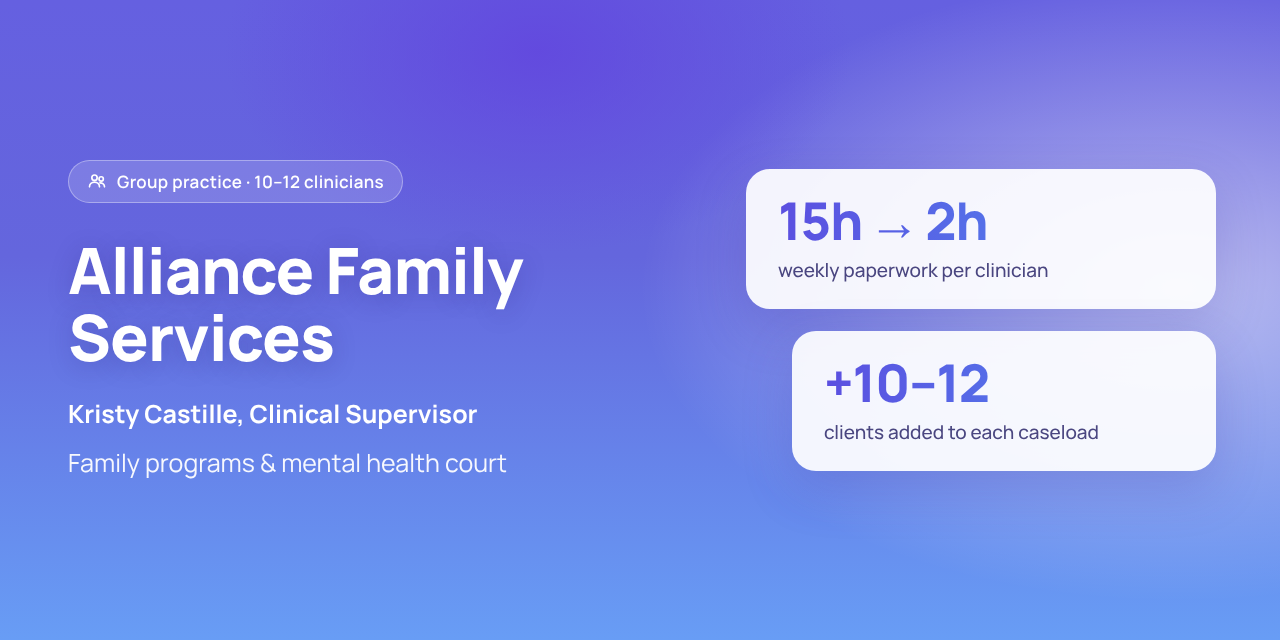
- Paperwork time cut from 10–15 hours a week to about 2.
- Caseloads up by 10–12 clients per clinician once the documentation backlog stopped feeling intimidating.
- Custom templates for every program, from parenting classes to mental health court to intern supervision, standardized documentation across the team.
- Telehealth moved from doxy.me to Upheal, with built-in recording and no second device.
The challenge
Before Upheal, documentation meant hours of manual recall after each session.
We don't get paid for any of that, and the burnout that comes with having to spend so many hours a week trying to recall things, keep paper notes, put everything together...
Client communication was just as fragmented. The practice's existing portal, attached to their EHR (BestNotes), couldn't send messages. Outcome surveys went out by email and often landed in spam. Most communication fell to the front office calling clients directly. For telehealth, clinicians were using doxy.me, a single-purpose video link with no built-in recording, so sessions had to be recorded on a separate device.
Documentation was also inconsistent across the team: BestNotes offered only a blank template with checkboxes, and "everybody kind of was up to their own interpretation of what each section required."
The solution
Kristy built a library of custom note templates tailored to each program the practice runs: parenting classes, mental health court, team meetings, clinical supervision, even employee evaluations. As a learning-based facility that hosts social work and counseling interns, she also created a dedicated template for intern clinical-skills feedback. Clinicians use the same template on their own sessions, too, as a quick gut-check on how a session went.
To keep everything consistent, she manages every template herself. Clinicians simply request changes and she builds them.
I don't allow other people to mess with the templates, because they have a bad habit of accidentally deleting them.
The team also moved telehealth sessions from doxy.me to Upheal, gaining multi-person chat and built-in recording without a second device. During intake specifically, clinicians no longer need a laptop in front of the client. Kristy calls it a game changer for how the team runs intakes.
You get that more authentic engagement up front, and it retains so much more information, so you're not double-asking questions.
On the client side, the portal is used mainly for appointment schedules, one-tap telehealth access, and AI-generated session summaries. Clients have learned to say "tell the AI lady I want this in my report," and Kristy walks clients through finding it on their phone so everything they need lives in one place. Messaging is used less; most clients still prefer calling the front office, though newer clients are picking it up as they onboard.
For the mental health court program specifically, multiple clinicians treating the same participant (for example, a substance-use counselor and a mental-health counselor) tag themselves to the same client record, sharing one chart and each other's insights instead of working in silos.
The results
- Paperwork time cut from 10–15 hours a week to about 2. Kristy and her colleagues describe it as one of the biggest changes Upheal has made to their week.
- Caseloads up by 10–12 clients per clinician. "Everybody's been able to increase their caseload," Kristy says, largely because the paperwork backlog stopped feeling intimidating.
- Lower burnout, and an unexpected culture shift. With less admin work to catch up on during breaks, clinicians spend more time talking to each other instead of closing their office doors.
- More confident clinicians, richer supervision. Seeing the AI reflect back what they were already thinking builds confidence, and as a clinical supervisor, Kristy finds it sparks deeper conversations in supervision, since clinicians can ask why a note came out one way instead of another.
- Standardized documentation across the team, replacing a blank-template system where every clinician interpreted the same fields differently.
- Smoother onboarding for new clinicians, despite a small learning curve reconciling Upheal with the practice's EHR (BestNotes).
I feel like we spend more time talking to each other instead of hiding from each other.
Advice for other practices
Kristy's top recommendation for group practices considering the same approach: put one person in charge of templates. "Give one person that responsibility" so changes stay traceable instead of everyone tweaking things independently. Her second piece of advice is to actually input client data into the system rather than working around it; skipping that step just creates extra work later.
Her advice on templates themselves: build one for every specialized workflow, not just the general cases.
Think about what you're doing in your caseload and use it for all of them: your CANS assessments, your CDAS, your intake notes. Make something that's tailored exactly to what you need, so you're not sitting there pulling out information. We want to copy and paste. We don't want to spend all of our time reinventing what could just be right there.
