
Upheal vs SimplePractice: which EHR fits your practice?

TL;DR
- SimplePractice is a well-established EHR with solid scheduling, billing, and a large user community.
- SimplePractice charges $49 to $99/month base, plus $35/month for AI notes or $59/month for the Care Aide bundle. Upheal is $1 per session with no seat fee, and AI notes and treatment plans are included, so a 40 to 60 session month costs less than a SimplePractice subscription with AI on top.
- Upheal is an AI-native EHR built around a conversational, agentic assistant: one assistant handles documentation, scheduling, billing, telehealth, and client communication.
- SimplePractice's AI runs at fixed points in the workflow. Upheal's Assistant is something you ask, in your own words, about any client, at any time, and it acts on the answer.
- From October 1, 2026, SimplePractice charges $0.39 per insurance claim on every plan and the free claims on Essential and Plus go away. Upheal charges $0.30 per claim with no monthly billing fee.
You're here because something in your current setup stopped making sense. Maybe SimplePractice's bill went up. Maybe notes are eating your evenings. Maybe you've heard that some EHRs have AI actually built in rather than bolted on, and you want to see what that looks like in practice.
This page covers the real differences between Upheal and SimplePractice: how their AI features work, how pricing compares, and where the gaps are on both sides.
Upheal vs SimplePractice at a glance
| Feature | Upheal | SimplePractice |
|---|---|---|
| Pricing | $1/sessionNo seat fee | $49 / $79 / $99/moStarter, Essential, Plus |
| Pricing Model | Pay-as-you-goScales with your caseload | SubscriptionMonthly or annual |
| AI Note Taker | IncludedIn-person & telehealth | Add-on ($35/mo)Telehealth on web, in-person via mobile app |
| AI Assistant | Conversational + agenticFree tier; Pro $39/mo | Care Aide ($59/mo)Features at fixed points |
| Custom Note Template from PDF | Yes | Template builder onlyBuild from scratch or duplicate |
| Goal & Treatment Plan Linking | Golden ThreadFrom session data | Treatment PlannerIn Care Aide (Beta) |
| Client Messaging | AI drafts, attachments, group threads | Client portal messagingEssential and above |
| Scheduling | Yes | Yes |
| Insurance Billing | $0.30/claim, $0.15/eligibilityNo monthly billing fee | $0.39/claim from Oct 1, 2026Eligibility $0.15, free on Plus through Mar 31, 2027 |
| Client Portal | Yes | Yes |
| Telehealth | Yes | Yes |
| Mobile Apps | Provider & client apps | Provider & client apps |
| Payment Processing Fees | 2.9% + $0.30 | 3.15% + $0.30 |
| Automated Migration | From any EHRClients, notes, templates, forms | Client profiles onlyTheir team imports a template you fill in; notes, appointments and billing excluded |
| Jurisdictions covered | HIPAA, PHIPA and PIPEDA, GDPR and DPA | HIPAAThe jurisdiction SimplePractice names |
| Independent attestation | SOC 2 Type IIContinuously externally tested | SOC 2 Type II + HITRUSTHITRUST validated, per SimplePractice |
Where SimplePractice fits best
SimplePractice is the right choice if you want a mature, traditional EHR with a long track record in insurance billing, HITRUST certification, and one of the largest peer communities in the category. It stores your records, manages your calendar, and handles your billing, and it has been doing all three for over a decade. Its AI features are real and they help, but they run at defined points in the workflow: a summary at intake, a discussion outline during a telehealth session, a note after. The work in between is still yours.
If you're comfortable with the status quo and not looking to change how you practice, SimplePractice delivers.
Where Upheal fits best
Upheal is the better option if you want practice management software that works for you rather than software you work in. Upheal's AI drafts your notes after each session, pulls context before the next one, drafts messages to clients, and handles the administrative work that builds up between sessions. Your evenings stop being work hours.
If you're using SimplePractice while paying separately for an AI scribe, Upheal replaces both.
Insurance billing is live, with claims submission, ERA processing, and eligibility checks built directly into the platform. Migrate your records and get started.
How do Upheal and SimplePractice compare on AI?
Both platforms have AI. The difference is what kind.
SimplePractice sells two AI products. Note Taker ($35/month) records sessions and generates draft progress notes. It transcribes live inside SimplePractice Telehealth on the web, and live during in-person sessions through the SimplePractice for Clinicians mobile app on both iOS and Android. You can also upload an audio file or a document, or dictate a note after the fact. Before you turn it on, it's worth reading what SimplePractice's Note Taker does with your session transcripts. Care Aide ($59/month for the account owner, $49 for each additional clinician) bundles Note Taker with Intake Summaries, Session prep, an in-session Session Sidekick, Client Summaries, a Treatment Planner that their pricing page marks as beta, and Note Checker, a documentation-feedback tool for pre-licensed supervisees.
What those features have in common is that each one fires at a defined point. A summary when a client completes intake. A discussion outline while a telehealth session is running. A treatment plan draft afterward. You trigger them, they produce output, you accept or edit it. Session Sidekick is editable, so you can rewrite the outline items mid-session, but there is nowhere in it to ask a question in your own words.
Upheal's Assistant is a different kind of tool. It's conversational and agentic: you ask it something in your own words, about any client, at any point in your week, and it answers from your own session history and notes, then acts on the answer. The free tier is included with every plan. Assistant Pro, a $39/month add-on, removes the monthly limits and adds pre-built agents that run whole workflows on your behalf.
In practice, Upheal's AI covers three areas:
Documentation:
- Generates notes for in-person sessions, Upheal telehealth, and external platforms like Zoom or Google Meet, included rather than an add-on
- Multiple note formats: SOAP, DAP, BIRP, and others
- Custom note sections: you define exactly what gets captured
- Custom templates from your own PDF
- Notes link to client goals and treatment plans via Upheal's Golden Thread
- Compliance flags surface documentation gaps before you finalize
- Documentation is where the time goes: a survey of nearly 500 therapists by Barbara Griswold found clinicians seeing 18 clients a week spend about two and a half hours a week writing notes. In Upheal's Provider Experience Survey, published in The Session Comes First: Mental Health Practice AI Impact Report 2026, 90% of 996 active Upheal users said the time saved goes back into their clinical work (self-reported, surveyed in product)
- Ask it anything: "Summarize this client's last six sessions." "Draft a discharge summary for this client." "Flag any notes I haven't signed this week."
Sessions:
- Automated intake forms and consent documents sent when a client books
- Scheduling, reminders, and cancellations handled without manual follow-up
- One-click HIPAA-compliant telehealth built in, no third-party app required
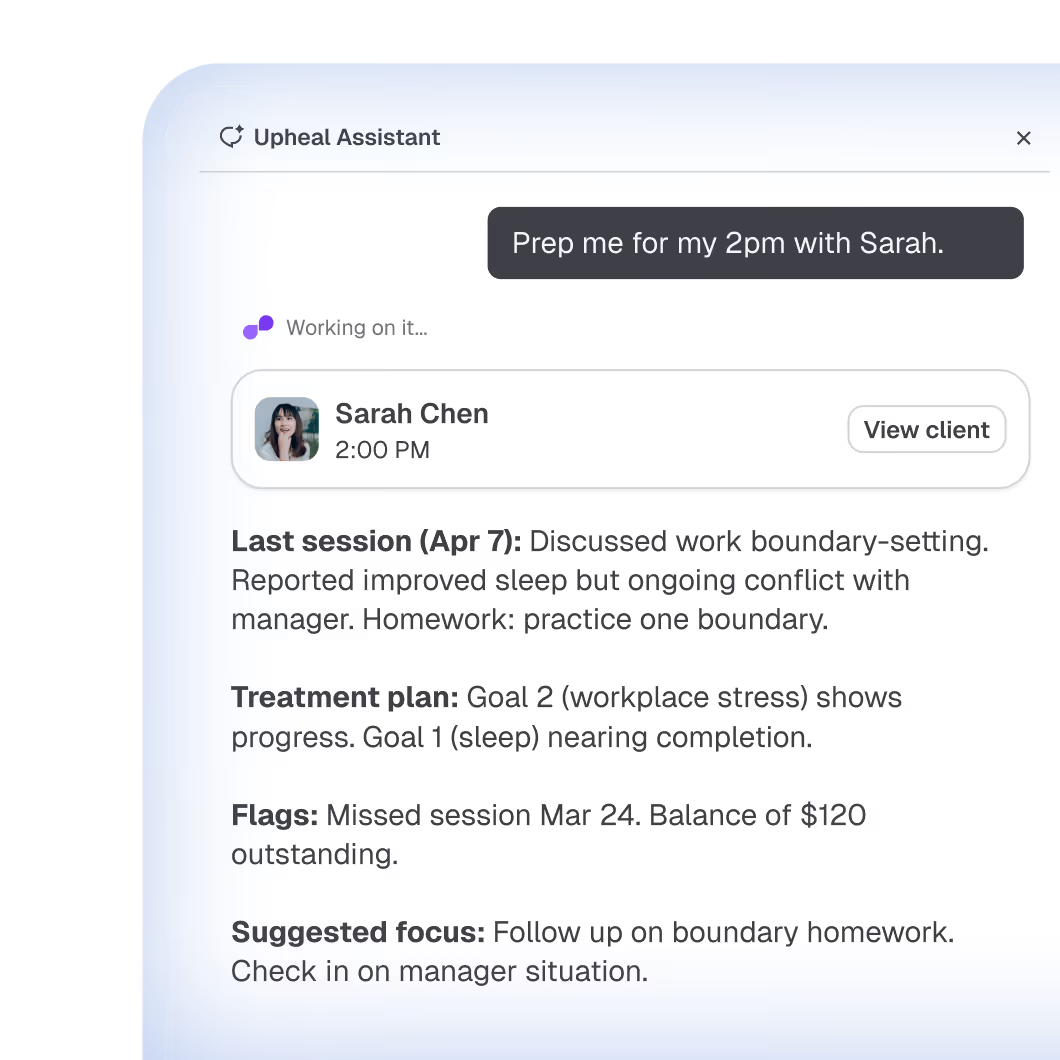
- Session prep: treatment plan status, prior session context, and open tasks surfaced before each client
- Ask it anything: "Prep me for my 2pm with Sarah." "Reschedule my 3pm to next week and send the client a message."
Billing:
- Automated payment processing and invoicing at session end
- Superbill generation from signed notes, formatted for insurance submission
- Claims, ERAs, and eligibility checks in the same platform, populated from the note
- Dashboard view of paid, pending, and overdue balances
- Ask it anything: "Which clients have outstanding balances?" "Generate superbills for last month." "Flag any sessions I completed but haven't invoiced."
How do the two platforms handle client messaging?
Upheal includes AI-drafted client messages. You can compose a message to a client and Upheal will generate a draft for you to review and send. This is useful for anything from appointment reminders with a personal touch to follow-ups between sessions to routine practice communications. Messages support attachments, and a conversation can include more than two people, so a client's parent, partner, or care team can be in the thread when that's clinically appropriate.

SimplePractice includes secure client messaging through its client portal on the Essential plan and above. Care Aide can generate a client-facing summary of a session that you can review and share in a few clicks, but drafting the message itself is not among the features SimplePractice documents. You write that yourself.
For therapists who communicate frequently with clients outside sessions, or who manage their own admin without support staff, having AI-drafted messages reduces one more piece of overhead.
What's the difference in pricing between Upheal and SimplePractice?
SimplePractice charges solo providers $49/month (Starter), $79/month (Essential), or $99/month (Plus). AI notes cost an additional $35/month, or $59/month for the Care Aide bundle. Upheal charges $1 per session with no seat fee, and AI notes and treatment plans are included in that price.
The comparison that matters most isn't the base plan. It's whether AI is included or extra. A solo provider on SimplePractice's Essential plan with Note Taker pays $114/month before any claim fees. New accounts that add a card within seven days currently get 50% off for three months, so that starts at about $57 before settling at $114, and both Note Taker and Care Aide come with a 30-day free trial. On Upheal, a therapist seeing 12 clients a week pays about $50 a month, and a quieter month costs less instead of the same.
Three additional cost factors worth noting:
Payment processing fees. Upheal charges 2.9% + $0.30 per transaction. SimplePractice charges 3.15% + $0.30 per transaction. For a practice collecting $5,000/month in credit card payments, that 0.25% difference works out to around $150 a year.
Insurance billing. Upheal charges $0.30 per claim, which covers the claim and its ERA, and $0.15 per eligibility check, with no monthly billing fee. A rejected claim that you fix and resubmit is not charged again. From October 1, 2026, SimplePractice charges $0.39 per claim on every plan, and the 10 free claims on Essential and the 35 on Plus are removed. Their eligibility checks are $0.15 on Starter and Essential from the same date, and stay free on Plus through March 31, 2027. We worked through what that change costs by plan and claim volume in a separate breakdown of SimplePractice's new insurance pricing.
Annual CPT code fee. SimplePractice charges $20 per clinician per year for AMA CPT code access, made up of an $18 royalty to the AMA and a $2 processing fee. Their own terms exclude it from promotional discounts.
For group practices, SimplePractice charges $74/month for each additional clinician on the Plus plan, dropping to $72 above five and $69 above fifteen, plus $39/month for a practice manager. Upheal's group pricing depends on the size of the practice, and associates are discounted, so talk to sales for a quote rather than multiplying the per-session rate. For roles, supervision, and what a 10 clinician practice pays across Upheal, SimplePractice, and TherapyNotes, see our guide to the best EHR for group practices.
What do therapists say when they switch from SimplePractice to Upheal?
When therapists consider leaving their EHR, two things come up every time: cost and fragmentation.
"Everything is a la carte and pieced together. You end up paying out the wazoo." The EHR for scheduling. The AI scribe for notes. The billing tool for claims. Each one costs something. None of them talk to each other.
After switching to Upheal, therapists describe the opposite: one workflow, one bill, notes that don't need a second app. "This feels like software I could actually use." And for the ones who care about what their documentation says over time: "It's not just a time-saving tool, it's a learning tool."
If you've been on SimplePractice and want to see what an AI-native EHR feels like to use:
Start free at upheal.io/signup
Frequently asked questions
Is Upheal a good SimplePractice alternative?
Yes. Upheal is a full EHR with scheduling, telehealth, AI-native session notes, and a conversational AI assistant, all built into the platform. Insurance billing is live too, with claims submission, ERA processing, and eligibility checks built directly in, at $0.30 per claim and $0.15 per eligibility check with no monthly billing fee. If insurance billing is what's kept you from switching, that reason is gone.
Can I migrate my client data from SimplePractice to Upheal?
Yes. Upheal includes a self-serve AI migration that handles the process without manual data entry or onboarding calls. You export your records from SimplePractice, drop the export into Upheal, and the Assistant recreates your practice: clients, notes, session history, contracts, your note templates, and your intake and consent forms. For an individual provider, the whole switch takes around an hour. Once your records are in, the Assistant can draw on your full client history immediately.
Is SimplePractice or Upheal better for solo therapists?
If documentation time is your biggest source of overhead, Upheal's AI notes are included in the $1 per session price and the Assistant has a free tier on every plan. SimplePractice's AI is a separate $35/month add-on, or $59/month for Care Aide, each with a 30-day free trial. Usage pricing also means a quiet month costs less rather than the same.
Is SimplePractice or Upheal better for group practices?
It depends on what your team needs. SimplePractice's per-clinician pricing on Plus starts at $74/month each and its AI is priced per clinician on top, so both scale linearly with headcount. Upheal's group pricing depends on the size of the practice with discounts for associates, and AI notes are included rather than added per seat. Both handle multi-clinician accounts, consolidated billing, and per-clinician access controls. Talk to sales for a quote for your team.
What is SimplePractice Care Aide, and how does it compare to Upheal's Assistant?
Care Aide is a $59/month bundle that includes Note Taker, Intake Summaries, Session prep, an in-session Session Sidekick, Client Summaries, a Treatment Planner their pricing page marks as beta, and Note Checker for pre-licensed supervisees. Each runs at a defined point in the workflow. Upheal's Assistant is conversational and agentic: you ask it questions in your own words about any client at any time, and it answers from your own session history, then runs the workflow for you. The free tier is included with every Upheal plan; Assistant Pro is $39/month.
What makes Upheal's AI different from SimplePractice's AI Note Taker?
Upheal's AI is built into the EHR from the ground up. Session notes connect to client goals and treatment plans, AI compliance flags check your documentation before you finalize it, and you can build custom note templates from your own PDF. SimplePractice's Note Taker costs $35/month extra and records live in telehealth on the web and in person through their mobile app; its draft notes save into the client's chart, but the features that build on them, intake summaries, session prep and treatment planning, are a separate $59/month bundle.
Is Upheal HIPAA compliant?
Yes. Upheal is HIPAA, PHIPA, PIPEDA, GDPR, and DPA compliant, has completed a SOC 2 Type II audit, and is continuously externally tested. It signs a Business Associate Agreement with every practice. Audio is deleted by default after note generation, client data is never sold, and Upheal does not train AI on your data without consent. SimplePractice states that it is HIPAA compliant, SOC 2 Type II certified and HITRUST validated, so if your organization requires HITRUST specifically, SimplePractice meets that requirement and Upheal does not. Current control status is published at trust.upheal.io.
The bottom line
SimplePractice is a solid EHR with a long track record and reliable billing. If insurance billing is central to your practice and you want a platform that's been running those workflows for years, SimplePractice is the more tested option today.
But if documentation time, cost creep, or the sense that your tools are patched together are the reasons you're looking around, those are the problems Upheal was built for. The AI is part of the platform rather than a separate line item, notes connect to goals and treatment plans, and the Assistant is something you can ask rather than a set of features that fire at fixed points.
Insurance billing is live on both. From October 1, Upheal's per-claim fee is lower at every volume.
You can compare Upheal to other EHR platforms at upheal.io/comparisons if you're weighing additional options alongside SimplePractice.
Sources: SimplePractice pricing and feature claims on this page are taken from SimplePractice's own pricing page and support documentation, checked on 5 September 2026 and re-checked on 23 September 2026 for plan prices, the AI add-ons, the current promotion, and the insurance-claim pricing changes effective 1 October 2026, and on 24 September 2026 for the Care Aide feature list. SimplePractice's compliance and certification claims were checked on SimplePractice's own site on 15 September 2026. Where this page says SimplePractice does not have something, that reflects its published plan and add-on documentation. Upheal claims are taken from the Upheal support center and pricing page on the same date. Pricing and features change; confirm current terms with each vendor before deciding.