AI therapy notes: how they work, what happens to recordings, and what to check
The session ends. The client leaves. And before the next appointment there is a progress note to write. A survey of nearly 500 therapists by Barbara Griswold found that clinicians seeing 18 clients a week spend about two and a half hours a week writing notes.
AI therapy notes exist to take that work off your plate without taking the clinical judgment out of it. This guide explains how they work, how accurate they are, what happens to the recording, what your client needs to consent to, and what to check before you trust a tool with protected health information. It is written for therapists who are curious but appropriately skeptical.
TL;DR
- AI therapy notes are clinical progress notes generated from a recording or transcript of a session, in your chosen format (SOAP, DAP, BIRP, and others). You review, edit, and sign every note before it enters the record.
- Good tools produce a reliable draft. What the session meant clinically stays the therapist's judgment, which is why the review step is not optional.
- What happens to the recording depends on the vendor. Ask whether audio is deleted by default once the note is generated, and who can change that setting.
- HIPAA compliance is a set of verifiable facts, not a badge: a signed BAA, a current SOC 2 Type II report, encryption in transit and at rest, and a written retention policy.
- Clients need to consent before a session is recorded. Put it in your intake paperwork, not in a last-minute disclosure.
What are AI therapy notes?
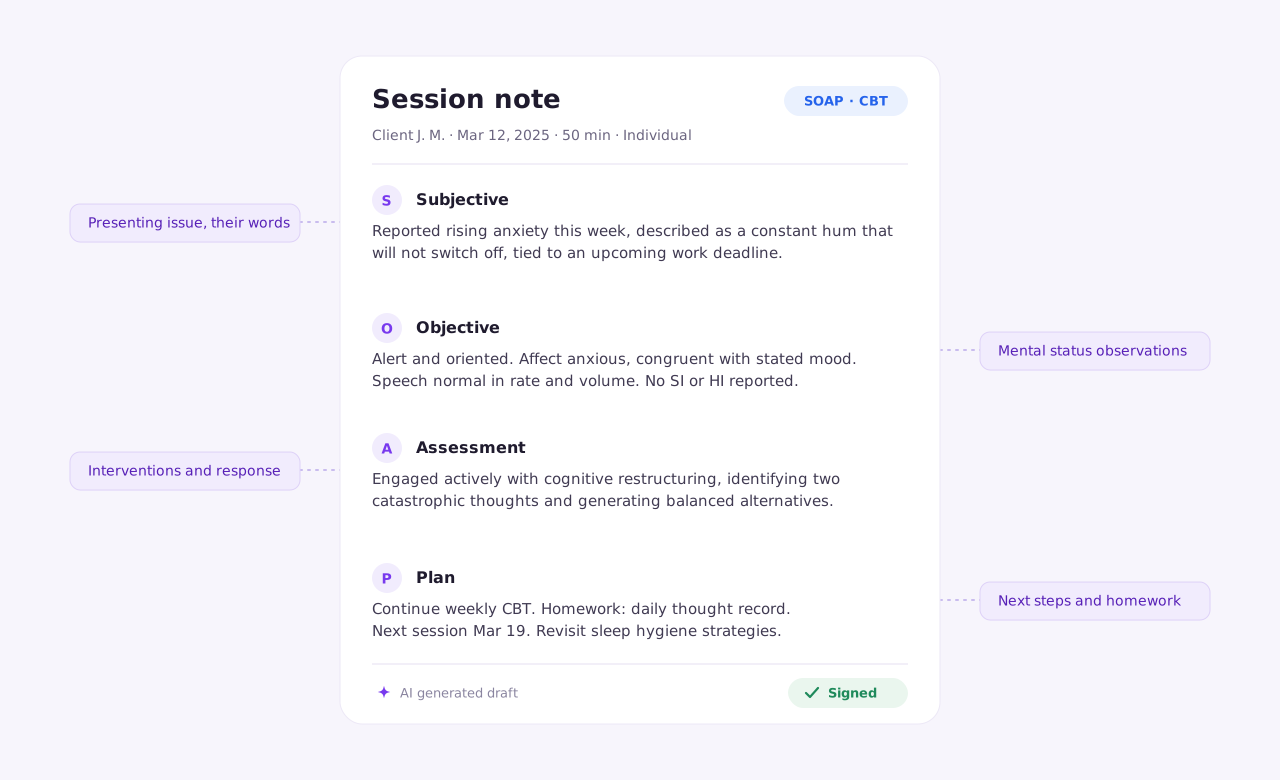
AI therapy notes are clinical session notes generated automatically from a recording or transcript of a therapy session. They are not transcripts. A transcript is a word-for-word record of what was said. A therapy note is a structured clinical document that captures presenting issues, observations, interventions, the client's response, and the plan going forward.
The AI produces a draft in whatever format the therapist uses: SOAP, DAP, BIRP, GIRP, PIRP, or others. The therapist reviews the draft, edits it, and signs it. Only then does it become part of the client's clinical record.
What makes this different from a voice recorder or a transcription service is the clinical structuring. A voice recorder gives you audio. A transcription service gives you text. AI therapy notes give you a clinical document.
Why therapists write session notes at all
A progress note does several jobs at once, which is why the bar for one is higher than "something to jog your memory." It is the clinical record of what happened and what comes next, so treatment stays coherent across sessions and across clinicians. It is the document a payer examines when deciding whether a session was medically necessary. It is what a licensing board or a court would look at. And it is what continuity of care rests on if a client transfers to another provider.
An AI tool changes who does the drafting. It does not change what the note is for, or who is accountable for it.
Who can access AI therapy notes?
The same people who can access any progress note, because that is what it becomes once you sign it.
- The client. Under HIPAA, clients have a right to request their records, and progress notes are generally part of that record.
- Other treating providers, where the client has authorized it or the disclosure is permitted for treatment purposes.
- Payers, during an audit or a medical necessity review.
- Courts, where properly compelled.
- Your vendor's staff, to the extent your BAA permits for support and operations. That is a clause worth reading rather than assuming.
One distinction matters here. HIPAA treats psychotherapy notes, meaning the private process notes a therapist keeps separate from the clinical record, differently from progress notes, and they generally require specific client authorization to disclose. AI tools draft progress notes. If you keep separate process notes, keep them separate.
How do AI therapy notes work?
The process varies by platform, but the core steps are consistent:
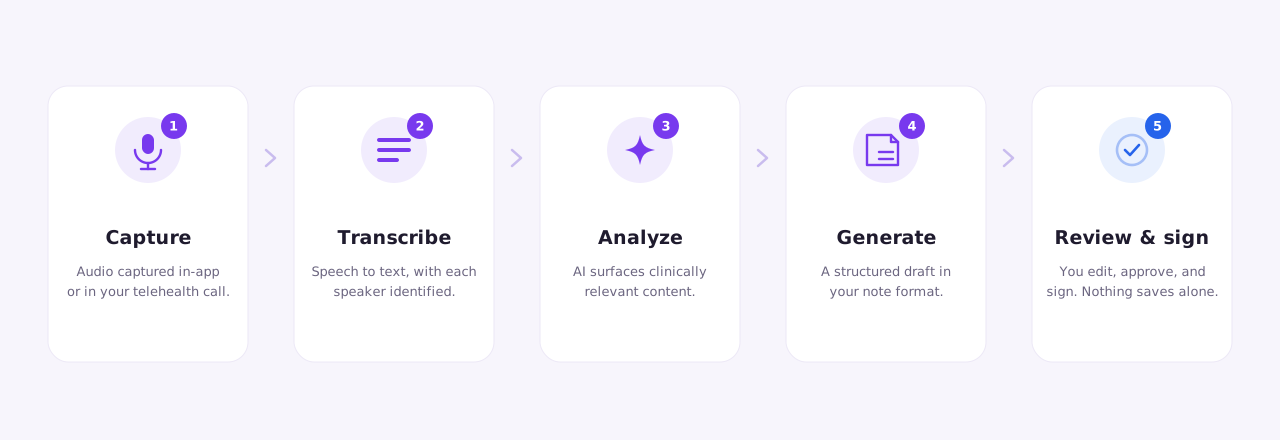
- Session capture. Audio is captured during the session through a mobile app for in-person work, built-in telehealth, or a browser extension for external video platforms. Some tools also accept an uploaded recording or a dictated summary after the session.
- Transcription. The AI converts audio to text and identifies who is speaking.
- Clinical analysis. The AI identifies clinically relevant content: presenting issues, mood and affect, interventions used, client response, and progress toward treatment goals.
- Note generation. The AI drafts a structured note in the therapist's chosen format. Some platforms also draw on existing client context such as diagnosis, treatment goals, and prior session notes.
- Therapist review. The therapist reads the draft, corrects anything inaccurate or incomplete, and signs it. That signed note is the official record.
Platforms differ most at step four. A basic tool works from the session transcript alone. More sophisticated platforms also draw on the client's treatment plan, which can itself be AI-generated, and on previous session notes, so the draft reflects the arc of the client's therapy rather than one isolated hour. That is also what makes a note useful for showing progress against treatment goals.
No AI therapy note system creates a clinical record without human sign-off. Therapist review is not a formality. It is the step that makes the note clinically valid.
How much time do AI notes actually save?
It depends on how you write notes today. The Griswold survey puts the average at roughly eight to ten minutes per note, around two and a half hours a week at 18 clients. With AI notes the writing is replaced by review: reading the draft, correcting the clinical framing, and signing.
Treat any vendor's minutes-per-note figure as a claim to test in your own practice rather than a fact. And note that the consistency benefit is separate from the time benefit: the same structure every time matters for audits regardless of how fast you are.
How accurate are AI therapy notes?
Good tools produce a reliable draft. The clinical responsibility stays with the therapist. That distinction is the whole answer, and it is worth being precise about, because accuracy means different things at different layers of a note.
Content and structure. Strong, and consistently so on the better platforms. If a client described a conflict at work, the note records it. If the therapist used a cognitive restructuring exercise, the note names it. The chosen format is applied the same way every time, which matters for insurance audits where inconsistent documentation is a common flag.
Clinical meaning. This is where the therapist's judgment does the work. A draft can set out what happened in the session. Deciding what it signified for this client, at this point in their treatment, is a clinical act. Reviewing and signing is not a rubber stamp on the tool's output. It is the point at which a document becomes a clinical record.
What the session holds beyond words. Basic tools work from the transcript alone. More sophisticated platforms analyse the session itself. Upheal surfaces session analytics, including speaking balance and periods of silence, giving the therapist signal a plain transcript does not carry. Analytics are currently available for individual sessions held in English. The interpretation of that signal remains the therapist's.
More than two voices. Speaker attribution is harder with more than two people in the room, and couples, family and group sessions are where transcription errors cluster across the category. If you run them, ask the vendor specifically whether those session types are supported and how speakers are attributed, and review those drafts more closely.
Languages. Transcription quality varies by language, and the languages a tool supports for capture are not always the ones it supports for analytics. Ask for both lists. Upheal supports 35 languages.
Risk and safety content. Any mention of self-harm, harm to others, or a safety plan needs the therapist's direct review before signing. AI tools will usually record that the topic came up. Whether the documentation meets your licensing board's and your payer's expectations is your call, not the tool's.
Audit readiness. The test is specificity. A progress note needs the presenting issue in the client's own words, mental status observations, the intervention actually used, the client's observable response, progress against treatment goals, and a plan. A draft that could apply to any client is a weak draft regardless of who wrote it. A good draft gives you the scaffolding. The therapist supplies the meaning.
See how Upheal generates session notes automatically
What happens to session recordings?
This is the question clients ask most, and the one that varies most between vendors. Three things to establish before your first recorded session:
Default retention. Some platforms delete the audio automatically once the note is generated. Others keep recordings indefinitely unless you change a setting. Know which one you are using before you record anyone.
Who can change it. If deletion is the default, check whether a clinician can choose to retain audio for their own review, and whether the practice owner controls that setting for the whole team.
What deletion covers. Ask whether deletion applies to the audio only or also to the transcript, and whether backups are included. A vendor with a real retention policy can answer this in one sentence.
Session audio is deleted by default once your notes are generated. Clinicians who want to keep a recording for their own review can choose to. See Upheal's privacy and compliance documentation for the full policy.
Do AI note tools train on client data?
Some do. Some do not. The answer belongs in the vendor's terms of service and privacy policy rather than on their marketing page, and it is worth going to the source. When we compared vendor marketing pages against their own published policies, we repeatedly found the two did not line up, or that the policy left the question genuinely unclear. A training clause can sit in the terms of service and appear nowhere in the privacy policy at all.
What to ask for, in writing: whether session data is used to train models, whether that requires your explicit agreement, whether the client has to agree as well, and whether data is de-identified first.
Upheal does not use session data to train AI unless you and your client both choose it.
Are AI therapy notes HIPAA compliant?
It depends on the vendor. HIPAA compliance is not a feature. It is a set of requirements that a platform either meets or does not, and each one is verifiable.
Business Associate Agreement (BAA). The vendor must sign a BAA before you share any protected health information with them. No BAA means no HIPAA compliance, regardless of what the marketing says.
SOC 2 Type II report. A SOC 2 audit verifies a company's security controls. Type I checks them at a single point in time. Type II verifies they operated over a period, typically several months to a year, which is the more meaningful attestation. Ask for the type and the report date.
Encryption. Session audio, transcripts, and notes should be encrypted in transit and at rest.
Retention and training policies. Covered in the two sections above. Both belong in writing, in the vendor's legal documents.
Upheal is HIPAA compliant. Upheal is SOC 2 Type II certified. Upheal signs a BAA with every practice. Control status is published at trust.upheal.io.
Do clients need to consent to AI note-taking?
Yes. If the tool records the session, the client must consent to being recorded. Recording laws differ by state, and some states require consent from everyone on the call, not just one party. Check your state's rule and your licensing board's guidance, and treat the stricter standard as your default.
Consent is also an ethical requirement independent of the law. Clients are entitled to know that a third-party tool will process their session.
What should a client consent form for AI note-taking include?
A consent form for AI documentation should cover, in plain language:
- That an AI tool is used to draft session notes from a recording or transcript
- What the tool does with the recording: whether and when it is deleted, and whether a transcript is kept
- Who has access to the recording, the transcript, and the note
- Whether session data is ever used to train the AI, and that it is not without the client's explicit agreement
- That the therapist reviews and signs every note before it enters the record
- That the client can decline recording, or withdraw consent, at any time without affecting their care
- A signature, a date, and a copy for the client
Build it into your intake paperwork alongside your other informed consent documents. Do not present it as a last-minute disclosure before the first session.
If you would rather start from something drafted, Upheal's guide to collecting client consent covers what needs to be agreed and includes a downloadable consent template.
What if a client declines?
Declining should cost the client nothing, and it should not cost you the note. Most tools let you dictate or type a summary after the session instead of recording, so a client who does not want to be recorded still gets documented care and you still get a structured draft. In Upheal, dictation is available on the free plan. Check that the tool you are evaluating has that path before you need it.
How to explain it to a client
Something like: "I use an AI tool that helps me write my session notes. It listens to our session and produces a draft that I review and edit before it becomes part of your record. By default the recording is deleted once the note is generated. You can ask me not to record at any time."
Clients typically ask three things: who has access, how long the recording is kept, and whether they can opt out. Have clear answers ready before the conversation. Most clients, when it is explained plainly, do not object.
What to check before choosing an AI therapy notes tool
This guide does not rank tools. For a side-by-side of specific products, see our comparison of AI tools for mental health professionals. Whichever you look at, ask the same seven questions:
- Will they sign a BAA? Before any PHI is shared. If the answer is anything other than yes, stop.
- What is the SOC 2 type and report date? Type II, and recent.
- What happens to the recording by default? Deleted once the note is generated, or retained. And who can change that.
- Is session data used for AI training? Opt-in or opt-out. Check the terms of service, not just the privacy policy.
- Does it capture in-person sessions? Or only telehealth on the vendor's own platform.
- Does the therapist review before anything is signed? Every note, every time.
- Does the note connect to the clinical record? Or does it produce a standalone document you then copy into your EHR. That last difference matters more than any feature on the spec sheet.
Frequently asked questions
Are AI therapy notes accurate?
Good tools produce a reliable draft of what happened in the session, structured in your clinical format. What the session meant for that client is a clinical judgment, and it stays with the therapist. Every note is reviewed, edited where needed, and signed before it enters the record. That review is what makes the note clinically valid.
Does the AI note-taking tool keep recordings of sessions?
It depends on the vendor, and if you are a client asking about your own therapist's tool, this is a fair question to put to them directly. Some delete audio by default once the note is generated; others retain it until someone changes a setting. Ask for the default, who can change it, and whether deletion covers the transcript and backups. With Upheal, session audio is deleted by default once your notes are generated.
Do AI therapy note tools sign HIPAA business associate agreements?
The compliant ones do, before any protected health information is shared. A vendor that will not sign a BAA is not HIPAA compliant regardless of what its marketing says. Upheal signs a BAA with every practice.
Do AI scribes train their models on client session data?
Some do, and the answer is usually in the terms of service rather than the privacy policy. Look for explicit opt-in, meaning no session data is used for training unless someone agrees. Upheal does not use session data to train AI unless you and your client both choose it.
Can AI replace a therapist's clinical judgment?
No. AI therapy notes handle transcription and structuring. Clinical judgment, meaning the interpretation of what happened, the assessment of what it means, and the plan for what comes next, remains the therapist's responsibility. Every note is reviewed and signed by the therapist before it enters the clinical record.
Do clients need to consent to AI note-taking?
Yes. If the tool records sessions, clients must consent to the recording. Recording laws vary by state and some require consent from all parties. Build it into your intake and informed consent process, and give the client a copy.
How much do AI therapy notes cost?
Pricing models vary: some tools charge a flat monthly subscription, others charge per session, and some EHRs include AI notes in the platform price. If you are paying separately for an AI scribe and an EHR, an all-in-one platform is often less expensive. See Upheal's pricing for current plans.
Which AI therapy note tool is best?
The right tool produces clinically useful notes in your format, signs a BAA, holds a current SOC 2 Type II report, deletes recordings by default, does not train on your data without opt-in, and connects the note to your clinical record. For named options compared side by side, see our comparison of AI tools for mental health professionals.
The bottom line on AI therapy notes
AI therapy notes remove the part of documentation that is purely mechanical: the transcription, the structuring, the formatting. What remains is the part that requires clinical training: checking whether the note is accurate, adding interpretation where the AI missed the point, and signing off.
Of everything on the checklist above, one item predicts most of the day-to-day difference: whether the note connects to your clinical record, or produces a document you then have to move yourself.