
Therapist billing software: what to look for (2026)

Billing can live in three places: a standalone product, a service you outsource to, or a feature built into your EHR. For most private practice therapists, the right answer is the last one, and we're going to cover why: what good therapist billing software actually does, what to look for, and why bolting on a separate billing tool almost always costs more than it saves.
TL;DR
- Therapist billing software handles insurance claims, superbills, ERA posting, and client payments.
- Standalone billing services cost $50 to $200+ per month. Upheal's EHR is $1 per session (capped at $69 per month), and insurance billing runs separately at $0.30 per claim and $0.15 per eligibility check, with no monthly fee.
- Integrated billing reduces errors by pulling directly from session notes rather than requiring manual data entry.
- The most important features: clearinghouse integration, superbill generation, ERA posting, CPT code support, and HIPAA-compliant payments.
- If your EHR charges extra for billing, switching to an all-in-one platform will almost always save money.
What is therapist billing software?
Standalone billing software or a billing service handles only the money—things like claims, superbills, payments, collections. Nothing about your session notes or diagnosis codes lives there, so you're the one keeping two systems in sync. EHR-integrated billing puts the session note, the diagnosis code, and the claim in the same place, which is the whole advantage.
For solo and small group private practice therapists, integrated billing is almost always the better choice, since it cuts manual re-entry, reduces coding errors, and folds two bills into one.
The features that actually matter
Good therapist billing software should handle claim submission, superbill generation, payment tracking, ERA posting, and patient invoicing without requiring you to enter data in more than one place.
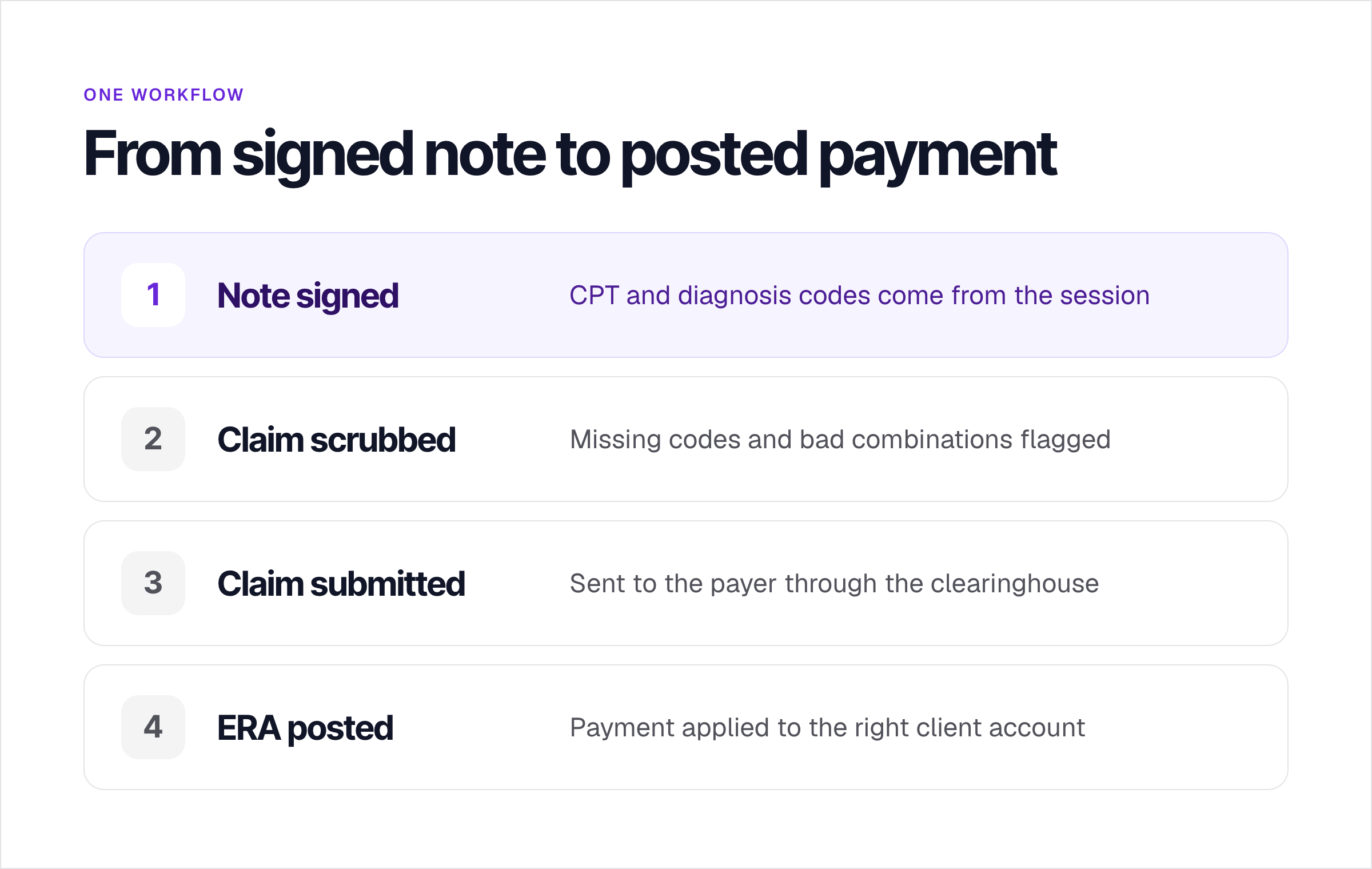
These are the features that actually matter:
Insurance claim submission. Your billing software should connect to a clearinghouse and submit claims directly to your payers. You should not be printing and mailing claims in 2026.
Superbill generation. For out-of-network or self-pay clients, a superbill is what they hand their insurance company for reimbursement. If you're building that by hand from your notes, your software is making you do its job. It should generate automatically from session data.
ERA (Explanation of Remittance Advice) posting. When a payer processes a claim, they send back an ERA explaining what got paid, what got denied, and why. That should land on the right client's account by itself. If you're the one reading remittance codes and typing them in, that's not billing software, that's data entry with extra steps.
CPT code support. Your billing software must support the therapy CPT codes you use: 90837 (60-minute individual), 90834 (45-minute individual), 90847 (family therapy with client), 90791 (diagnostic evaluation), and others. If it does not support these by default, look elsewhere.
Client invoicing and payment collection. The software should let you collect client payments, issue invoices, and track outstanding balances without a separate payment processor.
HIPAA-compliant payment processing. Any tool touching client payment data in a healthcare practice has to meet HIPAA standards, full stop. Ask before you connect a payment processor, not after a client's card number ends up somewhere it shouldn't.
Billing error flags. Good billing software catches the mistakes before the payer does: a missing diagnosis code, a CPT combination that doesn't fly, an authorization that expired last month. Catch it before you submit and you never see the denial at all.
Reporting. Aging reports, payment history, outstanding balances: you should be able to see where your practice's money actually is without digging for it.
Standalone billing software vs EHR-integrated billing
Here's where the two approaches actually differ:
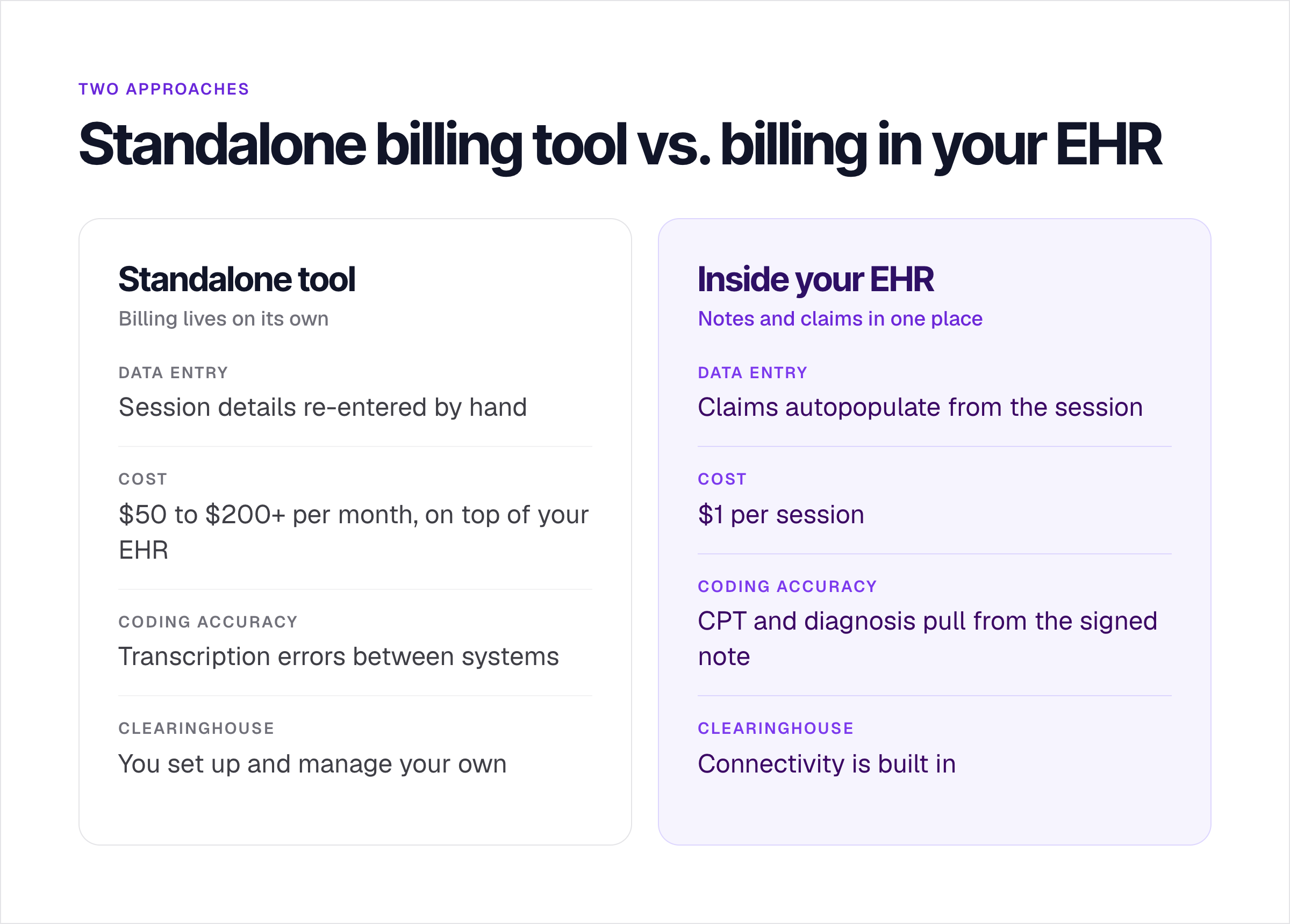
The cost gap alone is worth a look. A therapist using a separate billing service on top of their EHR subscription is often paying $150 to $300+ per month. Upheal's EHR (notes, scheduling, telehealth) includes client billing, and insurance billing runs on top as pay-per-claim ($0.30 per claim, $0.15 per eligibility check, no monthly fee), so most solo practices spend far less than the standalone alternative even after adding billing volume.
And potential errors matter just as much as the cost. When billing pulls directly from your session notes, the CPT code, diagnosis code, and session duration are already populated. Manual transfer between systems is where coding errors happen, and coding errors mean claim denials.
See how Upheal's billing features work
Does your EHR check every box?
Your EHR should include claim submission, superbill generation, ERA posting, and client payments as standard features. If these require a separate subscription or third-party integration, you're paying for fragmentation and too many systems.
Run any EHR through this checklist before you sign up:
- Clearinghouse integration included (not an add-on)
- Superbill generation from session data
- ERA auto-posting
- Client payment collection (credit card, HSA/FSA)
- Invoicing and statements
- Aging reports and payment history
- CPT codes for therapy pre-loaded
- Claim scrubbing before submission
Upheal's EHR, including superbills and client payment collection, is $1 per session. Insurance billing (claims, eligibility checks, and ERA posting) is a separate usage-based feature: $0.30 per claim submission and $0.15 per eligibility check, with no monthly fee and no setup cost. There's no separate billing subscription, just usage pricing for insurance claims on top of the EHR price.
For comparison with the most widely used alternatives, see the best EHR for private practice.
The best therapist billing software options in 2026
For most private practice therapists, the best billing solution is an EHR with billing built in. The platforms below are the most widely used options.
Upheal includes billing as part of an all-in-one platform that also handles AI session notes, telehealth, scheduling, and client management. If you're consolidating tools instead of paying for each one separately, this is where that math works out best.
SimplePractice is the most widely used EHR in private practice and includes billing on higher-tier plans. AI notes are a separate add-on.
TherapyNotes has strong insurance billing functionality. AI notes (TherapyFuel) are a paid add-on separate from the core platform.
Try Upheal free and see if it handles your billing workflow before committing. Start free, no credit card required
Frequently asked questions
What is the best billing software for therapists in private practice?
The best billing software for most private practice therapists is an EHR with billing built in. Upheal includes billing, superbill generation, and AI session notes at $1 per session with no separate billing subscription.
Do I need separate billing software if I have an EHR?
Not if your EHR includes billing. Most modern mental health EHRs include claim submission, superbill generation, and payment processing. If yours does not, switching to an integrated EHR is almost always more cost-effective than adding a standalone billing service.
What CPT codes do therapists use for billing?
The most common therapy CPT codes are 90837 (60-minute individual session), 90834 (45-minute individual session), 90847 (family therapy with client present), and 90791 (psychiatric diagnostic evaluation). Your billing software should support all of these by default. For a full list of therapy CPT codes and their descriptions, see the American Medical Association's CPT code reference. [add rel=nofollow on publish]
Can my EHR automatically generate superbills?
Yes, if your EHR includes billing. Upheal generates superbills automatically from session data. You can share them directly with clients for out-of-network reimbursement.
How much does therapist billing software cost?
Standalone billing services typically cost $50 to $200+ per month, while Upheal's EHR is $1 per session capped at $69 per month. Insurance billing is a separate, usage-based feature: $0.30 per claim submission and $0.15 per eligibility check, with no monthly fee (claims and eligibility checks are free through the end of September 2026 as part of Upheal's launch offer).
What is ERA posting in therapy billing?
ERA stands for Explanation of Remittance Advice, the document a payer sends explaining what was paid, adjusted, or denied on a claim. ERA auto-posting means your billing software applies that payment information to the correct client account automatically, without manual entry.
The bottom line
Billing does not have to be its own project. The right EHR handles claim submission, superbills, payments, and ERA posting as part of the same workflow you use for session notes and scheduling. If you're currently managing billing in a separate system, switching to an integrated platform pays off starting with your very next claim.
That's the whole pitch: one $1-per-session platform, capped at $69 a month, with insurance billing running alongside it at $0.30 per claim and $0.15 per eligibility check, no separate subscription required.
Start free at upheal.io/signup

![Best teletherapy platforms for therapists [2026]](https://cdn.prod.website-files.com/6328c07d72b05347cc236c49/68bb296e0a57158be728ee91_best%20teletherapy%20platform%20for%20therapists%20thumbnail.avif)