Best therapist billing software for private practice

You didn't spend years of clinical training to become your own claims department. But that's what happens without the right billing setup: claim submission, payment collection, invoicing, superbills, and EOB reconciliation all land on you, on top of the clinical work you're actually there to do. The right tool handles that layer without you noticing it. The wrong one turns into hours each week chasing rejected claims or reconciling payments by hand.
Here's what actually matters when you're comparing billing software, how the leading options for private practice stack up, and why the best answer is usually a platform that already has your clinical notes, not a separate tool you have to feed data into.
What to look for in therapist billing software
Not all billing tools were built with mental health private practice in mind. Before you compare options, get clear on what actually matters here.
Insurance claims submission. If you accept insurance, your platform should submit electronic claims, track their status, and handle rejections and resubmissions on its own, not hand each one back to you to manage by hand. Direct payer connections matter more than a clearinghouse pass-through here.
Superbills for out-of-network clients. If you run self-pay or a superbill model, your platform should generate ICD-10-coded superbills the moment payment comes in, not as a manual export you have to remember to run.
Payment collection. Card processing should live inside the platform itself, with auto-pay for recurring sessions, stored cards, and balance reminders built in, not stitched together with a separate processor.
ERA/EOB reconciliation. Electronic Remittance Advice processing, meaning insurance payments get matched to claims and posted automatically, saves real hours for practices that bill insurance. Manual EOB reconciliation is one of the quietest time drains in a billing-heavy practice.
Reporting. Revenue by payer, outstanding balances, claims aging, and collection rate are the numbers a solo practitioner actually needs to run the business side of a practice. If a platform doesn't surface these clearly, you won't know where your practice actually stands financially.
Integration with your EHR. When billing lives outside your clinical documentation, you end up entering the same information twice, and every re-entry is a chance for a billing error to creep in. A platform that combines billing, scheduling, and documentation removes that step entirely.
Best therapist billing software options in 2026
Upheal
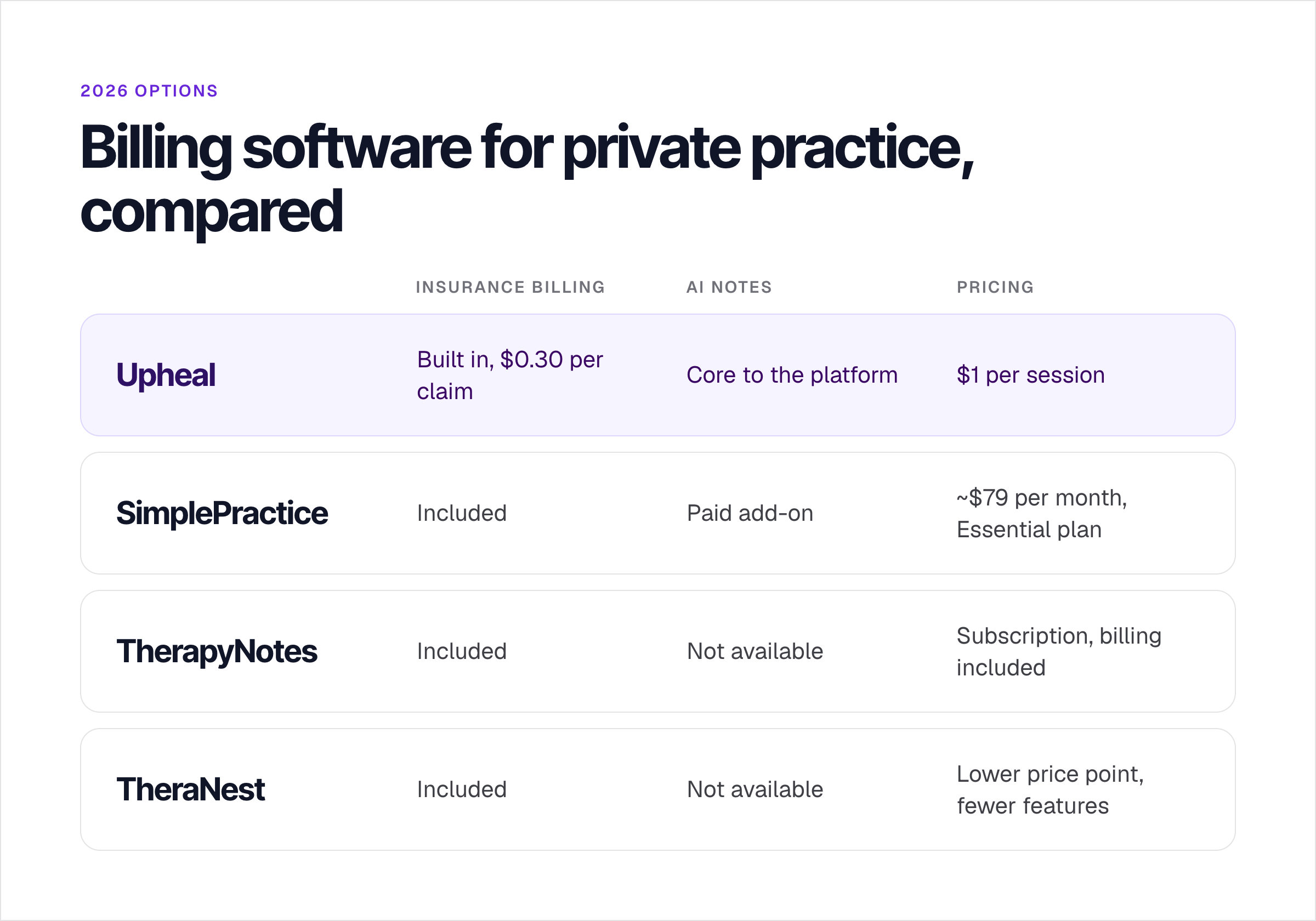
Upheal is built around one idea: your billing platform should already know your clients, because it's the same place you write your notes. Yes, Upheal's EHR accepts insurance. Set up your insurance or self-pay rates once, collect payment, and Upheal takes claims submission, ERA posting, and superbill generation from there.
What actually sets it apart is the AI documentation. Most Upheal users cut note time from 16 minutes per session to under 5, and that time comes back as real capacity: more sessions fit into a sustainable week, and the administrative weight that burns solo practitioners out gets a lot lighter.
Upheal also includes an AI Assistant that knows your practice: you can ask it about client history or documentation across your caseload without leaving the platform.
See how Upheal compares to SimplePractice on billing, documentation, and pricing.
Best for: Solo practitioners and small group practices who want AI notes, billing, and a practice-aware AI assistant in one place from day one.
SimplePractice
SimplePractice is the most widely used EHR in US mental health private practice. Its billing features are mature and comprehensive: insurance claims, ERA posting, Wiley Treatment Plans, telehealth, and a client portal are all built in. The platform has strong third-party integrations and a large user base, which means robust community support.
The tradeoff: SimplePractice's AI note features are an add-on rather than core to the platform. For solo practitioners who spend most of their administrative time on documentation, it matters whether AI notes are core to the platform or bolted on as an extra.
Best for: Practices that already use SimplePractice and want to stay on a familiar platform, or practices that prioritize breadth of integrations.
TherapyNotes
TherapyNotes is known for strong billing workflow and attentive customer support. Insurance claims, ERA posting, and a built-in client portal are included. The interface is less polished than SimplePractice or Upheal, but the billing functionality is solid and the support team is responsive.
TherapyNotes doesn't currently offer AI-generated notes. For a documentation-heavy practice, this is a meaningful gap.
Best for: Practices where billing accuracy and customer support responsiveness are the primary criteria.
TheraNest
TheraNest offers billing, scheduling, and documentation at a lower price point than most competitors. It covers the basics: insurance claims, superbills, payment collection, and reporting. The platform is less feature-complete than SimplePractice or Upheal and doesn't offer AI notes.
Best for: New practices or practices with minimal billing complexity looking to minimize software costs.
How Upheal's insurance billing works
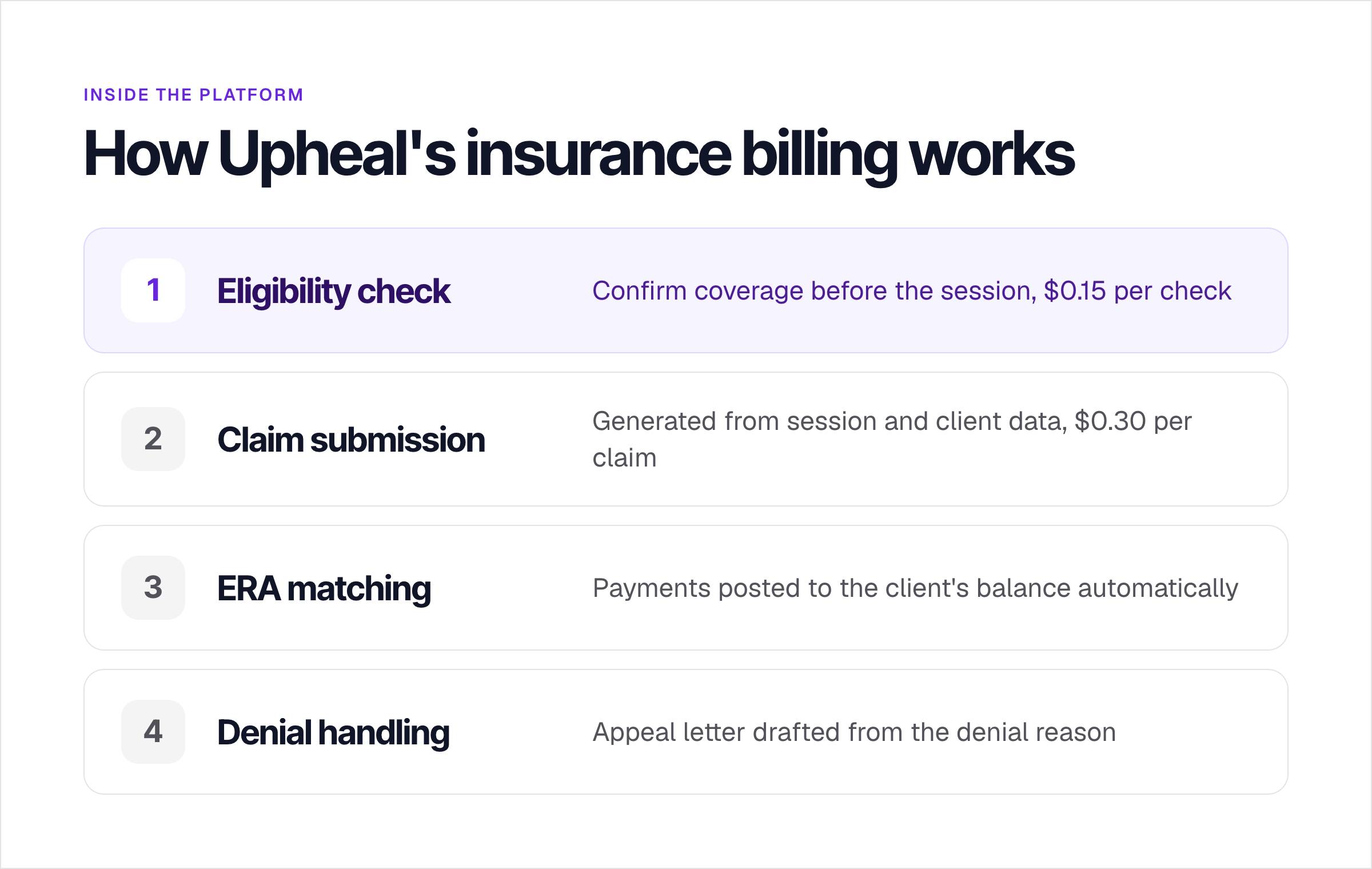
Insurance billing is a native part of Upheal, not a bolted-on module: $0.30 per claim and $0.15 per eligibility check, with no monthly fee.
Claim submission. Submit claims individually after a session, or in batches at the end of a billing cycle. Upheal generates the claim from your existing session and client data, so there's no separate data entry step.
Eligibility checks. Run a coverage check before a session, not after, so you know a client's benefits are active and what they'll owe before they walk in.
ERA payment matching. When a payer responds, Upheal automatically matches the Electronic Remittance Advice to the original claim and posts the payment to the client's balance, instead of leaving you to reconcile it by hand.
Denial handling. If a claim is denied, Upheal helps draft an appeal letter based on the denial reason, rather than leaving you to start from a blank page.
Secondary insurance. Upheal supports secondary insurance claims, but this is a manual, provider-initiated process rather than automatic crossover: you file the secondary claim yourself once the primary payer has adjudicated. This is a newer part of the platform, so treat it as useful but still maturing rather than a fully automated pipeline.
If you're comparing plans by price, Upheal's core EHR is $1 per session, and insurance billing on top of that is $0.30 per claim and $0.15 per eligibility check with no added monthly fee, so most solo practices land well under $100 a month even with insurance billing turned on.
How to choose the right billing software for your practice
The right question here isn't "which platform has the most features." It's "which platform reduces the total time I spend on administrative work."
For solo practitioners, documentation is typically a bigger time sink than billing. A platform that handles both well, and specifically one that uses AI to reduce note time, has a compounding effect on available capacity. Every hour not spent on documentation is an hour available for an additional session, a referral conversation, or simply leaving on time.
For practices that accept insurance, ERA reconciliation and claims workflow quality are non-negotiable. Test the billing workflow in any platform's trial period, specifically the claims submission and rejection handling process. This is where the differences between platforms show up most clearly.
Learn how Upheal is built for individual providers, including billing, AI notes, and scheduling in one platform.
FAQs
What is the best billing software for a solo therapy practice?
For most solo practices, the best option is an EHR that includes billing rather than a standalone billing tool. Upheal, SimplePractice, and TherapyNotes are the most commonly used platforms among US private practice therapists. The right choice depends on whether AI documentation is a priority and how complex your insurance billing needs are.
Does Upheal's EHR accept insurance?
Yes. Upheal submits insurance claims individually or in batches, checks client eligibility before a session, matches ERA payments to claims automatically, and helps draft appeal letters for denied claims. Billing runs at $0.30 per claim and $0.15 per eligibility check, with no monthly fee.
Is there a billing plan under $50 or $100 a month?
Yes. Upheal's core EHR is $1 per session capped at $69 a month, and insurance billing is priced per claim and per eligibility check rather than as a flat add-on, so most solo practices stay well under $100 a month total.
Does Upheal support secondary insurance claims?
Yes, but it's a manual process rather than an automatic one. You file the secondary claim yourself after the primary payer has adjudicated; there's no auto-crossover yet. Treat this as a newer, still-maturing part of the platform rather than a fully hands-off pipeline.
Can I bill insurance without a clearinghouse?
Most EHRs built for mental health practice include their own clearinghouse integration, so you don't need a separate clearinghouse account. Check whether your EHR's clearinghouse connects directly to your specific payers, as some smaller regional payers require separate setup.
How much does therapist billing software cost?
Most EHRs with integrated billing charge between $30 and $80 per month for a solo practitioner license, while Upheal is $1-per-session. SimplePractice runs approximately $79 per month for the Essential plan. Standalone billing software, without an EHR, is less common and generally not recommended for practices that also need documentation and scheduling.
Is it worth hiring a billing service instead of using software?
For most practices using a modern EHR with strong ERA automation, in-house billing through software is more cost-effective than a billing service. A billing service typically charges 5 to 10 percent of collected revenue in exchange for handling claims submission, rejection follow-up, and payment posting, which can still make sense for practices with high insurance billing complexity or a clinician who doesn't want to manage billing at all.
Do I need different billing software if I use telehealth?
No. Most EHRs used in mental health private practice support telehealth billing, including the appropriate modifier codes and telehealth-specific CPT codes introduced during and after 2020. Confirm with your specific payers that they accept telehealth claims and what their requirements are.
Get billing handled without a second job
The best therapist billing software doesn't just organize the overhead, it gets rid of most of it. Integrated billing, AI-generated notes, and automated scheduling together mean the admin work that used to eat a full afternoon each week now fits between sessions.
Start free at upheal.io/signup, no credit card required.