
Group therapy notes: examples, templates, and what to include
Group therapy notes are the clinical records a therapist writes to document what happened in a group session. Unlike individual session notes, they have to account for multiple clients at once: who attended, how the group functioned as a whole, and how each member responded individually.
That last part is where most therapists get stuck. Writing a separate note for every group member after a 90-minute session with eight clients takes time the rest of your caseload doesn't allow. This guide covers what group therapy notes need to include, how to write them efficiently, and gives you a template and examples you can use right away.
What are group therapy notes?
Group therapy notes are clinical documentation created after a group therapy session. They serve the same core function as individual therapy notes: they capture what happened in the session, how clients responded, and what comes next.
What makes them different is scope. A single group session generates documentation for every client who attended. You're capturing the session as a whole (group dynamics, themes, interventions) and individual progress for each member.
Most group therapy notes follow one of two formats: a general session note covering the group overall, plus an individual addendum for each member, or a fully individualized note written per client that references the group context. Which approach you use depends on your setting, payer requirements, and your own documentation style.
What to include in a group therapy note
A complete group therapy note should document six core elements:
- Session information. Date, time, duration, session number, and the group's treatment focus or program name.
- Attendance. A list of members present, noting any absences or late arrivals.
- Session theme and content. A brief summary of the topic or theme covered, any structured exercises or activities used, and the therapeutic approach applied.
- Group dynamics. An observation of how the group functioned: level of cohesion, significant interactions, conflicts, or notable moments that affected the session.
- Individual member response. For each client present: their participation level, affect, notable disclosures or behaviors, response to interventions, and progress toward treatment goals.
- Plan. What's planned for the next session, any follow-up needed for individual members, and any risk concerns or referrals.
The individual member section is the most time-consuming part. A well-structured template reduces this to filling in fields rather than writing prose for each person from scratch.
How to write group therapy notes
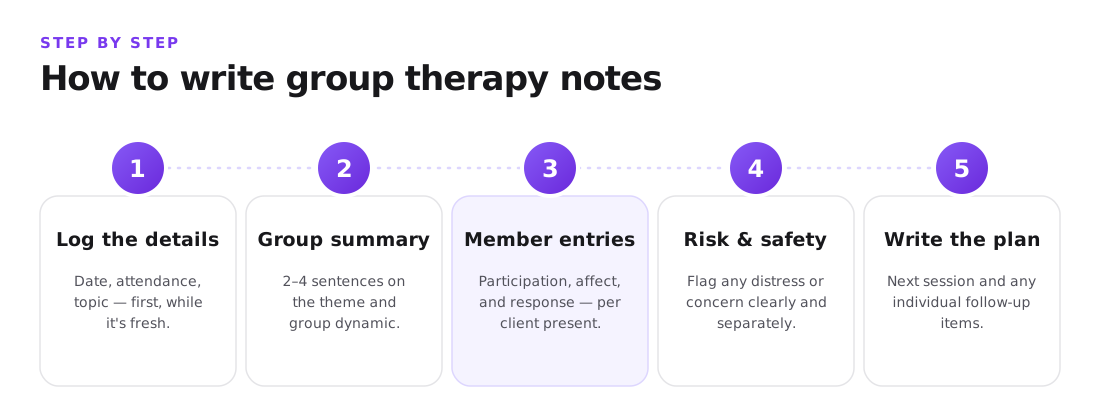
Step 1: Document session logistics immediately after the session ends.
Record the date, time, session number, attendance, and topic before moving on. This takes under two minutes and prevents errors that are harder to correct later.
Step 2: Write a brief group-level summary.
In 2-4 sentences, describe what the group covered: the theme, any structured activities, and the overall group dynamic. This section applies to all members and doesn't need to be repeated per person.
Step 3: Complete individual member entries.
For each client, note their participation level (active, passive, disruptive, absent), affect, any significant statements or behaviors, and how they responded to the session's content or interventions. Keep each entry to 2-4 sentences.
Step 4: Document any risk or safety concerns.
If any member disclosed distress, suicidal ideation, or concerns about others, document this separately and clearly. Note what action was taken.
Step 5: Write the plan.
State what's planned for the next session and any individual follow-up items. If a member needs individual check-in, referral, or modified participation, note it here.
Group therapy note template
Use this template for each session. Copy the individual member block and repeat for each client present.
Group therapy session note
Date: _
Session number: _
Duration: _
Group name/program: _
Therapist: _
Members present: _
Members absent: _
Session theme/topic: _
Session summary:
(2-4 sentences describing content covered, therapeutic approach, and group dynamic.)
Individual member note — [Client initials or ID]
Attendance: Present / Late / Absent
Participation level: Active / Moderate / Passive / Disruptive
Affect: _
Notable observations:
(Significant statements, behaviors, disclosures, or interactions with the group.)
Response to session content:
(How the client engaged with the theme, activities, or interventions.)
Progress toward treatment goals:
(Brief note on relevant treatment goal and any change observed.)
Risk/safety concerns: None noted / (describe if applicable)
Plan:
(Individual follow-up, adjustments for next session, or referrals.)
Group plan for next session: __________
Group therapy notes: examples
Example 1: Progress note format
Date: June 23, 2026
Session number: 8
Duration: 90 minutes
Group name/program: Adult CBT Skills Group
Members present: Client A, Client B, Client C, Client D, Client E
Members absent: Client F (no contact)
Session theme/topic: Cognitive restructuring — identifying cognitive distortions
Session summary:
Group reviewed automatic negative thoughts using a worksheet completed between sessions. Therapist facilitated discussion using Socratic questioning. Group cohesion was strong; members offered each other concrete examples and normalized shared experiences. Client C and Client D had a brief disagreement about comparisons between their experiences, which was redirected productively.
Individual member note — Client A
Participation level: Active
Affect: Euthymic, engaged
Notable observations: Shared a detailed example of catastrophizing related to work performance. Received peer validation.
Response to session content: Demonstrated ability to identify distorted thought and generate a balanced alternative. First time doing so without therapist prompting.
Progress toward treatment goals: Measurable progress on Goal 2 (reducing cognitive distortions).
Risk/safety concerns: None noted.
Plan: Continue CBT skills group. Revisit work-related thought patterns in individual session scheduled June 30.
Individual member note — Client B
Participation level: Moderate
Affect: Subdued, appropriate
Notable observations: Quieter than previous sessions. Did not initiate but responded when addressed directly.
Response to session content: Completed worksheet but expressed difficulty with the "balanced thought" step.
Progress toward treatment goals: Minimal progress on Goal 1 this session.
Risk/safety concerns: None noted.
Plan: Brief individual check-in before next group session to explore barriers.
Example 2: SOAP format
Date: June 23, 2026
Group: Grief Support Group — Session 12
Members present: Client G, Client H, Client I, Client J
Individual SOAP note — Client H
S (Subjective): Client H stated, "I finally went through her clothes this week. It was harder than I expected but I didn't stop." Reported increased sleep difficulty over the past week.
O (Objective): Present and engaged throughout session. Affect tearful but composed. Made eye contact with peers when sharing. No agitation or behavioral concerns observed.
A (Assessment): Client is in active grief processing. The disclosure suggests movement from avoidance to engagement with grief tasks. Sleep disruption consistent with acute grief presentation. No indicators of complicated grief or safety concerns at this time.
P (Plan): Continue grief support group. Therapist to follow up on sleep concerns at start of next session. Recommend client review sleep hygiene resources shared at session 10.
Common mistakes in group therapy documentation
Writing one note for the whole group instead of per-member entries.
A single group summary doesn't meet clinical or legal documentation standards for most settings. Each client's record needs to reflect their individual progress, participation, and any concerns. Check your payer requirements and jurisdiction — most require individualized documentation.
Documenting what you planned, not what happened.
Group sessions don't always follow the agenda. If the group shifted topics due to a member disclosure or crisis, the note should reflect what actually occurred, not the original session plan.
Vague participation descriptions.
"Participated appropriately" tells you nothing at audit time. Describe what the client actually did: what they said, how they responded, what they avoided.
Missing the plan section.
The plan documents continuity of care and connects each session to the broader treatment. Even "continue as planned" is better than leaving the field blank.
Frequently asked questions
What should be included in group therapy notes?
Group therapy notes should include session logistics (date, duration, attendance), a brief group-level summary, individual entries for each member present (participation, affect, notable observations, progress toward goals), any risk or safety concerns, and a plan for the next session.
How are group therapy notes different from individual therapy notes?
Individual therapy notes document one client per session. Group therapy notes document a shared session for multiple clients, requiring both a group-level summary and an individual entry for each member. They also capture group dynamics that don't apply to individual sessions.
Do you write separate notes for each group member?
Yes, in most clinical and billing contexts. Each client's clinical record needs to include their individual participation, progress, and any concerns. Some EHR systems support a shared session note with individual addendums attached per client.
Can group therapy notes be HIPAA compliant?
Yes, but group therapy documentation requires care. Notes should not reference other group members by name in a way that appears in an individual client's record. Use client initials or IDs when documenting peer interactions. Store and transmit notes through a HIPAA-compliant system with appropriate access controls.
How long should a group therapy note be?
The group-level summary is typically 2-5 sentences. Each individual member entry is usually 3-6 sentences. Total documentation per session runs longer than an individual note because of the per-member entries, but each individual entry should be concise.


%20thumb.webp)