A complete guide to SIRP notes (with example)

Free SIRP note template
In a regular therapist workday that's packed with client after client, who has time for clinical documentation?
The current reality for many mental health professionals is waiting until the end of the day or even the weekend to complete clinical notes.
Depending on caseload and private practice vs. agency considerations, this differs, but whether we have time for it or not, each session must be documented for legal, insurance, and clinical purposes to protect both client and therapist.
In this article, we'll explore what SIRP notes are, when to use them, and how to write them. We'll also share a SIRP note example from one of our valued clinical team members. Finally, we'll provide a template that you can download for free.
If you're not clear which notes to use and when, feel free to start with our article comparing progress notes.
What is a SIRP note?
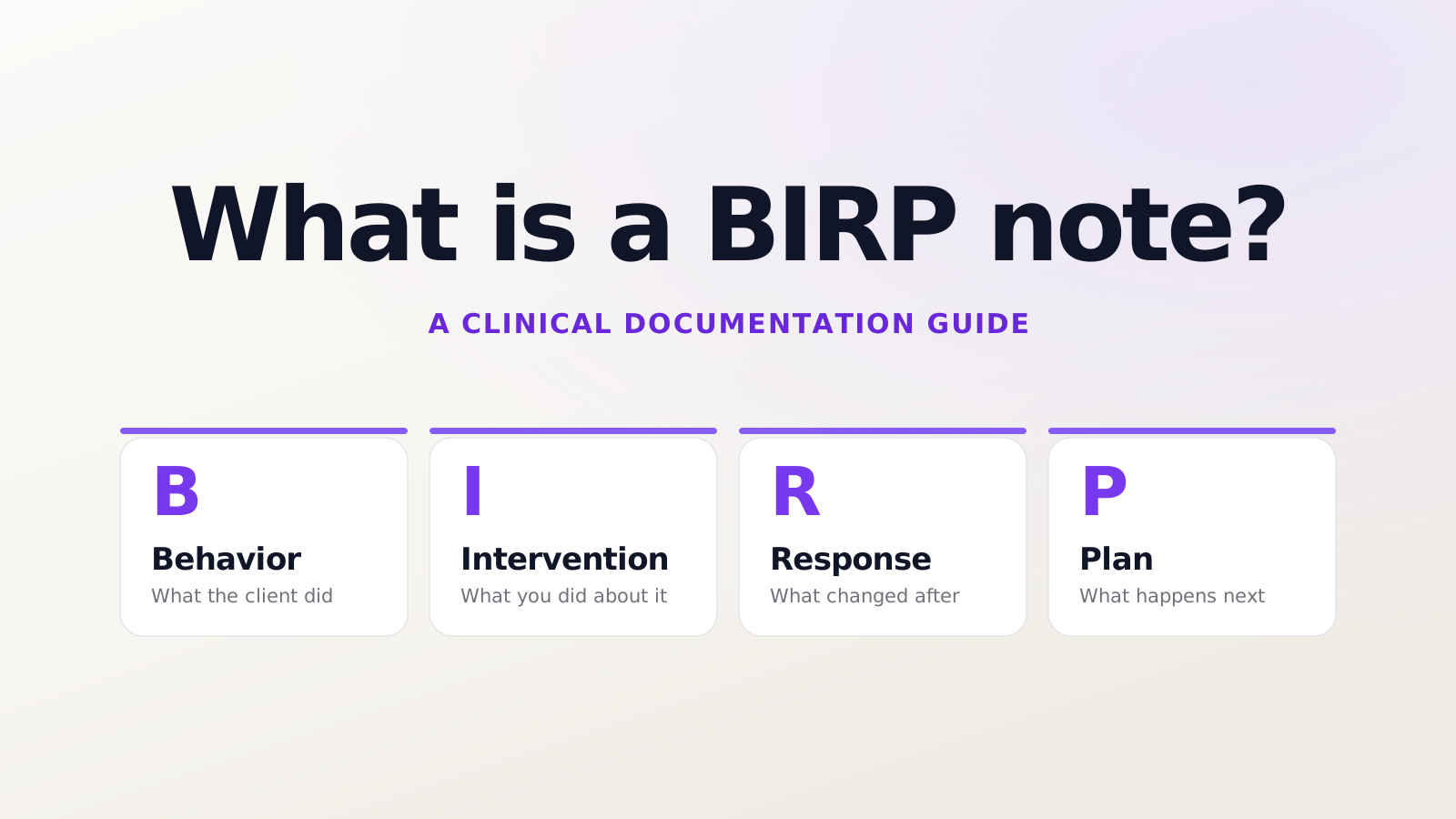
SIRP notes are a progress note type used by mental health professionals such as psychotherapists, counselors, social workers, psychiatrists, and psychologists.
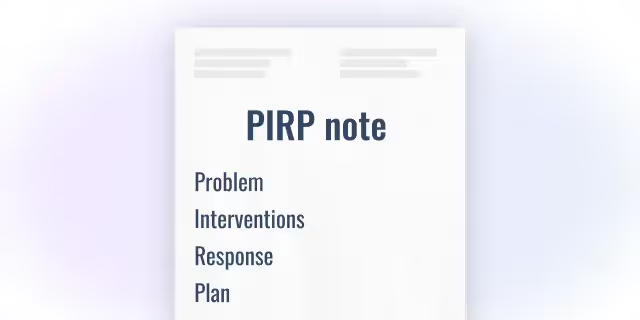
The SIRP note acronym stands for Situation, Intervention, Response, and Plan. Each of these sections is an essential component of the mental health SIRP note a practitioner has to write when using this particular note format.
The SIRP note components:
- Situation (S): Observations and descriptions of a client’s subjective experience.
- Interventions (I): Actions taken by the clinician in response to the behavior.
- Response (R): Patient's reaction to the intervention.
- Plan (P): Future treatment plan, follow-up actions, and next steps.
The SIRP note – a real-world scenario
Jeff Kashou, therapist and our Senior Clinical Product Lead, picked this scenario from his years in practice. It's a good fit for a SIRP note.
You start with the situation. Write down what's actually going on: the client's current struggle, and what they want to change.
Then you pick your interventions. Here, that's open-ended questions, reflective listening, and a decisional balance exercise, the kind that helps the client land on their own answer instead of yours.
In the response section, you capture what came up for the client: maybe they felt torn about cutting back around friends who don't, or maybe they leaned into the exercise instead of shutting down.
Then the plan. Write down what you agreed on: cutting back at parties, and what you'll dig into next time, like how their values line up with their drinking.
Patient SIRP note example – written by a therapist
Situation:
The client came to therapy to talk about concerns related to their alcohol use in social situations. They mentioned attending parties and gatherings where heavy drinking is common. The client shared experiences of negative effects from alcohol, like feeling sick, and observing friends behaving in ways they didn't like. They drink about two to three weekends per month, and while they've tried to limit themselves to one drink, they find it hard to say no when friends offer more. They want to cut back on drinking because of these negative experiences and worries about long-term health, especially given that alcohol problems run in their family. They also mentioned that they use alcohol to relax and have fun.
Intervention:
The therapist utilized motivational interviewing techniques, including open-ended questions and reflective listening, to explore the client's values and goals. They facilitated a decisional balance exercise to assess the pros and cons of alcohol use, aligning the client's behaviors with their values. The therapist emphasized autonomy and encouraged self-directed goal setting.
Response:
The client was open and engaged throughout the session. They responded well to the therapist's questions and felt heard during the conversation. They were able to express their mixed feelings about drinking, stating, 'I want to be healthy, but I also want to have fun with my friends.' The decisional balance exercise helped them think about the pros and cons of their drinking, and they became more aware of how alcohol affects their life. They showed a readiness to make changes, expressing a willingness to set goals for drinking less and to explore new ways to spend time with friends.
Plan:
The therapist and client agreed to work on strategies for reducing alcohol consumption, such as planning activities with friends that don't involve drinking and setting personal limits. The therapist suggested the client talk to friends about their goals to create a supportive environment. Future sessions will focus on exploring the client's personal values and how they relate to their behavior. The therapist and client will meet again in a few weeks to review progress and make any necessary adjustments.
Why use the SIRP template? 3 benefits
The SIRP format lets you write down the client's state and situation without splitting hairs over what's subjective and what's objective, the way a SOAP note makes you do.
You write the way you actually think about a session: what happened, what you did, how they reacted, what's next. That's faster, and it still leaves room for both what you observed and what's going on underneath.
Here's what that gets you:
- You separate the client from the problem. Writing "the client struggles with drinking" instead of "the client is a drinker" keeps judgment out of the note, which matters if you work from a narrative therapy lens. You get room for both what you saw and what the client told you.
- You can actually track what's working. Because Response sits right next to Intervention, you see fast whether reflective listening landed or fell flat, and you adjust next session instead of guessing.
- Your notes hold up for treatment plans and insurance. Situation, Intervention, Response, and Plan map cleanly onto what you already track for treatment planning, so when a claims reviewer or supervisor reads your note, the clinical reasoning is right there.
SIRP note template pdf
Use our free SIRP note template for your client sessions. It’s free to download.

How to write a SIRP note – a step-by-step guide
Here’s our head therapist’s step-by-step guide using the SIRP acronym.💡 It’s a neat way to remember what you’re trying to capture in each section.
STEP 1
S: Summarize the situation as you and the client see it
Describe the situation going on for the client. Why have they come to see you? What are they experiencing? List any relevant behavior, mood states, physical symptoms and emotions, and recount their perception of the story. Both subjective and objective information can appear here.
STEP 2
I: Intervene using clinical experience and judgment
This is where you, the therapist, decide on specific strategies or therapeutic interventions and implement them. In the Intervention section, you’ll find these verbs helpful: validated, encouraged, supported, role-played, modeled, prompted, recommended, taught, monitored, reviewed, and reinforced.
STEP 3
R: Response evaluation
In the Response section, take a moment to consider how the client responded to the methods you tried. Be sure to document what the client said and the way they reacted, including how they felt about the techniques used. Then, also capture whether the therapeutic intervention was effective or not. This is important as it can mean a re-evaluation of the intervention used or a simple direction of further progress and later interventions being used.
STEP 4
P: Plan the next treatment steps
The details around the next session, including the date and appointment time should all make up the Plan section, as well as what you will focus on. Add any homework your client was asked to work on and the interventions you’re planning to use next session. Your plan will always depend on what you uncover during the session, your client’s state and determination, including any change in goals. Make a note of any changes and the reasoning for the decision.
Your SIRP notes cheat sheet: the sections step by step
Here’s how to remember and understand SIRP sections in 4 easy steps.
- S: What is the situation the client is facing? What are the physical and emotional aspects?
- I: How did I, the therapist, intervene? What did I do to help the client with their situation?
- R: What was the response to that? How well did it work or not?
- P: What’s the plan going forward in the next session(s)?

Common use cases for the SIRP note template
Use case no.1: Documentation you can hand to another provider
When a client's psychiatrist calls for a treatment summary, or you're covering for a colleague on leave, your SIRP notes need to make sense to someone who wasn't in the room. Stick to behavior and observable responses instead of your own interpretation, and the note holds up whether it's read by a supervisor, an insurance auditor, or the next therapist who picks up the case.
Use case no.2: Tracking which technique actually works for this client
Name the exact intervention: cognitive restructuring, an exposure exercise, five minutes of mindfulness before ending the session. Then write down how the client responded to that specific thing, not the session as a whole. Six weeks in, you can flip back, see that exposure work moved the needle and reflective listening didn't, and adjust from there.
Use case no.3: Handing off a case without losing the thread
If a client transfers to a new therapist, moves to a higher level of care, or you go on leave, your notes are what the next clinician has to work with. Keep the same Situation, Intervention, Response, Plan structure session over session, and whoever picks up the case can trace what's been tried and what's next without calling you to ask.
Use case no.4: Justifying medical necessity to insurance
Whether you're writing an intake note, a crisis session, or session forty of an ongoing case, the SIRP format keeps every note tied back to the client's presenting problem. That's what an insurance reviewer is actually checking for: does this session connect to why the client is in treatment. A SIRP note makes that connection obvious without extra work on your end.
Additional insights
Although clinical documentation is necessary, it doesn’t necessarily need to be time-consuming. Using a trustworthy automated platform like Upheal can speed up the process greatly.
A drafted progress note is created for you, allowing you to save time by simply reviewing and editing, rather than writing an entire session note from scratch. **Take a look at our AI-powered SIRP note example.**
The SIRP note is flexible and can be used in psychotherapy whether for individual, or group settings such as family therapy. In terms of therapeutic modalities, the SIRP note template can be used across the range, including CBT and psychodynamic therapy.
When compared to other note formats like BIRP or GIRP notes, SIRP notes offer a more holistic view of both the client's situation and the therapist's interventions.
Frequently asked questions
What is a SIRP note?
A SIRP note is a progress note format used by mental health professionals, standing for Situation, Intervention, Response, and Plan.
Each of the four sections captures a distinct part of the session: what the client is experiencing, what the therapist did, how the client responded, and what happens next.
When should you use SIRP instead of SOAP or BIRP notes?
Use a SIRP note when you want a single, holistic view of both the client's situation and your interventions, rather than separating subjective and objective information into distinct sections like a SOAP note does.
Compared to BIRP or GIRP notes, SIRP offers a more holistic view of both the client's presenting situation and the therapist's interventions, which some clinicians find faster to write.
What are the four sections of a SIRP note?
The four sections of a SIRP note are Situation, Intervention, Response, and Plan.
Situation covers the client's subjective experience, Intervention documents the clinician's actions, Response captures the client's reaction, and Plan lays out next steps and follow-up.
Concluding thoughts
Now that you know all about the SIRP note, you can use it when and if you come across some of the cases and situations described above.
As we explored, the SIRP note is the perfect choice for providing a good balance of both internal and external landscapes. It allows the clinician to be treatment and intervention-focused, while also capturing the client’s internal state and assessment.
Of course, each clinician is free to use whatever progress note style they prefer. However, it’s our experience that clinicians are incredibly busy out of the gate, and some aren’t taught documentation at university! Hopefully, you’ll now have an idea of what the SIRP note is all about, and when appropriate add it to your admin routine and therapeutic care.
Start free, no credit card required and let Upheal draft your SIRP notes from the session itself.
Happy writing!