
How to write a therapist bio that actually gets clients
You know how to hold space for someone in crisis. You know how to sit with silence, reflect without projecting, and ask the question that unlocks something a client has been carrying for years.
What nobody trained you for was writing about yourself.
For most therapists, drafting a bio produces a specific kind of discomfort: it feels like self-promotion in a field where the whole point is to center the other person. So you list your credentials, name your modalities, describe your approach in clinical language that sounds professional. And then you wonder why potential clients aren't reaching out.
Here's the reframe: a good therapist bio isn't marketing. It's a service. It is the first thing a person in a vulnerable moment reads when they are trying to figure out if you are the right person to help them. Getting it right matters: not for your ego, but for theirs. (For a broader look at how admin burden affects therapists' ability to show up well, see The truth behind therapist burnout.)
This guide walks you through exactly how to write a therapist bio that connects, whether you're setting up your website, your Psychology Today profile, or a directory listing. You'll find step-by-step guidance, real examples, and copy-ready templates.
TL;DR
- Most therapist bios fail because they lead with credentials instead of connecting with the client
- Potential clients want to know: who you help, how you work, what sessions feel like, and that you are a real person
- Write in first person, answer the question "is this person right for me?", and end with a specific call to action
- Use different lengths for different contexts: 200-350 words for your website, under 1,500 characters for directories, one to two sentences for social media
- Include at least one copy-ready template so readers can act immediately
Why writing a therapist bio feels so hard (and why that's understandable)
Therapists are trained to be present for others, not to talk about themselves. The very skills that make you effective in session (empathy, active listening, holding back your own experience) work against you when you sit down to write a bio.
There's also the concern about getting it wrong. Say too little and you seem generic. Say too much and you seem self-important. Use clinical language and you sound distant. Use casual language and you worry about seeming unqualified.
It helps to know you're not alone: a thread on r/therapists titled "Writing my bio is hard" has resonated with thousands of practitioners, many of whom describe the same paralysis. If this is where you are, that's a completely reasonable place to be. The good news is that the discomfort usually means you care about connecting with clients, and that care is exactly what makes for a good bio.
What potential clients actually look for in a therapist bio
Before writing a single word, it helps to understand what the person reading your bio is actually trying to find out.
In a widely cited thread on r/TalkTherapy, potential clients shared what they look for when reading a therapist's profile. The responses were consistent:
- Theoretical orientation, with specifics. "The number one thing I look for is theoretical orientation. You can say eclectic or integrative, but I still want to know what that includes."
- A clearly defined niche. "I want to know what you specialize in, specifically. Not a huge list."
- Inclusion signals. "Indicating that you are inclusive of particular communities (LGBTQ+, BIPOC, veterans, etc.), if you are. My biggest fear is that my therapist wouldn't be supportive."
- A sense of what sessions feel like. Not just what you treat, but how you work.
- Humanity. Something personal, even small, that signals you are a real person.
Notice what is not on this list: your graduate school, the number of years you've been practicing, your professional affiliations, or a comprehensive list of every condition you've ever worked with.
Potential clients are not vetting your credentials. They are trying to feel safe enough to reach out. Your bio's job is to help them feel that.
What to include in your therapist bio: the essentials

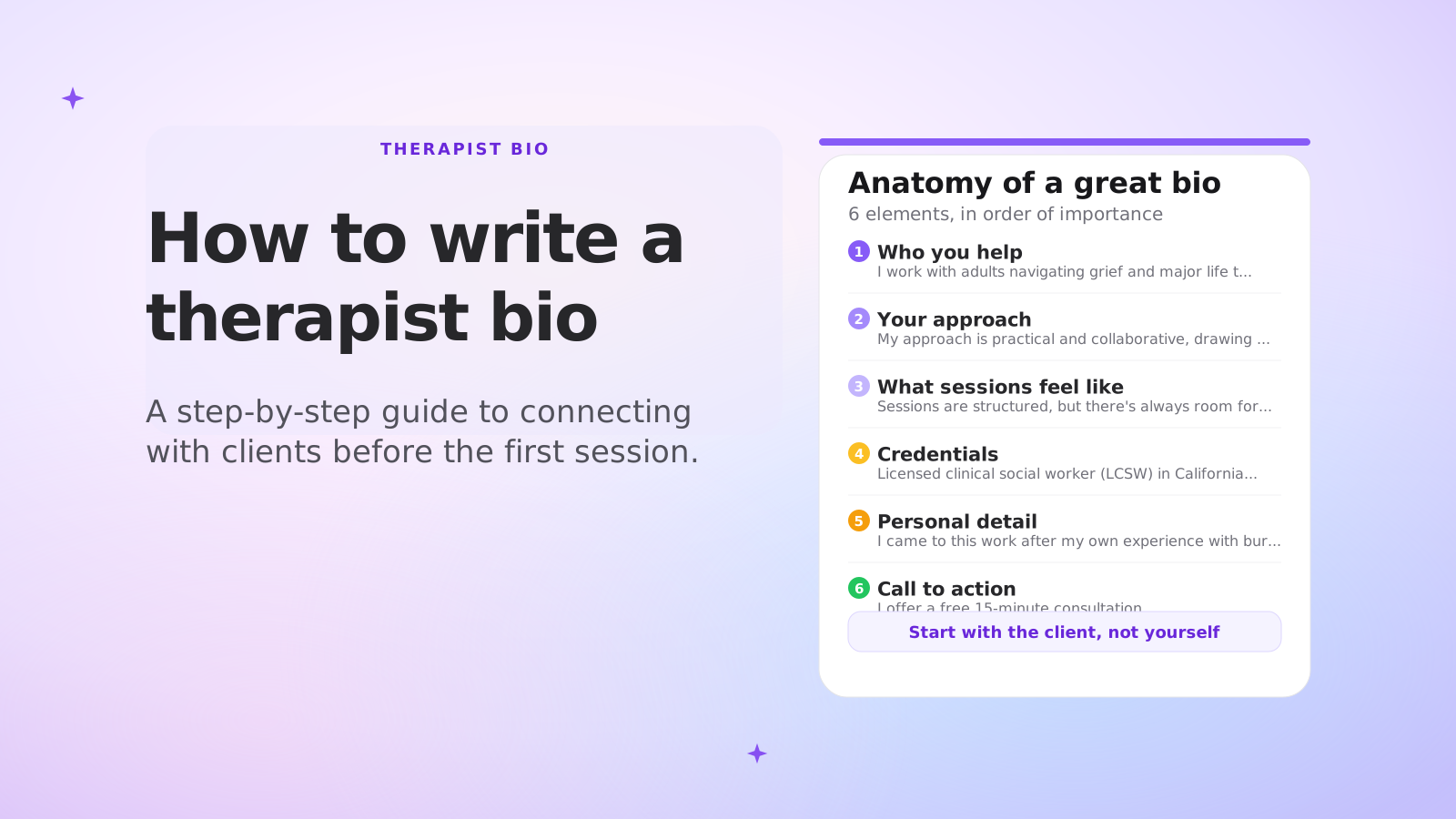
A strong therapist bio covers six things, in roughly this order:
1. Who you help and what they're struggling with
Start with your client, not yourself. Name the specific population or problem you work with. "I work with adults navigating grief, major life transitions, and the particular exhaustion of feeling like you should be fine by now" is more compelling than "I specialize in a range of mental health concerns."
2. Your therapeutic approach, in plain language
Name your modality or framework, then translate it into what that actually means in session. "I use EMDR, which is a research-backed approach that helps you process difficult memories without having to talk through every detail" is far more useful than "EMDR-trained."
3. What working with you feels like
This is the most underused element. Describe your style: structured or open-ended, directive or client-led, warm or matter-of-fact. Clients who don't know what to expect from therapy are more anxious about starting. Specificity here reduces that barrier.
4. Relevant credentials and licensure
Keep this brief. State your license type, your state, and any specific certifications that are directly relevant to your niche. This establishes legitimacy without becoming a resume.
5. A small personal detail
One or two sentences. Not a full personality profile, but something that makes you human: where you're based, what drew you to this work, a brief personal note. This is the on-ramp for connection.
6. A clear call to action
End with what you want them to do next. "If any of this resonates, I'd welcome a free 15-minute consultation" is direct and low-pressure. Don't leave the reader wondering.
What to leave out
Most therapist bios are too long and too credential-heavy. Here's what to cut:
- A comprehensive list of every condition you treat. Pick two or three core specializations. A long list signals "I'll take anyone" and makes it harder for the right client to self-identify.
- Jargon your clients don't know. Terms like "attachment-informed," "polyvagal theory," or "somatic experiencing" mean a great deal to colleagues and very little to most clients. Either cut them or define them in one plain sentence.
- Your entire educational history. Where you did your master's degree and your clinical hours rarely affects a client's decision, unless you went somewhere highly recognizable. Keep credentials to your license type and any directly relevant certifications.
- Third-person voice on your website. Third-person can work for some directories, but on your own website it creates distance. First-person is warmer and more direct.
- Vague outcome language. "I help clients live their best lives" tells a potential client nothing. Be specific about what change looks like.
.svg)
How to write a therapist bio: step by step
Step 1: Start with your ideal client, not yourself
Write one sentence that names who you help and what they're going through. Imagine your ideal client reading it and thinking "that's me." Example: "I work with therapists and helping professionals who are burning out, struggling to find the same care for themselves that they give to others every day."
Step 2: Name your approach in plain language
One to two sentences describing how you work and what that looks like in practice. Translate any clinical language into therapist language. Focus on what the client experiences, not on what you're doing theoretically.
Step 3: Describe what sessions feel like
This is often the step people skip. Write one or two sentences about your style. Are sessions structured or exploratory? Do you give homework? Are you more directive or more reflective? This helps clients calibrate their expectations before they reach out.
Step 4: State your credentials briefly
One sentence. License, state, any certifications directly relevant to your focus area. That's it.
Step 5: Add one human detail
Something personal that makes you real. "I'm based in Chicago, where I see clients both in person and via telehealth" or "I came to this work after my own experience with burnout, which is part of why I'm so committed to it" are both appropriate. This doesn't need to be deep. It just needs to be true.
Step 6: Write a clear call to action
Tell them what to do next. Make it specific and low-pressure. "I offer a free 20-minute consultation. Feel free to reach out through the contact form below" is better than "feel free to get in touch."
Step 7: Read it aloud
If it sounds like something you'd say to a colleague, revise it. If it sounds like something you'd say to a nervous new client, you're close.
Spending too much time on admin to focus on things like this? Upheal's AI clinical notes write themselves in 60 seconds after each session, so you can invest your time in the parts of practice that only you can do.
Therapist bio examples for different contexts
The right length and tone varies depending on where the bio lives. Here are real examples across common contexts.
Website About page bio
Website bios can be slightly longer: two to four short paragraphs. This is the one place where you have space to be a bit more personal.
I work with adults who are exhausted by anxiety: the kind that shows up as constant second-guessing, difficulty sleeping, and the nagging feeling that something bad is always around the corner. If this sounds familiar, you're in the right place.
My approach is practical and collaborative. I draw on cognitive behavioral therapy (CBT) and acceptance and commitment therapy (ACT) to help you understand the patterns driving your anxiety and build concrete skills for managing it. Sessions are structured, but there's always room to follow what's actually showing up for you that week.
I'm a licensed clinical social worker (LCSW) in California, and I see clients via telehealth across the state. I came to this work after my own experience with health anxiety, which gives me a particular appreciation for how exhausting it can be to live in your own head.
Psychology Today / directory profile bio
Directory bios typically have character limits and need to front-load the most important information, since many platforms truncate after the first few sentences.
I help adults struggling with anxiety, perfectionism, and the pressure to hold everything together. My approach is warm, practical, and rooted in CBT and ACT — we'll work on understanding what's driving your anxiety and building real tools to manage it, not just talk about it.
I'm an LCSW licensed in New York, offering telehealth sessions across the state. I specialize in working with high-achievers, healthcare workers, and people who find it easier to support others than to ask for support themselves. I am LGBTQ+-affirming and culturally responsive in my practice.
Social media bio (short form)
For Instagram, LinkedIn, or similar platforms where you have 150 characters or fewer:
LCSW | Helping anxious high-achievers quiet the noise | NY telehealth | Free consult ↓
Therapist bio templates you can adapt right now
If you want a head start on the documentation side of private practice while you work on your bio, Upheal's progress note templates and treatment plan tools are free to explore. For a practical comparison of EHR options for solo practitioners, see Best EHR for private practice in 2026.
Template A: Website About page
I work with [type of client] who are dealing with [specific challenge or experience]. If [brief description of what their life feels like right now], you're in the right place.
My approach is [1-2 adjectives: e.g., practical and collaborative / warm and exploratory]. I draw on [modality/framework] to help you [what the client gains from working with you]. Sessions are [describe the feel and structure].
I'm a [license type] licensed in [state]. [One personal sentence: what drew you to this work, where you're based, who you particularly love working with.]
[Call to action: e.g., "I offer a free 20-minute consultation. Reach out through the form below."]
Template B: Directory profile
I help [type of client] dealing with [specific challenge]. My approach is [adjective], using [modality] to [client outcome in plain language].
I'm a [license type] in [state], offering [in-person / telehealth / both]. I specialize in working with [niche]. [Inclusion signal if applicable.]
Ready to take admin off your plate? Upheal handles notes, treatment plans, scheduling, and billing so you can spend more time on what actually grows your practice. Start free at upheal.io/signup
Common mistakes and how to fix them
Writing for colleagues, not clients.
The most common mistake: bios filled with clinical terms that mean nothing to a potential client. Fix: read your bio and highlight every word a non-therapist might not know. Replace each one with plain language.
Starting with your credentials.
"I am a licensed professional counselor with 12 years of experience..." is the clinical equivalent of leading a cover letter with your GPA. Fix: start with the client and what they're struggling with. Credentials come later.
Being too vague about your niche.
"I work with individuals, couples, and families dealing with a wide range of issues" helps no one self-identify. Fix: pick your two or three primary specializations and name them directly.
Forgetting the call to action.
A bio that ends with your credentials leaves the reader wondering what to do next. Fix: always end with a specific, low-pressure next step.
Not updating it.
A bio that lists certifications you completed five years ago or a telehealth note from the pandemic looks dated. Fix: review your bio every six months and update it to reflect where your practice actually is.
Frequently asked questions
How long should a therapist bio be?
For a website About page, 200 to 350 words. For directory profiles, aim for under 1,500 characters. For social media, one to two sentences.
The length depends on where it lives, but shorter is almost always better. Website bios can run two to four short paragraphs; directory profiles should front-load key information since many platforms truncate early; social media bios should be one to two sentences or a short bulleted list.
Should I write my therapist bio in first person or third person?
Use first person on your website and third person only when a platform specifically requires it.
First person is warmer, more direct, and creates better rapport with someone who is deciding whether to reach out. Third person can work for certain directories or author bios in publications, but it creates distance on your own website.
Should I include personal details in my therapist bio?
Yes: one or two personal details make you feel human and accessible to a potential client.
What drew you to this work, where you are based, or who you especially love working with are all appropriate. The goal is to signal there is a real person behind the credentials, not to provide a full autobiography.
How often should I update my therapist bio?
At minimum, every six months, or immediately when your focus area, credentials, or practice format changes.
A bio that reflects your current practice is a better client-matching tool than one that was accurate two years ago. Review it as part of any practice audit.
Can I use the same bio everywhere?
Yes, but adapt the length and focus for each platform rather than copying it verbatim.
Your core message and voice should be consistent. Your website bio can be longer and more personal. Directory profiles should front-load searchable specifics since platforms often truncate early. Social media bios should be short and direct. Think of it as one bio, many formats.
The bigger picture
Writing a great bio is one part of building a practice that works. The other part is having systems that free up your time and attention for the things that matter: client care, professional development, and how you show up online.
Upheal is built for exactly that: an AI-native EHR that handles documentation, scheduling, and billing so you can focus on clients. Notes write themselves in 60 seconds. Admin runs in the background. You get your time back.

.svg)