How should a therapy practice handle no-show and late-cancellation fees?
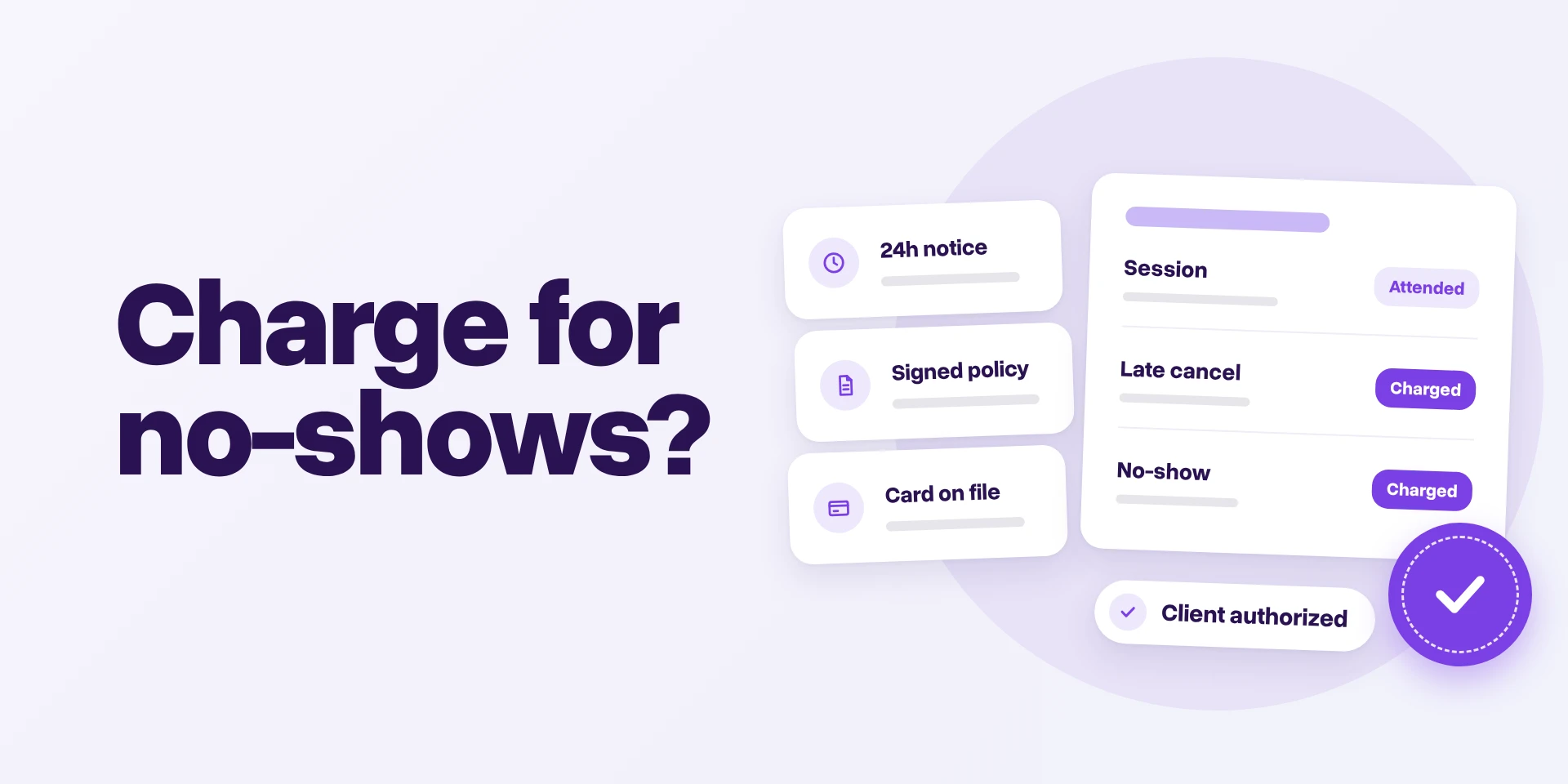
A therapy practice should handle no-show and late-cancellation fees with a written policy the client signs at intake: a 24-hour or 48-hour notice window, a stated fee, defined exceptions, and a saved card the client has authorized. Check every payer first. Medicare allows the fee only if it applies equally to all patients, and Medicaid generally prohibits it.
A late cancellation is a cancellation made with less notice than the practice's policy requires. A no-show is a scheduled appointment the client misses without cancelling.
TL;DR
- Put the fee in a written policy each client signs at intake, before the first session.
- Most policies use a 24-hour or 48-hour notice window and treat a client who is 15 or more minutes late without contact as a no-show.
- Medicare allows a missed-appointment fee only when the same policy and amount apply to every patient. Medicaid members generally cannot be charged at all.
- A missed appointment is never billed to insurance as a session that took place.
- The easiest way to collect is a saved card the client has authorized in writing, with the option of a notice before each charge.
This guide covers what a therapy cancellation policy should say, how much to charge, which payers restrict missed-appointment fees, the ethics, and how to collect without chasing clients. It is written for solo therapists and group practice owners in the United States. It is not legal advice, so check your state board rules and payer contracts before you adopt a policy.
What should a therapy no-show and late-cancellation policy include?
A therapy no-show and late-cancellation policy should cover seven things: the notice window, the definition of a no-show, the fee, the exceptions, how clients cancel, how the fee is collected, and what happens after repeated missed sessions.
| Policy element | Common choice | Why it matters |
|---|---|---|
| Notice window | 24 hours, or 48 hours for slots that are hard to refill | Clients need one clear deadline |
| No-show definition | Client misses the session, or is 15 or more minutes late without contact | Prevents disputes about late arrivals |
| Fee | A stated dollar amount: flat fee or a share of the session rate | Clients can plan for a number, not a formula |
| Exceptions | Medical emergency, sudden illness, severe weather, practice error; optional one-time courtesy waiver | Allows discretion without looking arbitrary |
| How to cancel | Phone, client portal, or email, including after hours | A rule clients cannot act on is not enforceable in practice |
| Collection | Saved card with written authorization, or an invoice | Decides whether the fee is ever paid |
| Repeated absences | A clinical conversation before any change to treatment | Protects continuity of care |
State whether the notice window counts calendar hours or business hours. Under a 24-hour calendar rule, a client with a Monday 9 a.m. session has until Sunday 9 a.m. to cancel, which many clients will not assume.
For telehealth sessions, define a no-show as not joining the video session within the grace period. Grow Therapy, for example, uses a 15-minute grace period and tells providers that a client who joins within that window, even briefly, should not be charged a no-show fee (Grow Therapy provider help center, as of October 2026).
How much should a therapist charge for a no-show or late cancellation?
No law or professional body sets a standard no-show fee for therapists, so each practice chooses its own amount. The three common structures are:
- Full session fee. The client pays what the session would have cost.
- Partial fee. A share of the session rate, such as half.
- Flat fee. One amount for every missed or late-cancelled session, whatever the service.
Some platforms cap the amount. Grow Therapy lets providers set a no-show or late-cancellation fee of up to $200, unless a payer requires a lower cap, and limits no-show fees for Magellan clients to $90 (Grow Therapy provider help center, as of October 2026).
Four questions help set a fair number:
- Could you have filled the slot? A fee closer to the full rate is easier to justify when the slot could not be offered to anyone else.
- Can your clients afford it? A fee that equals a week of a sliding-scale client's budget can end treatment.
- Is it one number? A single stated amount is easier to explain and apply than a percentage.
- Is it the same for everyone? For Medicare patients this is a requirement, not a preference (see the next section).
Can you charge insurance clients a no-show fee?
You can charge many insured clients a no-show fee, but the fee is always billed to the client, never to the insurer, and some payers forbid it entirely. Check each payer before the fee goes into your intake paperwork.
Medicare
Medicare allows a provider to charge a Medicare patient for a missed appointment only if the practice's missed-appointment policy applies equally to Medicare and non-Medicare patients and the amount is the same. The rule is in the Medicare Claims Processing Manual, Chapter 1, Section 30.3.13, which CMS added in 2007 (CMS MLN Matters MM5613). Medicare does not cover missed appointments, so the provider bills the patient directly, and CMS denies missed-appointment charges submitted on a Medicare claim. Medicare Advantage plans can add their own rules through your contract. On Grow Therapy, for example, providers cannot charge no-show fees to Kaiser Permanente Medicare members in Northern California or the Mid-Atlantic States (Grow Therapy provider help center, as of October 2026).
Medicaid
Under long-standing CMS policy, providers may not charge Medicaid members for missed or canceled appointments. CMS set out its position in a 1995 letter to state Medicaid agencies: a missed appointment is not a separate billable service, and providers must accept the Medicaid payment as payment in full (42 CFR 447.15). State agencies still apply it. Colorado's Medicaid agency, for example, states that federal and state policies prohibit these charges, and Grow Therapy applies the same rule to every Medicaid plan on its platform.
This is the opposite of the Medicare rule, so practices that see both need separate handling. The rare exceptions have been state programs CMS specifically approved, such as an Arizona missed-appointment fee authorized through 2012. Check your state Medicaid agency's and managed care plan's policy before assuming one applies.
Commercial plans, EAPs, and platforms
Commercial insurance contracts and employee assistance program agreements can cap or prohibit missed-appointment fees, so read the contract for every payer you are in network with. On Grow Therapy, for example, providers cannot charge no-show or late-cancellation fees to Kaiser Permanente Northern California clients (Grow Therapy provider help center, as of October 2026).
Never bill a missed session as a session
A missed appointment is not a clinical service, so it should never be submitted to insurance as a session that took place. Keep cancellation fees on their own line in the client's account, separate from session charges and copays. If you are still deciding between insurance and private pay, our guide to whether to accept insurance as a therapist compares the two models.
Is it ethical for therapists to charge cancellation fees?
Charging a cancellation fee is consistent with the APA Ethics Code when the client agreed to it in advance and the fee practice is consistent with law. Standard 6.04 of the APA Ethics Code asks psychologists to agree on compensation and billing arrangements with clients as early as feasible, and Standard 10.01 lists fees among the topics covered in informed consent for therapy. Standard 6.04(e) also requires psychologists to tell a client before taking collection measures on an unpaid balance and to give the client a chance to pay promptly.
In practice, that means three things:
- Disclose before the first session. Put the policy in the informed consent and financial agreement, and get a signature.
- Never change it retroactively. Give current clients advance notice and a new acknowledgment before a new fee applies.
- Apply exceptions the same way for everyone. Write the exceptions into the policy so a waiver is a rule, not a favor.
What to do about repeated no-shows
A pattern of missed sessions is clinical information as well as a billing problem. Depression, anxiety, and unstable work or caregiving schedules can all make attendance hard, and repeated fees without a conversation can push a client out of treatment. Raise the pattern in session with curiosity, and consider a different time, telehealth, or a different session frequency before changing anything else. If ending treatment becomes necessary, follow your ethics code and licensing board's termination requirements, including appropriate referrals.
How do you collect no-show fees without chasing clients?
The most reliable way to collect a no-show fee is a card the client saves at intake, backed by a signed authorization that names which charges the card can be used for. Invoicing after the fact means a separate conversation, and often a reminder, for every missed session.
A card-on-file authorization for a therapy practice should state:
- Which charges the card covers: session fees, copays, late-cancellation fees, and no-show fees
- When charges run
- The largest amount that can be charged at once
- Whether the client gets a notice before each charge
- How the client can withdraw the authorization
Upheal, an AI-native EHR for mental health clinicians, can charge late-cancellation and no-show fees to a client's saved card automatically once the client signs Upheal's automatic payment authorization form. These fees follow the same per-charge limit and notice options as any other automatic charge on Upheal. Clients can ask for a notice before every charge and can withdraw anytime in the Client Portal. Card payments on Upheal cost 2.9% + $0.30 per transaction, as listed on Upheal's client payments page in October 2026.
For a side-by-side look at card processing fees and HIPAA terms across therapy EHRs and standalone processors, see our guide to HIPAA compliant payment processing for therapists.
Fees work best as a backstop. Appointment reminders 48 and 24 hours before a session, easy cancellation through a client portal, and a short-notice waitlist all reduce how often a fee is needed at all.
Sample no-show and late-cancellation policy for therapists
Adapt this sample to your practice, fill in the blanks, and check it against your state rules and payer contracts before you use it.
Cancellation and missed appointment policy
Your appointment time is reserved for you. Please give at least [24/48] hours' notice to cancel or reschedule, by [phone, client portal, or email]. Notice counts in [calendar/business] hours.
Late cancellations. Sessions cancelled with less than [24/48] hours' notice incur a fee of $[amount].
No-shows. If you do not attend, or do not arrive or join a video session within [15] minutes of the start time without contacting us, you will be charged a no-show fee of $[amount].
Exceptions. We waive the fee for medical emergencies, sudden illness, severe weather, and scheduling errors on our side. [Optional: your first late cancellation is waived as a courtesy.]
Insurance. Missed-appointment fees are billed to you, not to your insurance, and are never submitted as a session. We do not charge these fees where your insurance plan or the law prohibits them, including Medicaid plans. Apart from those exceptions, the same policy and fee apply to every client.
Payment. If you authorize a card on file, we may charge it for late-cancellation and no-show fees as well as session fees, up to $[limit] per charge. You can ask for a notice before each charge and withdraw your authorization at any time.
Repeated missed sessions. If missed sessions become frequent, we will talk with you about what is getting in the way and look at other scheduling options together.
I have read this policy and had a chance to ask questions. Signature: ______ Date: ______
When the policy is ready, put it in your intake packet so every new client signs it before the first session. Try Upheal free to send your intake forms and the automatic payment authorization together.
The bottom line on therapy cancellation fees
A no-show fee protects your time only if it is agreed in writing before therapy starts, allowed by the client's payer, and easy to collect. Set one clear window and one clear amount, write the exceptions down, check Medicare and Medicaid rules, and let a saved, authorized card do the collecting. Start free, no credit card required
Frequently asked questions
Can a therapist charge for a no-show?
Yes, a therapist can charge a private-pay client for a no-show if the client agreed to the fee in writing in advance. The fee should be in the informed consent or financial agreement, applied consistently, and allowed under state rules. Insured clients are a separate question that depends on the payer.
Can I charge a Medicare patient a no-show fee?
Yes, but only if your missed-appointment policy and fee are the same for Medicare and non-Medicare patients. The rule is in the Medicare Claims Processing Manual, Chapter 1, Section 30.3.13. Medicare does not pay for missed appointments, so the fee is billed to the patient directly, never on a Medicare claim.
Can therapists charge Medicaid clients for missed appointments?
No, under long-standing CMS policy Medicaid members cannot be charged for missed or canceled appointments. CMS treats a missed appointment as part of the cost of doing business, not a separate service, and providers must accept Medicaid payment as payment in full under 42 CFR 447.15. Rare exceptions have needed specific CMS approval, so check your state's policy.
Can a no-show fee be billed to insurance?
No, a no-show fee should never be billed to insurance as a session. A missed appointment is not a clinical service. Where the payer allows a fee, it is billed to the client directly and kept separate from session charges and copays.
What is a reasonable late cancellation fee for therapy?
A reasonable late cancellation fee is a stated dollar amount, up to the full session fee, that your clients can realistically pay. No law sets a standard amount. Some platforms set caps: Grow Therapy allows up to $200, and $90 for no-shows by Magellan clients, as of October 2026.
Should I give clients one free late cancellation?
A one-time courtesy waiver is a reasonable option if it is written into the policy and offered to every client. It softens the first missed session without making waivers look arbitrary. After the courtesy waiver, apply the written fee and the written exceptions.
Last updated October 2026.