
Headway's $9.99 marketplace fee: who pays it, who doesn't, and what else changed in fall 2026
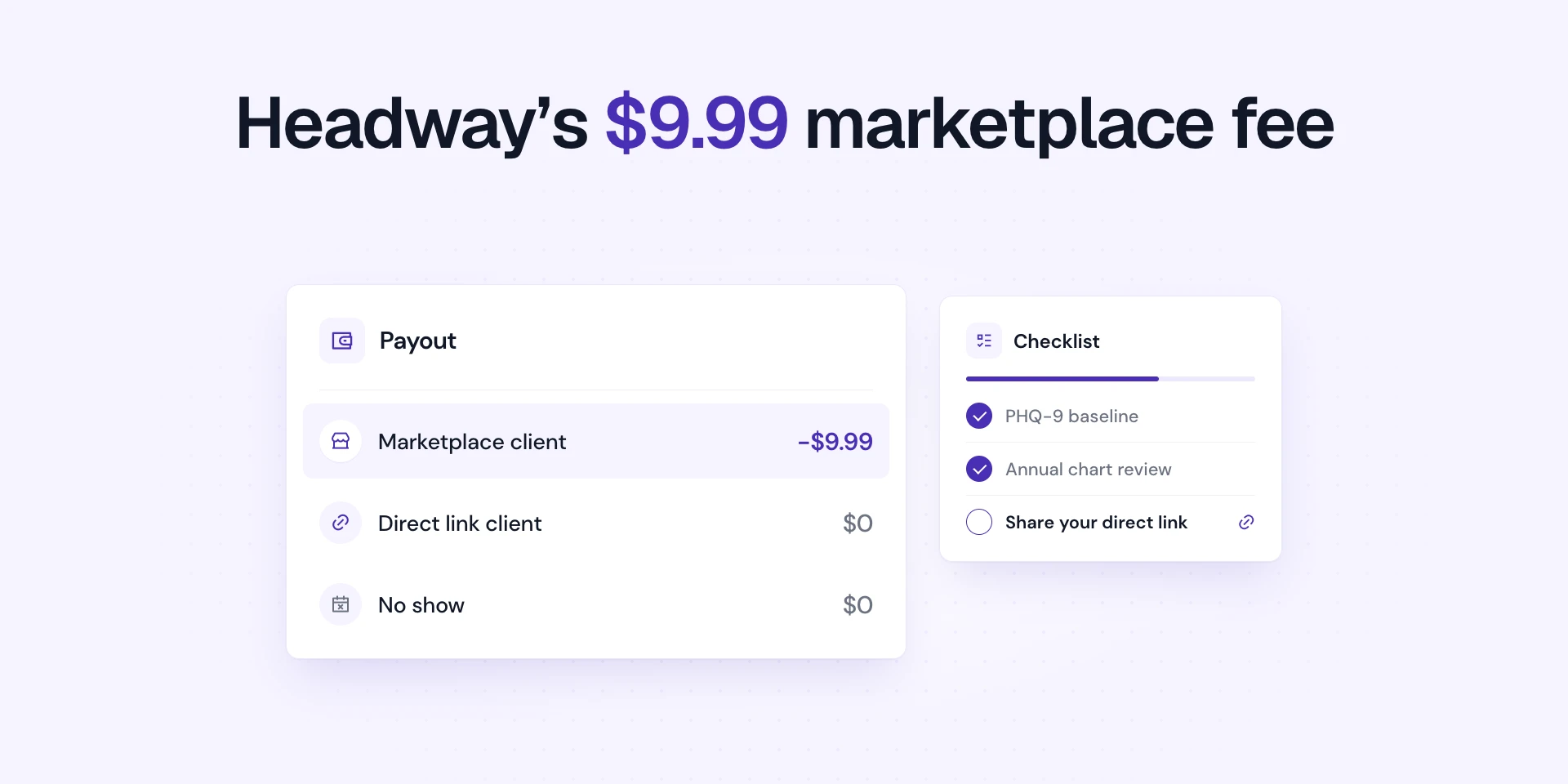
Headway's marketplace service fee is a $9.99 charge on every appointment with a client who found you by searching Headway and booking from your Headway profile. It is deducted from your payout, it applies to insurance and private pay sessions alike, and Headway says it is not a change to your contracted rate or to what clients pay. The fee starts October 8, 2026 for providers whose primary practice state is Virginia, Washington, Georgia, Ohio, or Illinois, and in every other state later in 2026.
The short version
The fee applies for as long as you see a marketplace client, not just the first session. Clients you bring yourself, clients who book through your direct link, health system referrals, and clients who found you on Headway before the fee started in your state are exempt, and so are cancellations and no shows. One weekly marketplace client costs about $400 a year in fees. The same release adds a baseline PHQ-9 or GAD-7 for adult clients from October 12, 2026 and an annual review of up to ten of your notes. You can turn your marketplace appearance off, and your direct link keeps working.
Last updated October 2, 2026. Headway details in this article come from Headway's fall 2026 platform updates page and its help center article on the marketplace service fee, both read on October 1, 2026. Confirm current terms with Headway before changing anything in your practice.
What did Headway announce in its fall 2026 release?
Headway published four changes on October 1, 2026, framed as protecting providers' time, income, and flexibility while health plans raise their expectations.
- A marketplace service fee. $9.99 on every appointment with a client who finds you through Headway's marketplace. Headway says the fee funds marketplace improvements, marketing, health system partnerships, and support.
- Outcome assessments. From October 12, 2026, talk therapists are asked to have every adult client complete a baseline assessment such as the PHQ-9 or GAD-7 at the start of care, where clinically appropriate, plus one completed follow up per client each year.
- Annual chart reviews. Once a year, Headway checks a sample of your notes against its documentation standards and works with you to close any gaps.
- EHR updates at no additional cost. Headway Telehealth moves to Zoom, with a new iOS app for clients. A session prep sidebar shows highlights from the last session, treatment goals, assessments, and billing status. Private pay fees dropped to 2.95% per session. Headway lists its Scribe for talk therapy intake notes, AI assisted treatment plans, and free e-prescribe as coming soon.
The fee drew the reaction. The assessments and chart reviews change what a Headway practice produces every week, and they are the parts to plan around.
Who pays Headway's $9.99 marketplace fee, and who doesn't?
The fee applies to clients who searched on Headway and booked with you from your Headway profile on or after your state's start date. Headway says it is never applied retroactively.
The fee applies to:
- Every appointment with a marketplace client who booked on or after your start date, for as long as you see them, not just the first session.
- Insurance and private pay sessions alike, at the same $9.99 for every health plan.
The fee does not apply to:
- Any session before the fee starts in your state.
- Clients you bring yourself, including clients you add in your provider portal.
- Clients who book through your direct link, wherever you share it: your website, a Psychology Today profile, or an email signature.
- Referrals from health systems.
- Clients who found you on Headway before the change, including their sessions after your start date.
- Sessions that don't take place: client cancellations, your cancellations, and no shows. Any cancellation fee you charge is still paid to you in full.
A client's source is set by the link they used the first time they booked with you, and it stays the same after that. Source is set per provider, so a client who already sees a colleague on Headway and then finds you on the marketplace is a marketplace client for your sessions only. Each client's page in the provider portal shows how they found you, with any fee listed under Pricing, and the Payments tab shows the fee on upcoming and past payouts.
Before your start date, check the clients you expect to be exempt. If a client you brought yourself shows as a marketplace client, raise it with Headway support before their next session.
How much does the Headway marketplace fee cost over a year?
A marketplace client seen weekly costs about $400 a year in fees. The table assumes 40 held sessions a year for a weekly client and 20 for a client seen every two weeks.
| Marketplace clients | Seen | Held sessions a year | Annual fee at $9.99 |
|---|---|---|---|
| 1 | Weekly | 40 | $399.60 |
| 1 | Every two weeks | 20 | $199.80 |
| 5 | Weekly | 200 | $1,998 |
| 10 | Weekly | 400 | $3,996 |
On a $100 session, $9.99 is about 10% of the session. On a $150 session it is under 7%. Because the fee is the same for every health plan, it takes a bigger share of lower reimbursement rates.
Headway says the fee is not a change to your contracted rate. It is deducted from your regular payout, one fee per session with a marketplace client, with no separate bill.
When does the Headway marketplace fee start in my state?
October 8, 2026, for providers whose primary practice state is Virginia, Washington, Georgia, Ohio, or Illinois, and only for marketplace clients who book on or after that date. Every other state follows later in 2026, and Headway says you will see a banner in your Headway account at least seven days before the fee starts for you.
The fee follows each provider's primary practice state, not the client's. A group practice with providers in several states will see the fee for some providers and not others until every state is live at the end of 2026. The practice admin controls marketplace settings for everyone in the group, and the practice payments report shows when the fee was deducted.
What does Headway's PHQ-9 and GAD-7 requirement mean in practice?
Starting October 12, 2026, Headway asks talk therapists to have every adult client complete a baseline assessment, such as the PHQ-9 or GAD-7, at the start of care where clinically appropriate, plus one completed follow up per client each year. If a client does not complete a required assessment, Headway asks you to give a reason. Headway says psychiatric providers and group practices come next.
The PHQ-9 is a nine item depression measure and the GAD-7 is a seven item anxiety measure. Headway says most clients already complete them while onboarding. The minimum workflow:
- Choose the instrument when you add the client. Headway lets you select which assessment to send when you add a new client. PHQ-9 for depressive symptoms, GAD-7 for anxiety, both if both apply.
- Schedule the follow up when the baseline comes back. Headway's floor is one a year. Repeating it more often gives you a picture of progress before any chart review.
- Write the reason when you skip one. "Where clinically appropriate" is Headway's wording, and it asks for a reason when an assessment is not completed. One sentence is enough.
- Use the score in your notes. A score that never appears in a progress note or treatment plan does little for a chart review. Tie it to a goal.
Headway's floor is a baseline and one follow up a year. If you want a trend line between those points, or you keep your clinical record outside Headway, Upheal is an AI-native EHR and note taking platform for mental health clinicians. Therapists can send PHQ-9 and GAD-7 assessments from Upheal's practice forms or from a client's chart. Clients complete them through the Client Portal. Each submission is scored automatically with a severity level, plotted on a trend chart in the client's Insights tab, and paired with an AI-generated interpretation that ties the score to what came up in the client's most recent session. A score above zero on PHQ-9 item 9 triggers an immediate alert.
What does Headway's annual chart review involve, and how do you prepare?
Once a year, Headway will check a sample of your notes against documentation standards covering patient safety, clinical best practices, and documentation quality that supports billing. You get instructions by email and in your portal, and you share up to ten notes within 30 days. Feedback applies to future notes, so you will not need to rewrite anything, and clients do not need to sign additional consents.
The review replaces some of the ad hoc reviews Headway already ran, and it applies whether you keep documentation on Headway or somewhere else. Headway names the three areas but not a line by line rubric. Insurance focused reviews usually look for four things in a note:
- Medical necessity. Why this client needs this level of care, at this frequency, with this modality.
- A link to the treatment plan. Each session should connect to a goal or objective in the plan, and the note should say how the client is progressing toward it.
- Session length justification. A session billed as 90837 (53 minutes or longer) needs a documented reason the extra time was clinically necessary compared with 90834 (38 to 52 minutes).
- Diagnostic support. Symptom evidence in the note that supports the diagnosis on the claim.
Upheal includes a Headway SOAP note template that aligns with Headway's note structure, with sections for the clinical summary, diagnostic support statement, medical necessity, and progress toward treatment objectives, plus a Headway Intake template for first sessions. You can see how Upheal's AI SOAP notes handle the Headway format on the feature page. A template does not guarantee a review outcome. It does give medical necessity, the treatment plan link, and diagnostic support a place in every note, so they are not left to memory at 9 pm. On sessions billed as 90837, check that the note states why the extra time was needed.
Upheal is not a marketplace: it will not send you clients or carry your Headway credentialing. Therapists who use Headway for referrals and billing can use Upheal for notes alongside it.
Should you stay on Headway, turn off the marketplace, or go independent?
For most Headway therapists, the cheapest response to the fee is to send new clients through your direct link. Four options, in order of effort:
Share your direct link everywhere. Clients who book through it are exempt, and Headway calls sharing it the best way to make sure clients you bring are recognized as your own. The link is in your Profile settings. Put it on your website, directory profiles, and email signature.
Limit or turn off your marketplace appearance. In Sigmund, under Settings and then New Clients Settings, you can turn your marketplace appearance off. That hides you from client search on Headway, so no new marketplace clients or fees arrive, and your direct link keeps working. Headway's release page also says you can turn new clients on or off for each health plan you are credentialed with. Turning appearance off does not remove the fee for marketplace clients who booked on or after your start date.
Run a hybrid. Keep Headway for marketplace referrals and billing while you credential under your own tax ID. Credentialing commonly takes 90 to 180 days per payer, so treat it as a long project. Our step by step guide to insurance credentialing covers the sequence.
Leave. Worth considering for therapists with a full caseload that mostly came through their own channels. Harder to justify if Headway's marketplace is your main source of new clients, because $9.99 a session is usually cheaper than replacing that pipeline. Before deciding, compare what you would take home on insurance versus private pay, and read how to leave Headway or Grow Therapy and go independent, which covers the order of operations and the mistakes that create income gaps.
Frequently asked questions
Is Headway free for therapists in 2026?
Not entirely. From October 2026, Headway deducts a $9.99 fee per appointment for clients who found you through its marketplace. The fee applies to insurance and private pay sessions. Clients you bring yourself, clients who book through your direct link, and clients who found you before the fee started in your state are not charged.
Does the Headway marketplace fee apply to my existing clients?
No. Clients who found you on Headway before the fee started in your state stay exempt, including their sessions after the start date. Headway says the fee is never applied retroactively. It applies only to marketplace clients who book with you on or after your state's start date.
Does Headway charge the marketplace fee for no shows or cancellations?
No. Headway charges the fee only on sessions that take place. Client cancellations, provider cancellations, and no shows carry no fee, and any cancellation fee you charge is paid to you in full.
When does the Headway marketplace fee start in my state?
October 8, 2026 in Virginia, Washington, Georgia, Ohio, and Illinois, and later in 2026 everywhere else. The fee follows your primary practice state. Headway says providers in other states will see a banner in their Headway account at least seven days before the fee starts for them, and every state will be live by the end of 2026.
Can I turn off the Headway marketplace?
Yes. You can turn your marketplace appearance off in your Headway settings, and your direct link keeps working. Turning it off hides you from client search on Headway, so no new marketplace clients or fees arrive. It does not remove the fee for marketplace clients who already booked with you on or after your start date.
Do I have to give a PHQ-9 or GAD-7 to every Headway client?
From October 12, 2026, Headway asks talk therapists to have every adult client complete a baseline assessment such as the PHQ-9 or GAD-7 at the start of care, where clinically appropriate. Headway also asks for one completed follow up per client each year. If a client does not complete a required assessment, you give a reason. Headway says psychiatric providers and group practices come next.
What happens in a Headway chart review?
Once a year, Headway asks you to share up to ten notes within 30 days and reviews them against its documentation standards. The standards cover patient safety, clinical best practices, and documentation quality that supports billing. Feedback applies to future notes, so you will not rewrite anything, and you will know about the review in advance.
Sources: Headway details are taken from Headway's fall 2026 platform updates page (headway.co/m/fall-2026-release) and its help center article "Understanding the marketplace service fee", both read on October 1, 2026. Upheal details are taken from Upheal's support center and feature pages on the same date. Fees, dates, and requirements can change; confirm current terms with Headway before deciding.
The fee is the headline. The documentation requirements are the work. If your notes and assessments are already in order, Headway's changes cost you $9.99 per marketplace appointment and a short chart review once a year. If they are not, try Upheal free and let the templates carry the structure.