Upheal vs AutoNotes: Privacy, value, and the true cost of AI documentation

AutoNotes does one thing: listens to your session and writes a note. For practices running on manual documentation, that's a real improvement.
The question is about what it doesn't do.
AutoNotes has no scheduling, no billing, and no telehealth, though scheduling and telehealth are listed as coming soon. Therapists using it today still need a separate EHR for practice management. Two subscriptions, two systems, neither talking to the other. Upheal does what AutoNotes does, plus replaces the EHR you'd otherwise run alongside it.
There's also a privacy difference worth understanding. Both platforms are HIPAA-aligned, but what you can actually verify before signing up is not the same.
What is AutoNotes?
AutoNotes is an AI documentation tool. It accepts session recordings or uploaded audio, transcribes the session, and generates a progress note. All plans include AI treatment plans, client records, and assessments. There is no free plan, though a free trial is available, after which paid plans start at $14/month (annual) or $29/month (monthly). Live session recording requires the First Class plan at $34/month (annual) or $69/month (monthly).
What it doesn't have: scheduling, billing, telehealth, or a client portal — though scheduling and telehealth are listed as coming soon. Therapists using AutoNotes today are paying for documentation on top of whatever practice management system they already use.
Upheal is an AI-native EHR. Notes connect to treatment plans, goals, and the client's full history. The compliance checker audits them against payer standards before you sign. The AI assistant handles documentation, scheduling, billing, and admin. If you're currently paying for AutoNotes plus a separate EHR, Upheal replaces both.
AutoNotes vs Upheal at a glance
The most significant distinction between these platforms lies in their approach to data privacy and client consent — areas where therapists rightly have the highest concerns. And, between Upheal and AutoNotes, one platform raises more questions than answers when it comes to how they handle protected information.
Privacy: what you can and can't verify
Both platforms are HIPAA-aligned and sign a BAA with every customer. The meaningful difference is what you can actually verify.
Upheal's privacy policy is public. It requires explicit opt-in consent from both therapist and client before any session data is used for AI training. It's independently audited and SOC 2 Type II certified. You can read the policy, confirm what it says, and hold Upheal to it.
AutoNotes' privacy posture has improved. Their Trust Center states that PHI is de-identified before any external AI processing, and that subprocessors are contractually restricted from training on PHI. A BAA is signed at signup. Those are meaningful commitments.
The gap is verifiability. AutoNotes has published a public privacy notice, but it explicitly states it applies only to website visitors, not to the platform or your clients' session data. The policy that actually governs clinical data is deliberately not published. Their own notice states it's withheld "because it contains proprietary compliance details" and is available only by contacting their Privacy Officer directly. That means therapists can't review it before signing up, can't share it with clients who ask, and can't independently confirm that marketing claims about data handling match the legal terms. AutoNotes is also not SOC 2 certified, so there is no independent audit of whether their stated security practices are actually in place.
For therapists who need to answer a client asking "what happens to what I say in session?" Upheal gives you a public document you can point to. AutoNotes asks you to take their word for it.
AI documentation
AutoNotes has a custom template builder on their First Class plan. You can create templates that match your modality or workflow, choosing from standard formats like SOAP, DAP, and BIRP, or building your own structure.
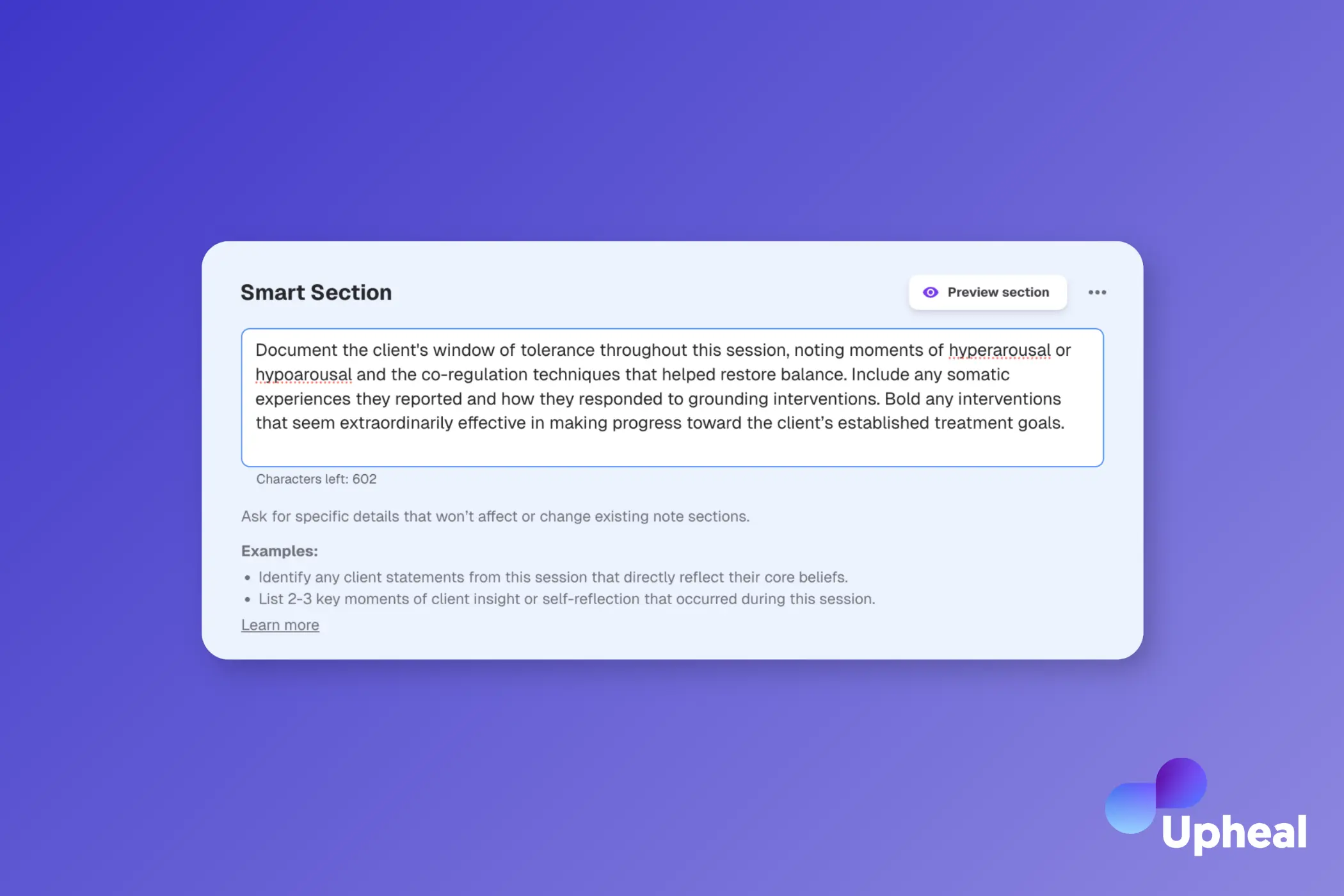
Upheal's Smart Sections go further: custom AI-powered sections built from your own prompts at the section level, not just the template level. You can teach the AI to capture exactly what matters in your practice — EMDR phases, DBT skills, family systems dynamics, any modality — in the specific way you document it. Smart Sections work from the current session's transcript, so the output reflects your clinical structure and voice. That's different from the deeper record integration covered below.
What the AI knows
AutoNotes does have note-to-note continuity on all plans, so prior session themes and treatment goals carry forward. What it doesn't have is the full clinical record: the diagnosis, the modality, the compliance layer, the pattern of how a client has moved toward or away from their goals over months.
Upheal's AI has all of that. The note it generates connects to treatment goals, flags when something hasn't moved, and reflects what shifted from last session. Treatment plans link to every session note through Golden Thread, creating a continuous clinical narrative rather than a series of isolated summaries.
Flexibility
Upheal supports in-person sessions, virtual sessions through any telehealth platform, manual uploads, and includes its own video calling platform with integrated AI across eight languages.
AutoNotes is limited to transcribing sessions automatically, requiring you upload session audio or a dictation, and then using that transcript to generate notes.
Insights & analytics
AutoNotes uses its AI to make recommendations to the therapist on how to proceed with care, but it does not surface analytics or insights over the course of the client’s care.
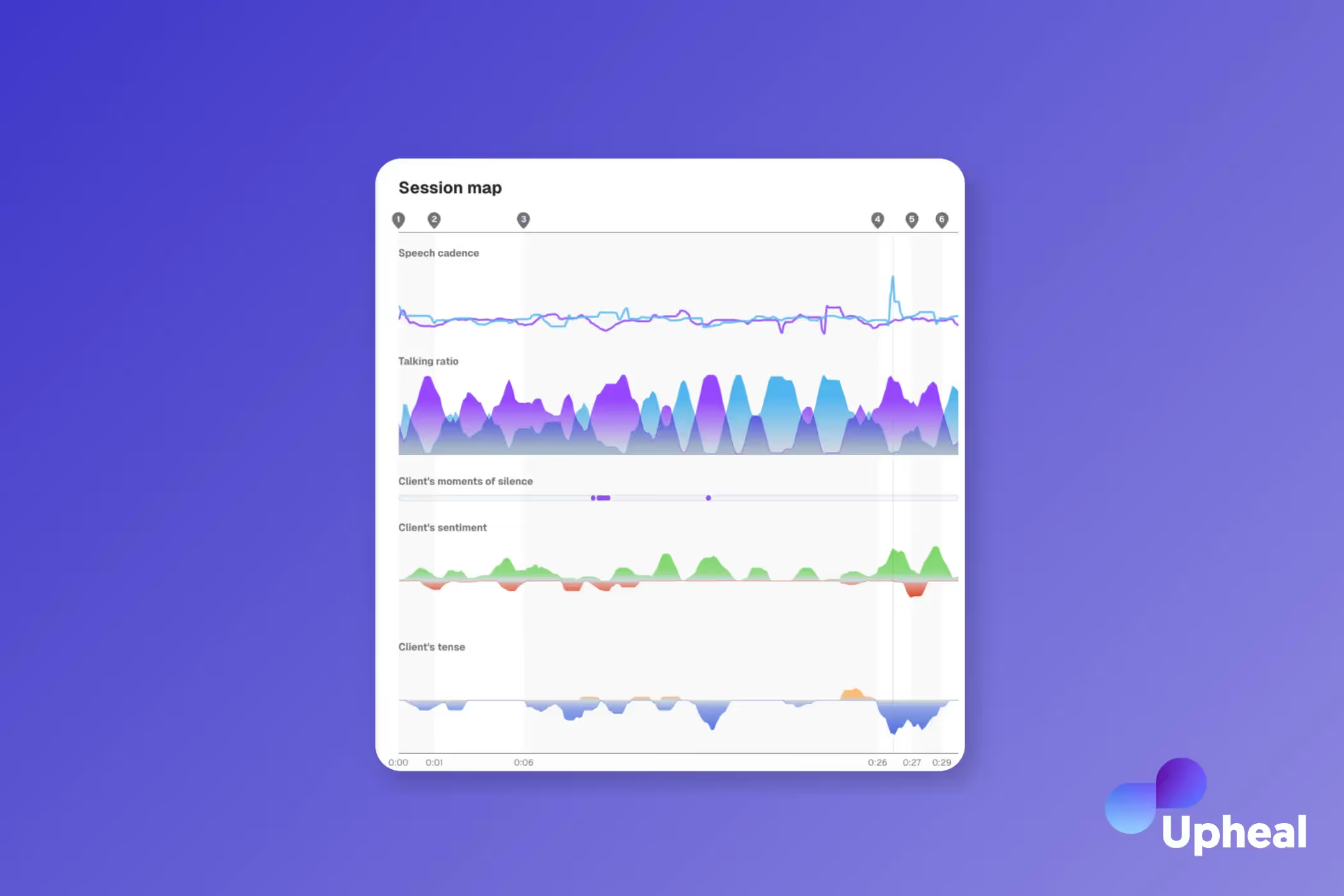
Upheal, by comparison, has advanced analytics that offer insights into therapeutic dynamics, session patterns, and client behavior.
Pricing
AutoNotes has no free plan — a free trial is available, after which plans run $14-34/month (annual) or $29-69/month (monthly) for notes only.
Upheal's free plan includes unlimited notes and unlimited HIPAA-compliant telehealth. Paid plans are NZ$1.70/session capped at NZ$119/month, including AI notes, treatment plans, compliance checking, scheduling, billing, and client messaging.
The more relevant comparison is total practice cost. AutoNotes at $29/month plus a separate EHR at $49-99/month puts you at $78-128/month for two systems that don't share data. Upheal is NZ$119/month for everything. A lighter caseload pays less.
Insurance billing is coming soon. If that's part of your practice, now is a good time to get started on the Upheal free plan and get familiar before it goes live.
What therapists say about Upheal
"THIS MAKES ME SO HAPPY!!! It is exactly what I was wanting and I just made the most perfect note that fits in with our note structure." — Lindsey Ferris, MS, LMFT
"Many companies haven't aligned their Privacy Policy and Terms of Use with their marketing claims — often implying stronger privacy protections than the legal docs actually offer. Props to Upheal for making privacy a differentiator. That matters to therapists." — Hannah Weisman, PhD
Is Upheal or Jane right for you?
AutoNotes makes sense if you want a standalone documentation tool and are comfortable maintaining a separate EHR for everything else. If documentation is your only pain point and you have no interest in changing your practice management setup, it does what it says.
Upheal makes sense if you want AI documentation and a complete EHR in one platform. If you’re looking for notes that connect to the full clinical record, compliance checking, an AI assistant that handles the work between sessions, or a pricing model that replaces both AutoNotes and your current EHR at the same or lower cost, then Upheal is for you.
Frequently asked questions
AutoNotes makes sense if you want a standalone documentation tool and are comfortable maintaining a separate EHR for everything else. If documentation is your only pain point and you have no interest in changing your practice management setup, it does what it says.
Upheal makes sense if you want AI documentation and a complete EHR in one platform. If you’re looking for notes that connect to the full clinical record, compliance checking, an AI assistant that handles the work between sessions, or a pricing model that replaces both AutoNotes and your current EHR at the same or lower cost, then Upheal is for you.