How to get more therapy clients in private practice
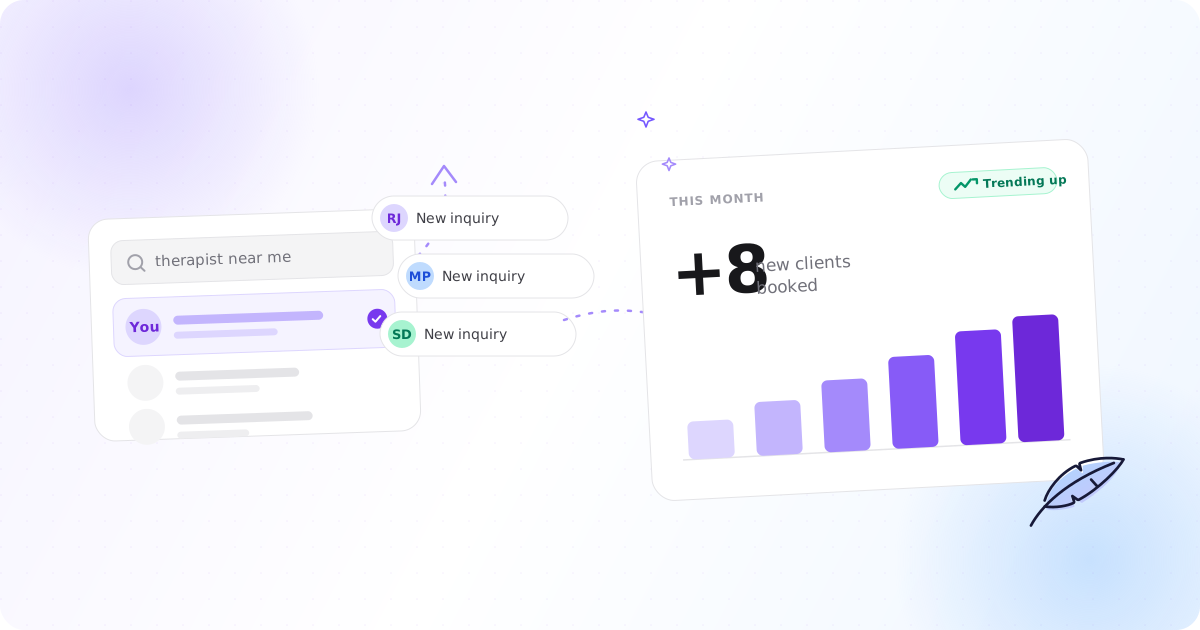
If your caseload has felt harder to fill lately, you aren't imagining it.
The surge in therapy demand that defined 2020 through 2022 has leveled off. More therapists have entered private practice. Directory platforms have become more competitive. And many of the tactics that worked three years ago (post something on Psychology Today and wait) no longer produce reliable results.
This guide covers what actually works in 2026 to get more therapy clients: the foundational moves you can't skip, the highest-leverage tactics for filling your caseload, and the operational changes that most therapists overlook entirely. It's written for solo and small group practices, whether you're just starting out or trying to grow a practice that has plateaued.
TL;DR
- Define your ideal client before doing anything else: targeting the wrong audience wastes every tactic below
- Your directory profiles, website, and Google Business Profile are the non-negotiables that everything else depends on
- Referrals work best when they're specific and systematic, not ad hoc
- Responding to inquiries within 24 hours is one of the highest-leverage things you can do to improve conversion
- Admin burden directly limits your client capacity: reducing documentation and scheduling overhead frees up the time and energy that practice growth requires
Why getting therapy clients feels harder right now
Therapy demand hasn't disappeared, but the landscape has shifted in ways that affect how clients find therapists and how they decide.
According to data from the National Institute of Mental Health, demand for mental health services remains high, but supply has also expanded significantly since 2020. More licensed therapists entered private practice during and after the pandemic, increasing competition in most markets.
At the same time, how clients search for therapists has changed. A potential client in 2026 is likely to consult multiple sources before reaching out: a directory profile, your website, Google reviews, and increasingly, AI search tools that aggregate and surface provider information. A strong presence in any one channel is no longer enough on its own.
The good news: most of your competition isn't doing the fundamentals well. A therapist with a clear niche, a well-written profile, a functioning website, and a fast intake response will outperform a therapist with a longer credential list and no clear positioning, almost every time.
Start here: define your ideal client before anything else
The single most important thing you can do before investing in any marketing tactic is get specific about who you want to work with.
This isn't about limiting yourself. It's about making every marketing touchpoint more effective. A profile that speaks to adults navigating anxiety and perfectionism will attract more of the right inquiries than a profile that lists fifteen conditions and populations.
Three questions to anchor your positioning:
- What type of client do you do your best work with?
- What presenting problems do you most want to work on?
- What would a client in that situation search for when looking for a therapist?
Your answers to these questions should shape your directory profiles, your website copy, your bio, and how you describe your practice to potential referral sources. Everything else follows from this.
Your online presence: the foundation everything else depends on
Before investing time in networking, content, or paid advertising, these three things need to be in place and working.
Directory profiles. Psychology Today remains the highest-traffic therapy directory for most US markets. TherapyDen, Zencare, TherapyFinder, and GoodTherapy are worth maintaining depending on your niche and location. Complete profiles with a professional headshot, a well-written bio that leads with your client (not your credentials), and up-to-date availability consistently outperform incomplete ones. Treat your directory profile as a landing page, not a form to fill out.
Your website. Your website doesn't need to be elaborate, but it does need to clearly answer three questions for a first-time visitor: Do you work with people like me? How do you work? How do I reach you? A clear bio, a simple description of your approach in plain language, and a visible contact form or booking button are more valuable than a beautiful design with vague copy.
Google Business Profile. For in-person or hybrid practices, a complete and active Google Business Profile is one of the highest-leverage free tools available. It determines whether you appear in local search results when someone searches "therapist near me." Keep your hours accurate, add photos, and ask satisfied clients to leave reviews where appropriate and within your ethical guidelines.
How to get referrals that actually convert
Referrals are the most reliable source of new clients for most established private practices. The challenge is that most therapists approach referral building too passively.
Identify specific referral partners. The most effective referral relationships are with professionals whose clients regularly need what you offer. Depending on your niche, this might include primary care physicians, psychiatrists, school counselors, employee assistance programs, OB-GYNs (for perinatal mental health), or pediatricians. Generic outreach to "anyone in healthcare" is far less effective than a focused list of ten specific professionals with whom you genuinely share a client population.
Make it easy to refer to you. Referral sources need to know: what you specialize in, who you're the right fit for, and how to reach you. A one-page referral card (physical or digital) with your name, specialty, contact information, and a clear description of your ideal client makes it far easier for a busy physician to pass your name along.
Follow up and reciprocate. Referral relationships require maintenance. Let referring colleagues know when a mutual client has made progress (within the bounds of confidentiality and with appropriate releases). Refer back when you encounter clients whose needs fall outside your scope. Relationships built on genuine professional reciprocity produce more referrals over time than transactional outreach.
How to convert inquiries into booked clients
Response time to new inquiries is one of the most underestimated factors in practice growth.
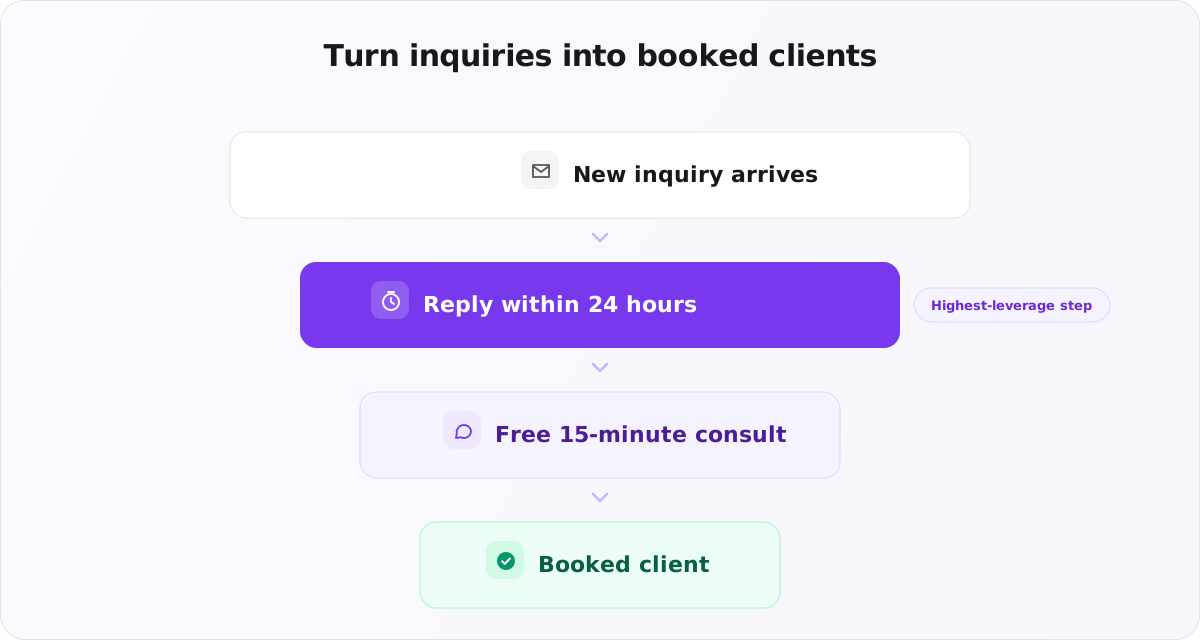
Research consistently shows that service businesses that respond to inquiries within 24 hours convert at significantly higher rates than those that take 48 to 72 hours or longer. For therapy specifically, the stakes are higher: a person who reaches out for mental health support is often in a moment of readiness that's time-sensitive. A slow response doesn't just lose the booking; it can lose the person.
Practical steps to improve inquiry conversion:
- Set an auto-response on your contact form or intake email that confirms receipt and gives a realistic timeline for your reply
- Aim to respond to all new inquiries within 24 hours on business days
- Offer a free 15 to 20 minute consultation to reduce the barrier for a first contact
- Keep your intake process simple: a straightforward contact form is better than a lengthy questionnaire as a first step
- Use a scheduling tool that lets potential clients book a consultation directly without a back-and-forth email exchange
Upheal's scheduling features allow clients to self-book directly from your intake flow, reducing the friction between inquiry and first appointment and freeing you from calendar management overhead.
How to build visibility without social media
Social media has a poor return on time investment for most private practice therapists. Building a following takes months or years. Content creation is time-consuming. And social media algorithms favor frequent posting that most solo practitioners can't sustain.
There are more reliable channels.
SEO and your website. A website optimized for the specific terms your ideal clients search is a long-term asset that generates inquiries without ongoing maintenance. A well-written page targeting "anxiety therapist [your city]" or "therapist for new moms [your city]" can drive consistent organic traffic. Focus on a small number of pages done well rather than a large quantity of thin content.
Local SEO. Your Google Business Profile, consistent NAP (name, address, phone) information across directories, and local-focused content on your website all contribute to appearing in local search results. For in-person and hybrid practices, this is often the highest-impact visibility investment available.
Content that answers specific questions. A single well-written article answering a specific question your ideal clients are searching for ("how to know if you need therapy," "what to expect in your first therapy session") can generate consistent organic traffic for years. You don't need a large blog. You need a small number of pages that genuinely answer the questions your ideal clients are asking.
Email. For therapists with an existing audience or list, a short monthly email with a resource, reflection, or update keeps you visible to people who aren't yet ready to book. Low effort, high trust.
What to try if your caseload has stalled
If you have existing profiles and a website but aren't getting inquiries, work through this checklist before adding new tactics.
- Does your profile or website bio lead with your client? If it leads with your credentials or years of experience, rewrite it to open with who you help and what they're dealing with.
- Is your niche clear? A bio that tries to appeal to everyone tends to convert no one. Get specific.
- Are your directory profiles complete? Incomplete profiles are deprioritized in directory search algorithms. Fill in every field, including a professional photo.
- Is your website easy to contact? Test your contact form. Check that your phone number or email is visible on every page. Make sure a first-time visitor can reach you within one click.
- How fast are you responding to inquiries? If you're taking more than 48 hours, improving your response time will likely produce faster results than any new marketing initiative.
- Are your rates and availability current? Outdated information creates friction and signals to potential clients that your practice may not be active.
How admin burden limits your growth (and what to do about it)
This is the piece most guides on getting more therapy clients skip entirely.
For solo and small group practitioners, time is the primary constraint on growth. Every hour spent on session documentation, scheduling, billing, and administrative follow-up is an hour unavailable for responding to inquiries, cultivating referral relationships, or improving your online presence.
A multicenter study published in JAMA Network Open found that clinicians using ambient AI documentation tools saw burnout rates drop from 51.9% to 38.8% after just 30 days, with significant reductions in cognitive task load and time spent documenting. The study, which enrolled clinicians across six US health systems, concluded that reducing documentation burden directly correlates with improved clinician wellbeing and capacity. Read the full study: Troup et al., JAMA Network Open, 2024.
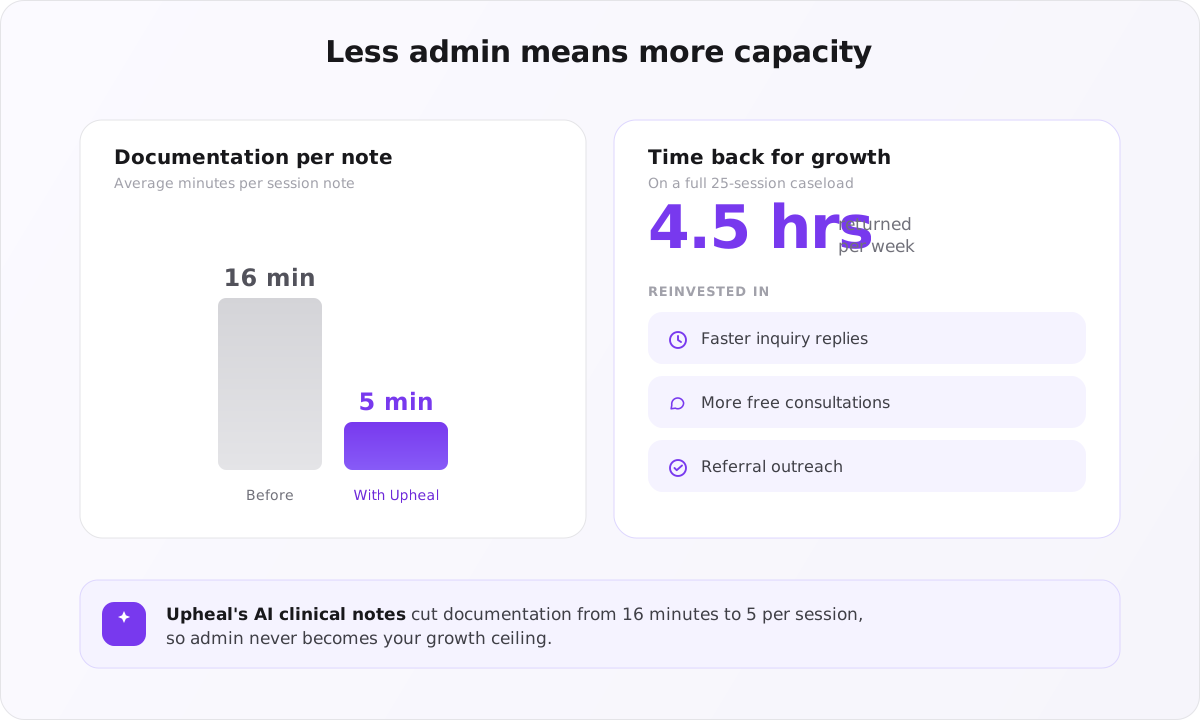
Therapists who spend 16 minutes per note (the industry average before AI tools) on a 25-session caseload are investing roughly 7 hours per week in documentation alone, before billing, scheduling, and administrative tasks.
Reducing that load has a direct practice growth effect: faster inquiry responses, more capacity for consultations, more energy for the marketing and relationship-building work that fills caseloads.
Upheal's AI clinical notes reduce documentation time from 16 minutes to 5 minutes per session on average. That's roughly 4.5 hours per week returned to a full-time caseload. On top of notes, Upheal handles scheduling, billing, and treatment plan documentation so the operational overhead doesn't accumulate into a growth ceiling. Learn how Upheal is built for individual providers.
A note on what not to prioritize
Before spending money or time on paid advertising, social media, or content marketing, make sure the fundamentals are working: a clear niche, complete and compelling directory profiles, a functional website, and a fast intake process. Paid traffic sent to a weak profile or a slow intake response is expensive and rarely productive.
If the fundamentals are solid and you're looking to accelerate, Google Ads targeting local high-intent searches ("therapist for anxiety [city]") can be effective with a modest budget and careful targeting. Social media is worth considering only if you have a specific content strategy and the time to execute it consistently.
FAQ
How long does it take to build a full therapy caseload?
Most private practice therapists reach a full caseload within 6 to 18 months, depending on their niche, location, marketing activity, and intake process efficiency.
The timeline varies significantly based on how specific your positioning is, how active your referral network is, and how quickly you respond to inquiries. Therapists with a clear niche and fast intake processes typically fill their caseload faster than those with broad positioning and slow response times.
What is the best way to get private pay therapy clients?
The most effective path to private pay clients is a compelling directory profile targeting your ideal client, a professional website with specific positioning, and a fast, low-friction intake process.
Private pay clients often have more options and do more research before choosing a therapist. Standing out requires clear positioning, a bio written for the client rather than colleagues, and a professional online presence across multiple platforms.
How many therapy directories should I be listed on?
Focus on two to four directories where your ideal clients are most likely to search, rather than listing on every platform available.
Psychology Today has the highest general traffic for most US markets. TherapyDen, Zencare, and GoodTherapy are worth evaluating based on your niche and location. Maintaining two to four complete, active profiles well outperforms ten incomplete ones.
Should therapists use social media to get clients?
For most solo practice therapists, social media has a low return on time investment and is not recommended as a primary client acquisition channel.
Building a meaningful following requires consistent effort over months or years. SEO, directory optimization, and referral networks typically produce more reliable results with less ongoing time investment. Social media is worth considering only with a clear strategy and genuine capacity to sustain it.
Does having an EHR help attract more clients?
An EHR with client-facing scheduling, intake forms, and a client portal reduces friction in your intake process, which directly improves inquiry-to-booking conversion rates.
Beyond client experience, an EHR that reduces documentation time frees up hours each week that can be invested in the marketing and relationship-building activities that grow a caseload. See how Upheal compares to SimplePractice for practice management and AI notes.
Building the practice you trained for
Getting more therapy clients is less about finding the perfect marketing tactic and more about getting the fundamentals right and removing the barriers that prevent you from responding quickly, showing up clearly, and staying available.
Upheal is built to handle the operational layer of private practice so that the clinical and growth work stays central. Notes, scheduling, billing, and treatment plans handled automatically. More time for the clients you're here to serve.
Start free at upheal.io/signup, no credit card required. Or read our guide to the best EHR for private practice in 2026 to see how Upheal compares.