
Mental health EHR software: a therapist's guide
.svg)
TL;DR
- A mental health EHR is an all-in-one platform for behavioral health clinicians that handles notes, scheduling, billing, and telehealth in one system
- Mental health EHRs are built around therapy-specific workflows: SOAP and DAP note formats, treatment plan tracking, and session consent, not hospital billing infrastructure
- In 2026, AI-native EHRs built around AI from day one offer significantly better documentation workflows than legacy platforms that added AI as a paid add-on later
- Upheal charges $1 per session, capped at $69 per month, with all features included and no add-ons
In 2024, over 60 million adults in the US received mental health services in the prior year. And the therapists behind that care are managing most of it across tools that were never designed to work together: it’s just what happens when solo therapists and small practices begin to realize their software needs are bigger than they thought.
They have one platform for scheduling. One for notes. One for billing. Something cobbled together for telehealth. Every week brings the same manual overhead. They spend far too much time copying client information between systems or tracking down a payment in one tool while a note sits unfinished in another.
A mental health EHR is software that consolidates all of that into a single system. Not a general medical EHR repurposed for therapy, but a platform designed specifically around how behavioral health clinicians actually document, schedule, bill, and communicate with clients.
This guide covers what a mental health EHR is, what it must include to actually replace that patchwork of tools, how pricing works across the market, and what separates an AI-native EHR from one that simply added AI on top of a system that predates it.
What is a mental health EHR?
A mental health EHR (electronic health record) is practice management software built specifically for behavioral health clinicians. It combines clinical documentation, scheduling, billing, client intake, telehealth, and compliance tools in a single platform designed around therapy-specific workflows, not hospital billing systems or general medical practices.
The term "electronic health record" is sometimes used interchangeably with "electronic medical record" (EMR). In behavioral health private practice, the distinction rarely matters since both refer to the same category of practice management software.
What does matter is the "mental health-specific" part. General medical EHRs handle acute care, multi-specialist handoffs, and large health system billing. They can technically store a therapy progress note. But they aren’t built around SOAP, DAP, or BIRP note formats, treatment plans that evolve over months, session consent and recording workflows, or the documentation standards specific to behavioral health. A mental health EHR is built for the way a therapist actually works.
What features should a mental health EHR include?
A complete mental health EHR should handle every operational layer of a private practice. Here is what to look for:
- Clinical documentation. Support for therapy-specific note formats including SOAP, DAP, BIRP, and GIRP. The ability to create, edit, sign, and store progress notes without a separate documentation tool.
- Treatment plan tracking. A way to set client goals, connect them to session notes, and track progress over time. In strong systems, this connection is automatic. It’s what clinicians call a "golden thread" running from intake through discharge.
- Scheduling and reminders. Calendar management with automated client reminders, availability controls, and self-booking. For group practices, this includes multi-clinician scheduling and admin-level oversight.
- Client intake and forms. Customizable intake forms and consent documents sent to clients before their first session, with responses landing directly in the client record.
- Secure client portal. A HIPAA-compliant space where clients can access documents, complete forms, message their therapist, and manage appointments.f
- Built-in telehealth. Video sessions that run inside the platform, not through an external tool. This matters especially when session recordings feed directly into note generation.
- Billing and superbill generation. Payment collection, invoicing, and superbills for clients who submit to their own insurance. Full insurance claim submission is a separate, more complex feature.
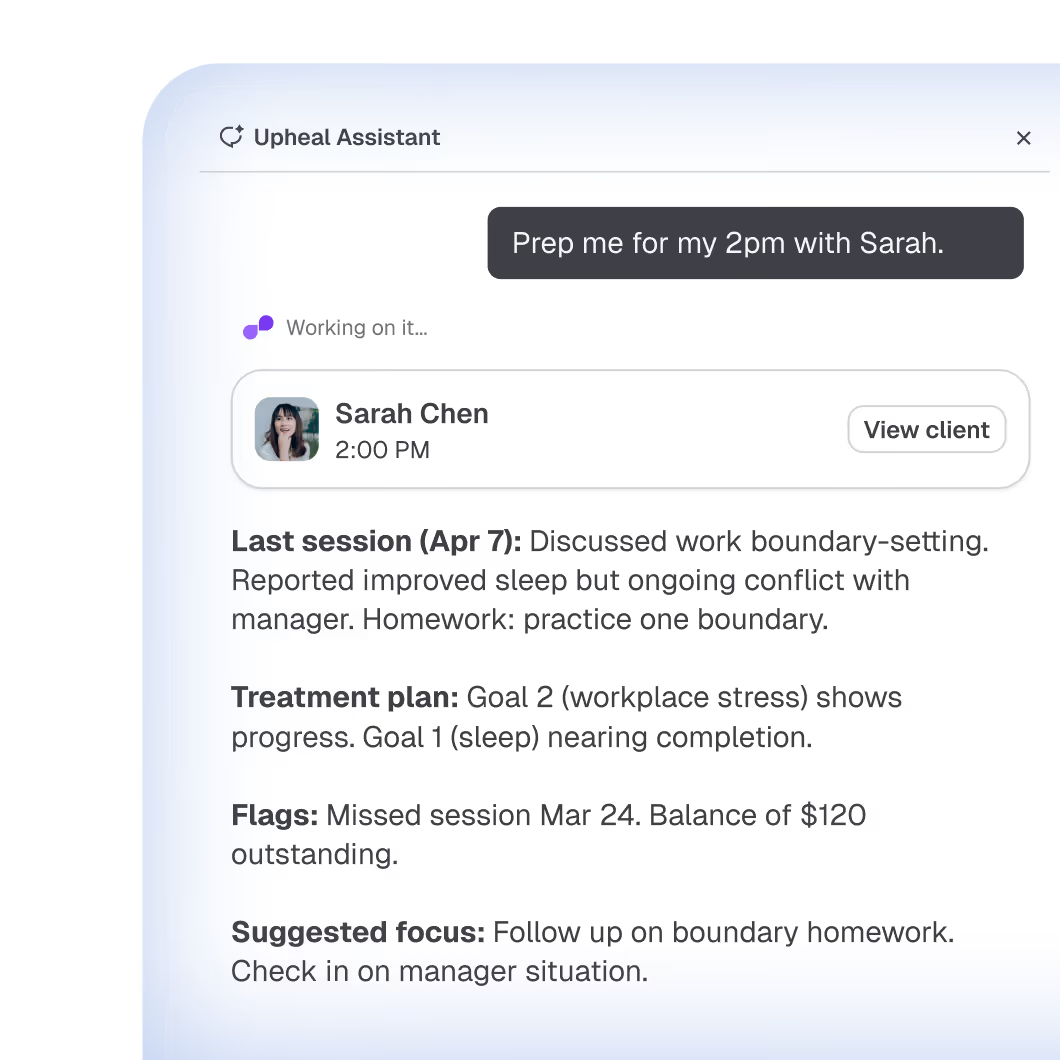
- AI-assisted note writing. Increasingly standard in 2026. The EHR listens to or transcribes a session and drafts the clinical note in your preferred format. In AI-native systems, this connects automatically to the treatment plan and compliance checker.
- HIPAA compliance and data security. Your data encrypted end to end, a signed Business Associate Agreement, and documentation standards that hold up to an insurance audit. Upheal's privacy and compliance documentation covers both in detail.
For a deeper look at how these features work in practice, Upheal's AI clinical notes covers the documentation workflow specifically.
How is a mental health EHR different from a general medical EHR?
The difference is architectural, not cosmetic.
General EHRs like Epic are designed for acute care: hospitalization records, multi-specialist handoffs, procedure codes, and large health system billing. A private practice therapist seeing 20 clients per week needs none of that. What they need is a system built around 50-minute sessions, documentation that follows the therapeutic relationship over time, and compliance standards specific to behavioral health.
The practical differences break down like this:
Note formats. Therapy uses SOAP, DAP, BIRP, GIRP, and other structured formats that general EHRs do not natively support. A mental health EHR builds these in as templates.
Treatment plans. Behavioral health requires goals that connect across sessions over weeks or months, not single-encounter medical notes.
Session workflows. Recording consent, telehealth integration, and session summaries that become notes automatically are therapy-native features.
Billing codes. Behavioral health uses specific CPT codes (90834, 90837, 90847, and others) and ICD-10 diagnostic codes. The billing logic is different from medical billing and requires a platform that understands it.
What should therapists look for when choosing a mental health EHR?
The market is crowded, and most platforms will tell you they do everything. Here is what actually differentiates them:
AI-native vs AI-bolted-on. This is the defining question in 2026. Most legacy EHRs were built before AI existed and added AI notes later as a paid add-on. AI-native EHRs are built with AI as the foundation, so documentation, compliance checking, and treatment plan tracking all connect to the same underlying system. The workflow difference is significant in day-to-day use.
All-in-one vs multi-tool. If your EHR handles notes but not telehealth, or scheduling but not billing, you’re still managing a fragmented stack. A true all-in-one EHR should let you cancel separate subscriptions. When evaluating, count how many tools you can actually replace.
Pricing structure. EHR pricing varies: flat monthly fees, per-session charges, and per-seat models for group practices. Per-seat pricing is common and gets expensive quickly as a practice grows. Pay close attention to what is and is not included in the base price. AI notes and compliance tools are frequently sold as add-ons.
Migration support. Switching EHRs is one of the most common concerns therapists raise before making a change. Ask specifically what the onboarding and data migration process looks like before committing to a platform.
Solo vs group practice fit. A solo practitioner and a group practice owner have different admin needs. Multi-clinician scheduling, admin-level calendar oversight, and team-level billing are group-specific features that not every platform handles equally well.
Upheal is built for individual providers and small group practices. See the full feature set and how it fits your practice structure.
How much does mental health EHR software cost?
Mental health EHR pricing falls into a few patterns:
Flat monthly fee. Most legacy platforms charge a fixed monthly rate. SimplePractice Essential starts at $79/month. TherapyNotes starts at $69/month (Solo plan) but charges per clinician in group practices.
Per-session pricing. A smaller number of platforms charge per session, which is favorable for therapists with lower caseloads or variable schedules.
Per-seat pricing. Common in group practice plans. Each clinician added increases the monthly cost, which can compound quickly at scale.
Hidden costs to watch for. AI note-taking is frequently sold as a paid add-on rather than included in the base plan. TherapyNotes offers AI notes through a separate product (TherapyFuel) at $40/month on top of the base subscription. Training fees, onboarding costs, and data migration charges can also add to the real total.
Upheal charges $1 per session, capped at $69 per month. All features are included in that price with no add-ons: AI clinical notes, telehealth, scheduling, compliance checker, client portal, payments, and practice forms. For a solo therapist running 20 sessions per week, the $69/month cap applies. For a full caseload, the $69 cap applies regardless.
What makes Upheal different from other mental health EHRs?
Three things set Upheal apart from the platforms other therapists currently use.
AI built in from day one, not added later. Upheal listens to sessions, drafts notes in your preferred format, checks them against documentation standards, and connects them to the client's treatment plan. The whole process runs automatically as part of the standard workflow. There is no separate subscription, no add-on to enable, and no copy-pasting between tools. Upheal reduces documentation time from an average of 16 minutes per session to under 5.
Built by licensed clinicians. Full-time licensed clinicians work inside Upheal's engineering and product teams, deciding what gets built and how it works. The compliance checker and the golden thread feature connecting treatment plans to session notes exist because clinicians built them, not because an engineer estimated what clinicians might want.
One price, everything included. $1 per session, capped at $69 per month. AI notes, telehealth, scheduling, compliance checker, payments, forms, and client portal, all in the base plan with no per-seat fees and no AI add-on.
For a side-by-side comparison of Upheal against specific platforms, the best EHR for private practice in 2026 covers the full landscape in detail.
Start free, no credit card required
The right EHR makes documentation the smallest part of your day
The fragmentation problem most therapists describe (notes in one tool, scheduling in another, billing in a third) isn't a quirk of private practice. It’s what happens when a workflow gets built from software that was never designed for it.
A mental health EHR is designed for it. One system, connected data, and documentation that follows the session rather than trailing it by hours.
Upheal is built specifically for solo and small-group private practices: AI-native, licensed-clinician-built, and priced at $1 per session with a $69/month cap.
Frequently asked questions
What is a mental health EHR?
A mental health EHR is practice management software built specifically for behavioral health clinicians. It combines clinical documentation, scheduling, billing, telehealth, and client intake in a single platform designed around therapy workflows, rather than general medical or hospital workflows.
What features should a mental health EHR have?
A complete mental health EHR should include therapy-specific note formats (SOAP, DAP, BIRP), treatment plan tracking, scheduling with automated reminders, a secure client portal, built-in telehealth, billing and superbill generation, HIPAA compliance tools, and AI-assisted note writing. The features section above covers each in detail.
What is the difference between an EHR and an EMR in mental health?
In behavioral health private practice, the difference is not meaningful in practice. Technically, an EMR (electronic medical record) is a single-practice digital record, while an EHR (electronic health record) is designed to share information across providers. Both terms refer to the same category of software in this context.
Is SimplePractice a mental health EHR?
SimplePractice is a practice management platform widely used by mental health professionals that includes scheduling, billing, telehealth, and notes. However, AI note writing is sold as a paid add-on at $35/month extra, and the platform was built before AI-native architecture was possible. It functions as an EHR for many therapists, but it is not an AI-native one. For a full comparison, see Upheal vs SimplePractice.
How much does mental health EHR software cost?
Pricing varies by platform. Most charge a flat monthly fee between $30 and $150. AI note-taking is often a paid add-on on top of that. Upheal charges $1 per session capped at $69 per month, with all features included.
What is the best EHR for a small mental health practice?
For a solo or small-group private practice, the best EHR handles documentation, scheduling, billing, and telehealth in a single platform without per-seat fees or paid add-ons. Upheal was built specifically for this structure: $1 per session, capped at $69 per month, with AI clinical notes, telehealth, scheduling, compliance checker, and everything else included in the base price.
Does Upheal work for group practices?
Yes. Upheal supports multi-clinician group practices. The $69/month cap applies per clinician. A three-clinician practice pays up to $207/month total, so costs scale predictably as the practice grows.