AI-native EHR for therapists: what it means and how to choose a mental health EHR

TL;DR
- A mental health EHR is practice management software built for behavioral health clinicians: clinical documentation, scheduling, billing, telehealth and client intake in one system, designed around therapy workflows rather than hospital ones.
- An AI-native EHR for therapists is one where AI is the architecture, not a feature. The AI can see the whole record, works at every step of the workflow, and is part of the platform rather than a paid add-on.
- The quickest test: ask what the AI can see and where it sits. If it only hears the session audio and only drafts the note, AI was added to the EHR. If it reads the treatment plan, prior notes, schedule and billing, and acts across all of them, the EHR was built around it.
- Choosing one comes down to six questions, covered below. For a side-by-side of named platforms, see the best EHR for private practice guide linked at the end.
- Upheal is an AI-native EHR for solo and small-group practices. Upheal costs $1 per session, with AI clinical notes included.
In 2024, over 60 million adults in the US received mental health services. The therapists behind that care are managing most of it across tools that were never designed to work together. One platform for scheduling. One for notes. One for billing. Something cobbled together for telehealth. Every week brings the same manual overhead: copying client information between systems, tracking down a payment in one tool while a note sits unfinished in another.
A mental health EHR consolidates all of that into a single system. Since 2025 a second question has mattered as much as the first: not just whether the EHR is built for therapy, but whether it is built around AI or had AI attached later.
What is a mental health EHR?
A mental health EHR (electronic health record) is practice management software built specifically for behavioral health clinicians. It combines clinical documentation, scheduling, billing, client intake, telehealth and compliance tools in a single platform designed around therapy-specific workflows rather than hospital billing systems or general medical practice.
The term is often used interchangeably with EMR (electronic medical record). In behavioral health private practice the distinction rarely matters; both refer to the same category of software.
What does matter is the "mental health" part. A general medical EHR can store a therapy progress note; it is not built around SOAP, DAP or BIRP formats, treatment plans that evolve over months, or session consent and recording workflows. The differences are covered below.
What is an AI-native EHR?
An AI-native EHR for therapists is an electronic health record built with AI as its foundation rather than as a feature added to an existing system. The AI is not a note-drafting tool sitting beside the record. It is the layer through which the record is created, connected and acted on.
In practice that means four things.
The AI can see the whole record. When it drafts a progress note, it draws on the client's treatment plan, previous session notes, diagnosis and goals, not just the audio of one session. The note reflects the arc of the client's therapy rather than an isolated hour, which is what makes it useful for showing progress against goals. That breadth of access is also why the data questions weigh more in an AI-native EHR: whatever the assistant can read is whatever the vendor's training and retention policies govern, so read those policies with the whole record in mind, not just the session audio.
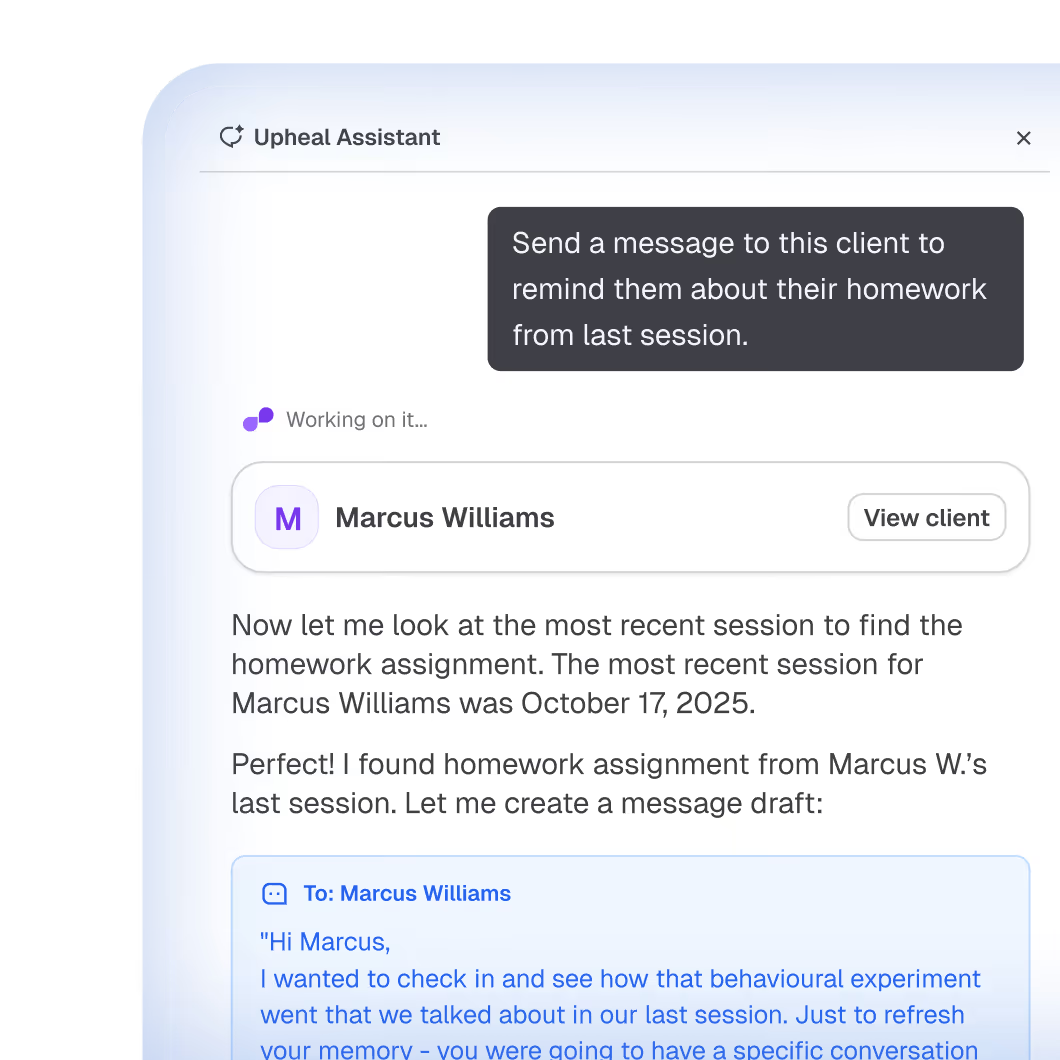
The AI works at every step, and increasingly it acts. In an AI-native EHR the same assistant that drafts notes can generate the treatment plan, check the note against payer documentation standards before you sign it, answer questions about your caseload, handle scheduling and reply to clients. The newest platforms go a step further with AI agents: jobs handed off to the AI with a defined level of autonomy, which it completes on the clinician's behalf and reports back on, closer to a member of staff than a feature. The clinician sets the scope and reviews the result. In an EHR with AI added, the AI typically does one job, note drafting, at one point in the workflow, and everything else is manual.
The AI brings you in. Migration is the first thing an EHR does for you, and it shows which kind you are dealing with. An AI-native EHR uses its assistant to rebuild your practice from an export of your old system: clients, notes, history, plans. An EHR with AI added hands you a spreadsheet template and a support article.
AI documentation is the platform, not an add-on. Because AI is the architecture, note drafting and the clinical record it feeds are part of the base product. Legacy EHRs that added AI later almost always sell note drafting as a separate monthly charge on top of the subscription. An AI-native EHR may still charge for higher tiers of autonomy; what it does not do is charge extra for the AI to write the note.
AI-native vs AI-added: how to tell the difference
Every EHR vendor now says "AI-powered." The label tells you nothing. These six questions do.
- What can the AI see? Only the session audio, or the full clinical record including treatment plan and prior notes? Ask the vendor to show you a note drafted with reference to a client's existing plan.
- Where does the AI sit in the workflow? At one fixed point (after the session, draft a note) or across the day (plan, document, check, schedule, bill, reply)?
- Can you ask it questions, and can you hand it a job? An assistant you can query about your caseload, your schedule or a client's history is a different thing from a template that fills itself in. An assistant you can delegate a whole task to, and that comes back when it is done, is different again.
- How does it migrate you in? AI that rebuilds your practice from your old EHR's export, or a CSV template and a help article. This is the earliest and most reliable tell.
- Is AI documentation in the base price? If note drafting is a per-clinician add-on to a subscription that works without it, AI was attached rather than designed in. That is the clearest single signal.
- Who reviews before anything is signed? In any EHR, AI-native or not, the therapist reviews and signs every note. If a vendor implies otherwise, that is a red flag rather than a feature.
The distinction is architectural, and it shows up in daily use. When documentation, compliance checking and treatment planning all read from the same record, the therapist stops copying context between tools. When they do not, "AI notes" becomes one more tab.
What AI agents mean in an EHR
An AI agent is an assistant you can hand a whole job to rather than a single step. Chase the unpaid balances from last month. Prepare a summary of everyone on Thursday's schedule. Rebook the three clients affected by a cancellation and let them know. The agent works through the task within a scope the clinician sets, and reports back when it is done or when it needs a decision. The useful comparison is to delegating to a capable member of staff, not to pressing a button.
What that does not mean is worth stating plainly. AI-native does not mean the AI makes clinical decisions. The therapist reviews and signs every note, sets what an agent is allowed to do, and stays accountable for the record. Autonomy in an EHR is a property of admin work, not of clinical judgment.
What should a mental health EHR include?
A complete mental health EHR should handle every operational layer of a private practice. Here is what to look for:
- Clinical documentation. Support for therapy-specific note formats including SOAP, DAP, BIRP and GIRP. The ability to create, edit, sign and store progress notes without a separate documentation tool.
- Treatment plan tracking. A way to set client goals, connect them to session notes and track progress over time. In strong systems this connection is automatic: the "golden thread" running from intake through discharge.
- Scheduling and reminders. Calendar management with automated client reminders, availability controls and self-booking. For group practices, multi-clinician scheduling and admin-level oversight.
- Client intake and forms. Customizable intake forms and consent documents sent before the first session, with responses landing directly in the client record.
- Secure client portal. A HIPAA-compliant space where clients access documents, complete forms, message their therapist and manage appointments.
- Built-in telehealth. Video sessions that run inside the platform. This matters most when session capture feeds directly into note generation.
- Billing and superbill generation. Payment collection, invoicing and superbills for clients who submit to their own insurance. Full insurance claim submission is a separate, more complex feature.
- AI clinical documentation. Standard in 2026. The EHR captures or transcribes the session and drafts the note in your format. In AI-native systems the draft draws on the treatment plan and is checked against documentation standards before you sign.
- Outcome measures and reporting. Integrated assessments like the PHQ-9 and GAD-7, plus dashboards for caseload, revenue and documentation status without exporting a spreadsheet.
- HIPAA compliance and data security. Encryption in transit and at rest, a signed Business Associate Agreement, a published position on whether session data trains AI models, and a default for what happens to recordings.
How is a mental health EHR different from a general medical EHR?
The difference is architectural, not cosmetic.
General EHRs are designed for acute care: hospitalization records, multi-specialist handoffs, procedure codes and health-system billing. A private practice therapist seeing 20 clients a week needs none of that. What they need is a system built around 50-minute sessions, documentation that follows the therapeutic relationship over time, and compliance standards specific to behavioral health.
Note formats. Therapy uses SOAP, DAP, BIRP, GIRP and other structured formats that general EHRs do not natively support. A mental health EHR builds them in as templates.
Treatment plans. Behavioral health requires goals that connect across sessions over weeks or months, not single-encounter medical notes.
Session workflows. Recording consent, telehealth capture, and session summaries that become notes are therapy-native features.
Billing codes. Behavioral health uses specific CPT codes (90834, 90837, 90847 and others) and ICD-10 diagnostic codes. The billing logic differs from medical billing and needs a platform that understands it.
How to choose an AI-native EHR for your practice
The market is crowded and most platforms will tell you they do everything. Six questions separate them.
- Is it AI-native or AI-added? Use the six tests above. This is the defining question in 2026 and the one vendors are least forthcoming about.
- Is it all-in-one or one more tool? If it handles notes but not telehealth, or scheduling but not billing, you still have a fragmented stack. Count the subscriptions you could actually cancel.
- How is it priced, and what is extra? Flat monthly, per session, or per seat. Then ask what is not in the base price. AI documentation and compliance tools are frequently sold as add-ons, and per-seat pricing compounds as a group grows.
- What happens to session recordings and client data? Whether audio is deleted by default, whether session data is used to train models and on what consent basis, and whether the vendor signs a BAA. Read the terms of service, not only the privacy policy.
- What does migration actually involve? Can the platform take an export from your current EHR directly? Does it rebuild notes and history or only client demographics? Is there a human to call when something does not map?
- Does it fit a solo practice, a group, or both? Multi-clinician scheduling, admin oversight and team billing are group-specific. A platform that works for one clinician should still work at five.
This guide does not rank platforms. For named options compared on these criteria, see the best EHR for private practice in 2026. For AI tools specifically, including scribes that sit beside the EHR you already have, see the best AI tools for mental health professionals.
How to plan the switch
A migration goes wrong when it is rushed, not when it is hard. A few hours of preparation prevent most of the problems therapists describe.
Decide what you are solving for. Write down what is not working before you look at alternatives, so the demo is measured against your list rather than the vendor's. In a group practice, name one person to own the transition and set a date.
Clean your data before you move it. Remove duplicate client records, standardize names and dates, correct anything outdated. Move active clients and recent notes first; archive inactive records securely rather than migrating everything at once.
Back up everything first. Export a full copy from your current EHR before you start, and keep the old account open until the new one has what you need. Billing history in particular often stays behind, so export it while you can.
Check the migration path. The best platforms take your export directly and recreate clients, notes and history. In Upheal the Assistant does this for you; see the section below.
How much does mental health EHR software cost?
Mental health EHR pricing falls into a few patterns:
Flat monthly fee. Most legacy platforms charge a fixed monthly rate per clinician. SimplePractice, for example, starts at $49 for Starter and $79 for Essential.
Per-session pricing. A smaller number of platforms charge per completed session, which favours therapists with lower or variable caseloads.
Per-seat pricing. Common in group plans. Each clinician added increases the monthly cost, which compounds at scale.
What to watch for. AI documentation is frequently a paid add-on rather than part of the base plan: SimplePractice's Note Taker is $35 a month and TherapyNotes' TherapyFuel is $40 a month, each on top of the subscription. Training, onboarding and data migration charges can also add to the real total.
Upheal costs $1 per session. AI clinical notes are part of that price rather than an add-on. Plans and what each includes are on the pricing page.
What makes Upheal an AI-native EHR?
Upheal was built around an AI assistant from the start, for solo and small-group behavioral health practices. Against the six tests above:
What the AI can see. Upheal drafts notes using the client's treatment plan and previous sessions, so the note reflects the arc of the client's therapy rather than one isolated session.
Where it sits, and what it can do on its own. The Upheal Assistant, also in the Upheal for Clinicians app, answers scheduling and attendance questions across your caseload and drafts client replies. Marking a no-show or late cancellation on the calendar prompts you to charge your fee. Reports adds a curated library of practice reports and dashboards. Assistant Pro adds custom charts on request and lifts the limits on agentic actions and routines: jobs the assistant completes on your behalf within a scope you set, and reports back on. Assistant Pro is $39 a month, or included in the $99 plan.
How it brings you in. The Upheal Assistant runs the migration, using AI to rebuild the practice, chart files included, rather than import a client list.
Who builds it. Licensed clinicians work on Upheal's product team and shape what gets built and how it works.
Compliance before signing. Upheal's compliance checker audits a note against Aetna and Optum standards before you sign it.
Documentation. Upheal supports 35 languages. Session analytics, including speaking balance and periods of silence, are currently available for individual sessions held in English.
Data. Upheal is HIPAA compliant. Upheal is SOC 2 Type II audited. Upheal signs a BAA with every practice. Session audio is deleted by default once your notes are generated. Upheal requires explicit opt-in before any session data is used for AI training.
Pricing. AI clinical notes are in the $1 per session price, and Biller and Practice Manager seats are free, without clinical access.
For how that compares platform by platform, the best EHR for private practice in 2026 covers the landscape. For how AI notes work, what happens to recordings and what clients consent to, see AI therapy notes: how they work.
Start free, no credit card required
The right EHR makes documentation the smallest part of your day
The fragmentation most therapists describe, notes in one tool, scheduling in another, billing in a third, is what happens when a workflow gets assembled from software that was never designed for it. A mental health EHR is designed for it. An AI-native one goes a step further: one record, one assistant reading it, and documentation that follows the session instead of trailing it by hours.
Frequently asked questions
What is a mental health EHR?
A mental health EHR is practice management software built for behavioral health clinicians. It combines clinical documentation, scheduling, billing, telehealth and client intake in a single platform designed around therapy workflows rather than general medical or hospital workflows.
What is an AI-native EHR for therapists?
An AI-native EHR for therapists is an electronic health record built with AI as its foundation rather than as a feature added later. The AI can see the whole clinical record, works across the workflow rather than at one fixed point, and is part of the platform rather than a paid add-on.
How can I tell if an EHR is AI-native or just has AI features?
Ask what the AI can see and where it sits. If it only hears the session audio and only drafts the note, AI was added to the EHR. If it reads the treatment plan and prior notes, and can plan, document, check, schedule and reply from the same record, the EHR was built around it. Add-on pricing for AI is the clearest signal of a bolt-on.
What can AI agents in an EHR do on their own?
Admin work with a defined scope: following up on unpaid balances, preparing caseload or schedule summaries, handling reschedules and the messages that go with them. The clinician sets what the agent may do and reviews the outcome. Agents do not make clinical decisions, and every note is still reviewed and signed by the therapist.
What is the difference between an EHR and an EMR in mental health?
In behavioral health private practice the difference is not meaningful in practice. Technically an EMR is a single-practice digital record and an EHR is designed to share information across providers. Both terms refer to the same category of software in this context.
Is SimplePractice an AI-native EHR?
SimplePractice is a widely used mental health practice management platform with scheduling, billing, telehealth and notes. AI note writing is sold as a $35 a month add-on to an EHR that predates it, so by the definition above it is an EHR with AI added rather than an AI-native one. For a full comparison see Upheal vs SimplePractice.
How much does mental health EHR software cost?
Pricing varies by platform and model: flat monthly fees per clinician, per-session charges, or per-seat group plans. AI documentation is often a paid add-on on top of the base price, so compare the total rather than the headline. Upheal costs $1 per session, with AI clinical notes included; plans are on the pricing page.
What is the best EHR for a small mental health practice?
For a solo or small-group practice, the best EHR handles documentation, scheduling, billing and telehealth in one platform, includes AI documentation in the base price, and rebuilds your practice on migration rather than importing a client list. For named platforms compared on those criteria, see the best EHR for private practice in 2026.