
Mental health scribe vs. generic healthcare scribe: what's the difference?
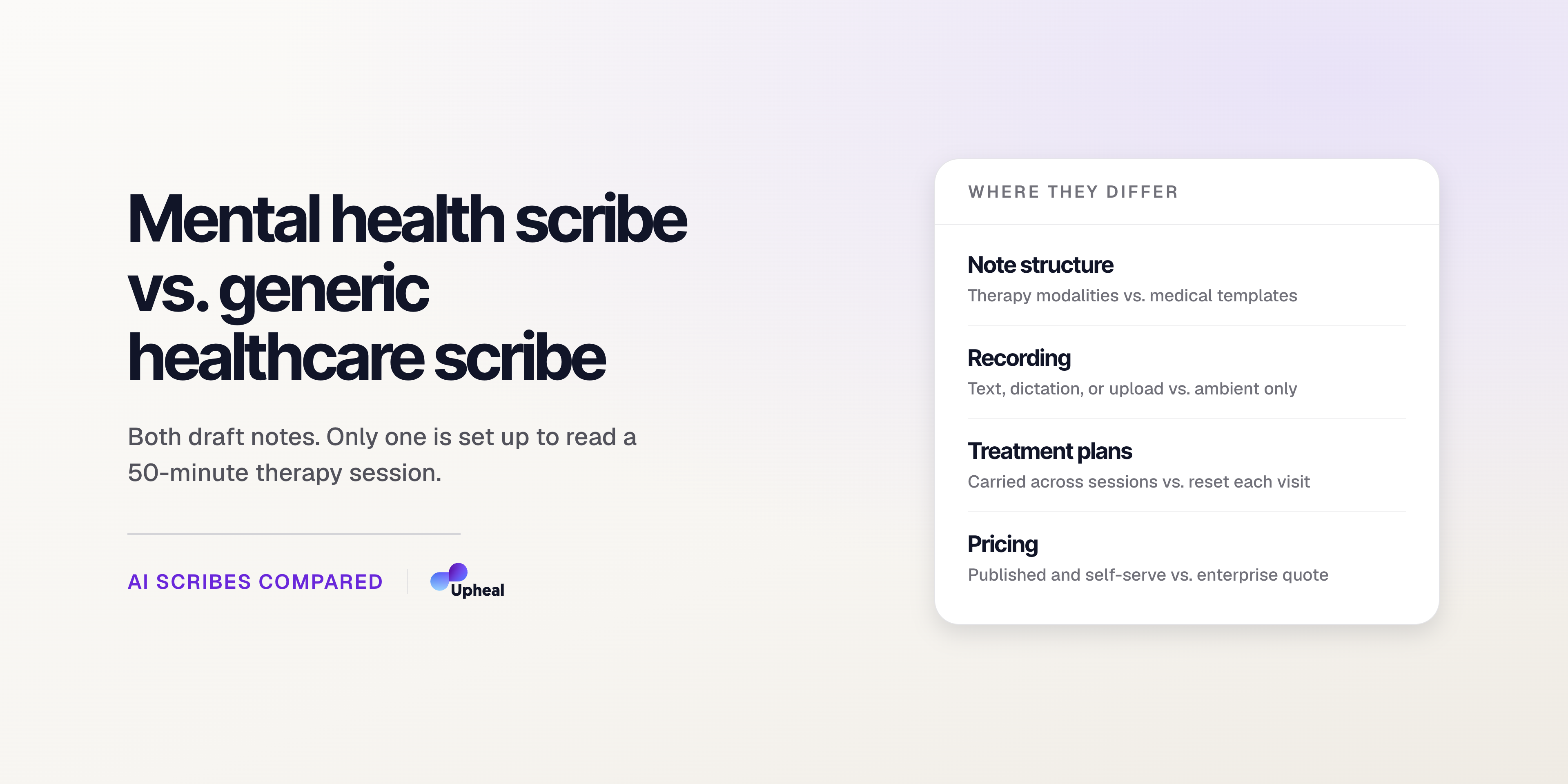
TL;DR: A mental health scribe is designed around a therapy session, things like CBT or EMDR structure, risk and safety language, and treatment plans that carry across sessions. A generic healthcare scribe like Abridge, Nabla, or Nuance DAX Copilot is designed around a medical encounter instead. Both transcribe and draft notes, but only one is set up to correctly read a 50-minute therapy session instead of a 15-minute physical.
If you search "healthcare scribe," most of what comes up is made for physicians, not therapists. That's not a strike against those tools. They were built for a different job, and the gap shows up in the clinical details, not just the marketing copy.
Each one is listening for something different
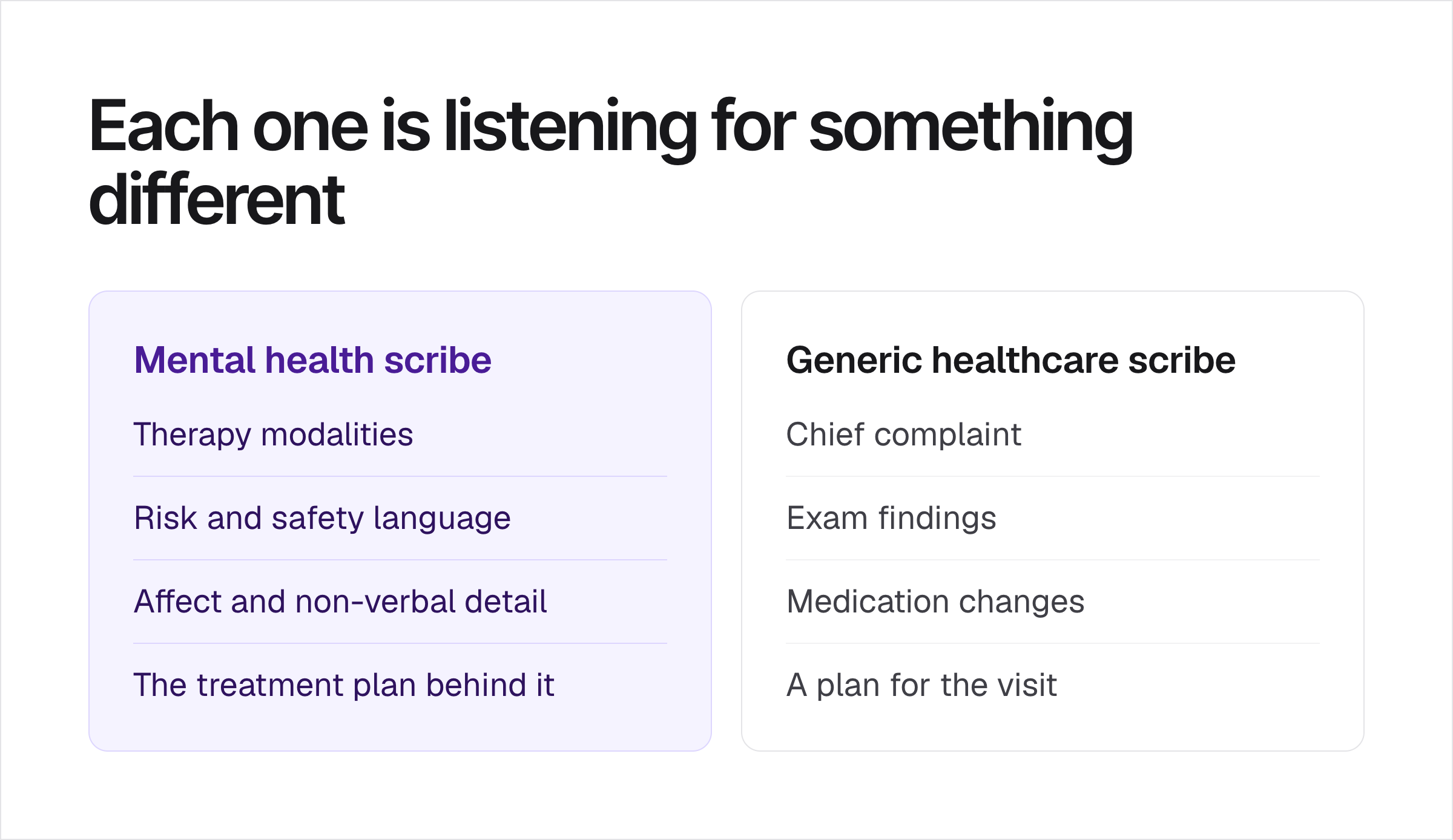
A generic healthcare scribe listens for the shape of a medical visit: chief complaint, exam findings, medication changes, a plan. A mental health scribe listens for the shape of a therapy session instead: modality-specific structure, risk and safety language, affect and non-verbal detail, and how this session connects to the last one and the treatment plan behind it.
Both categories run on ambient AI. Neither is more accurate than the other in any general sense. But a tool tuned for one kind of encounter will misread the other, structurally, every time.
The generic scribes: Abridge, Nabla, and Nuance DAX Copilot
These are the names that come up most when someone searches "healthcare scribe" or "AI medical scribe." All three were made for hospital systems and multi-specialty medical practices, not private-practice therapy.
Abridge runs across 55+ medical specialties inside large health systems, including primary care, cardiology, oncology, and emergency medicine. There's no self-serve pricing. Contracts are quote-based and negotiated at the health-system level, with third-party estimates commonly landing somewhere between $200 and $600+ per provider, per month, depending on the deal.
Nabla is an ambient medical scribe used across roughly 130 organizations. It needs real-time audio capture to generate a note, so if a client declines to be recorded, or a therapist would rather dictate after a session, it simply doesn't work. Nabla trains on session data by default, and the specifics live inside an enterprise agreement that isn't public, so a therapist evaluating it can't confirm what happens to a recording before signing up.
Nuance DAX Copilot is Microsoft's ambient documentation product, priced for enterprise health systems (reported list pricing has moved between roughly $600 and over $1,500 per user, per month, depending on plan and volume in 2026). Its ambient model is tuned for the pace of a procedural or primary care visit, and that tuning has a known failure mode in therapy settings: extended silence, which carries real clinical meaning in a session, gets misread as "end of encounter," and observational detail that was never spoken aloud gets dropped. In a therapy note, that's not a formatting quirk. Pauses, affect, and body language are often the exact thing a clinician needs on the page.
None of the three includes scheduling, billing, client records, or telehealth. They generate notes and hand you off to a separate EHR, so a therapist using one is running two systems that don't talk to each other.
The mental-health-specific scribes: Upheal, Freed, and Blueprint
Upheal, Freed, and Blueprint are shaped around a therapy session's clinical grammar, not a medical visit's.
That means modality-aware note structuring: SOAP, DAP, GIRP, BIRP, EMDR, and other therapy-specific formats, not a generic medical template. It means risk and safety language sits inside the note as a matter of course, not something bolted on after the fact. And it means treatment plans connect to every session note that follows, so progress is visible across a course of care instead of resetting every visit.
It also means recording flexibility. Not every client wants to be recorded, and not every therapist wants ambient audio running in the room. Upheal, for example, can generate notes from live capture, a text summary, dictation, or an uploaded recording, so documentation and a client's comfort aren't in conflict.
Category comparison
When a generic scribe is the right call
Sometimes it is. If you're in a large hospital or multi-specialty medical group where physicians and therapists share one documentation platform by design, ambient recording is already standard in the setting, and scheduling, billing, and telehealth are handled elsewhere, Abridge, Nabla, or DAX Copilot do exactly what they're supposed to.
When you need something built for therapy
If you're in private or group practice and documentation is only one piece of what you need a platform to do, a mental-health-specific scribe is the better fit. The notes already understand how therapy sessions are structured, the treatment plan carries forward instead of resetting, and with Upheal specifically, scheduling, billing, and telehealth live in the same platform as the notes.
Privacy carries just as much weight as clinical fit here. Explicit opt-in consent before any session data trains an AI model is a different standard entirely from a default-training policy hidden inside an enterprise contract you'll never see.
Frequently asked questions
Is a mental health scribe just a rebranded medical scribe?
No, the two are built on different note structures from the ground up. A mental health scribe includes modality-aware formats and treatment-plan continuity that a generic medical scribe was never designed to produce. Generic scribes follow the shape of a medical visit: exam findings, medication changes, a plan.
Can I use a generic healthcare scribe like Nabla or Abridge for therapy notes?
You can, but expect it to miss things a therapy-specific tool catches automatically, like modality formatting and treatment-plan continuity. Ambient models tuned for medical visit pacing also tend to misread extended silence or skip non-verbal detail that carries real clinical weight in a session.
Why don't generic healthcare scribes publish their pricing?
Because they sell almost exclusively through enterprise contracts with hospital systems, where pricing gets negotiated deal by deal rather than posted anywhere. Tools built for private practice, Upheal included, tend to publish self-serve pricing instead, since that's how their customers actually buy.
Do mental health scribes require ambient recording during sessions?
No. The better mental-health-specific platforms also work from text summaries, dictation, or an uploaded recording, not just live capture. Most generic healthcare scribes, by contrast, need ambient recording to function at all, which matters for clients who aren't comfortable being recorded.
What's the biggest privacy difference between the two categories?
Consent. The stronger mental-health-specific platforms require explicit opt-in from both therapist and client before any session data trains their AI. Several generic healthcare scribes train on data by default, under enterprise agreements that never see daylight. For sensitive clinical disclosures, that's not a small gap.