
How to bill insurance as a private practice therapist
Billing insurance as a private practice therapist means submitting the right CPT code, credentialing paperwork, and claim format to get reimbursed for sessions, and it's one of the few parts of running a practice where a small mistake can mean a denied claim or an audit flag months later. Whether you're paneling with your first insurer or trying to understand why claims keep bouncing back, the process comes down to five moving parts: codes, credentialing, claims, superbills, and follow-up.
TL;DR
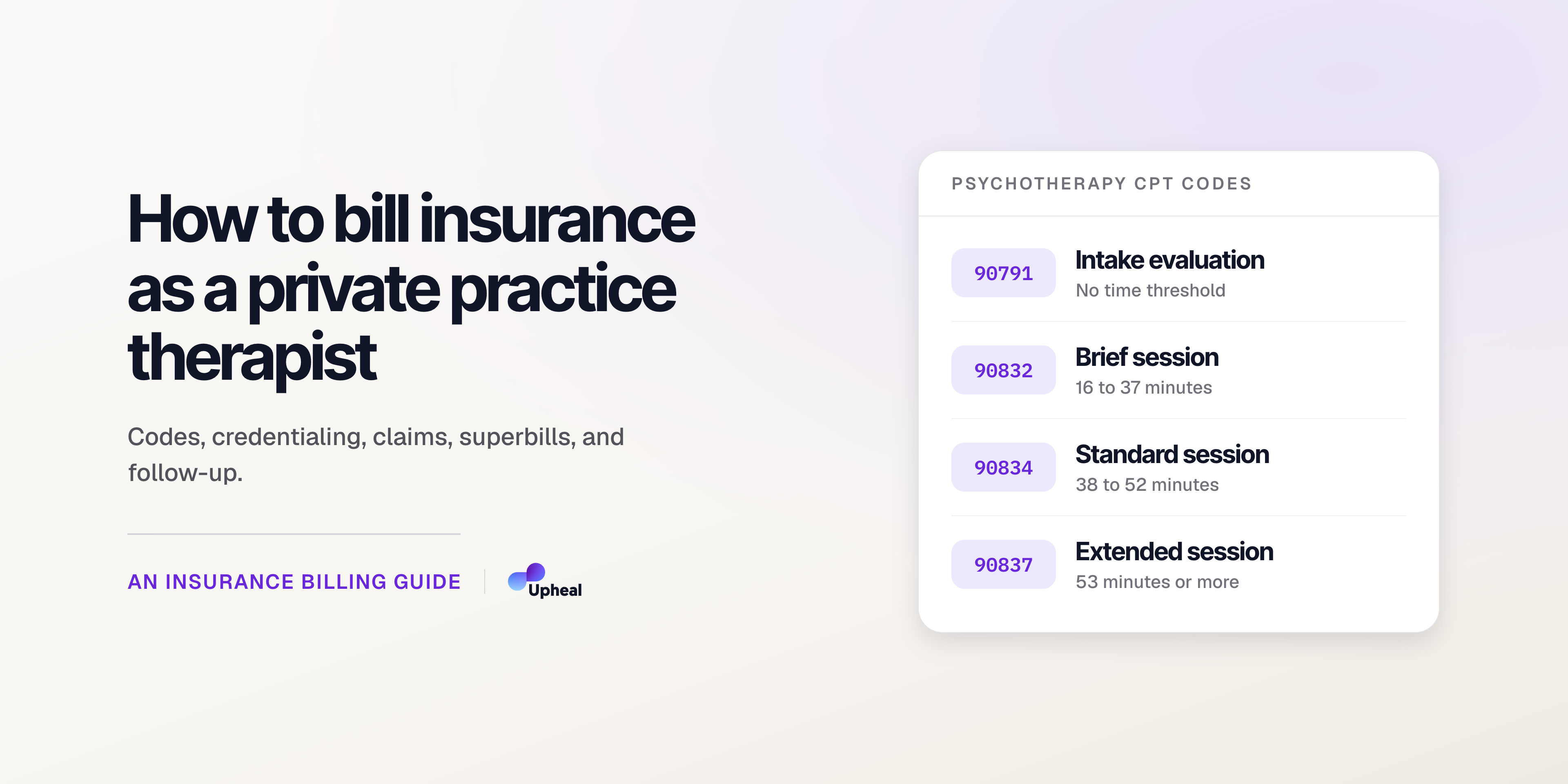
- Psychotherapy sessions are billed with CPT codes 90832, 90834, or 90837 depending on session length, with 90791 for the intake evaluation.
- You must be credentialed with an insurance panel before you can bill it directly; credentialing typically takes 60 to 120 days.
- A superbill is a detailed receipt a client submits for out-of-network reimbursement, different from a standard in-network claim you submit yourself.
- After you submit a claim, the insurer sends an Explanation of Benefits (EOB) showing what was paid, denied, or applied to a deductible.
- Most denials come from mismatched codes, missing modifiers, or credentialing lapses, not from the clinical content of the session.
How do you bill insurance as a private practice therapist?
Billing insurance as a private practice therapist means submitting a claim to the client's insurer using the correct CPT code, your credentialed provider information, and the client's coverage details, so the insurer reimburses you (or the client, for out-of-network benefits) for the session. The exact steps differ depending on whether you're in-network (credentialed with that specific panel) or out-of-network (the client submits a superbill themselves), but every claim requires the same core pieces: an accurate CPT code, a diagnosis code, your National Provider Identifier (NPI), and the date and length of service.
What are the CPT codes therapists use to bill insurance?
Psychotherapy sessions are billed using CPT codes 90832, 90834, and 90837, chosen based on session length, with 90791 used for the initial diagnostic evaluation. According to the American Psychological Association's coding guidance, the time thresholds are:
How do you become credentialed with an insurance panel?
Credentialing is the process of applying to an insurance panel so you can bill them directly as an in-network provider, and it typically takes 60 to 120 days from application to approval. The process usually involves submitting your license, NPI, malpractice insurance details, and practice information through the insurer's credentialing portal or CAQH, then waiting for a contract and effective date.
Until credentialing is complete, you cannot bill that panel directly. Many therapists see clients as out-of-network (using superbills) while credentialing is pending, then switch to direct in-network billing once approved.
What is a superbill and when do you use one?
A superbill is an itemized receipt you give a client so they can submit it to their own insurer for out-of-network reimbursement, and it's different from a standard claim because you're not submitting anything to the insurer yourself. A superbill typically includes your NPI, license information, the CPT and diagnosis codes, the date and length of service, and the fee charged.
Superbills are the right tool when you're not credentialed with a client's insurer, or when you've chosen to stay fully private-pay and let clients seek their own reimbursement. Keeping this documentation consistent and defensible matters just as much for superbills as it does for in-network claims, since clients may need to answer follow-up questions from their insurer. Upheal's documentation tools help keep session notes and billing details consistent, so the information on a superbill always lines up with what's in the clinical record. And for sessions where you are credentialed and in-network, that same platform now submits the claim itself, so the note that supports the bill and the bill itself live in one place.
What happens after you submit a claim?
After you submit a claim, the insurer processes it and returns an Explanation of Benefits (EOB) showing what was paid, what was denied, and what was applied to the client's deductible. If a claim is denied, the EOB should show a reason code, and most denials can be corrected and resubmitted rather than written off, as long as you catch the reason quickly.
Common denial reasons include a mismatched CPT and diagnosis code pairing, a missing or incorrect modifier, an expired authorization, or a lapse in your credentialing status with that panel. Tracking EOBs as they come in, rather than batching them monthly, makes it much easier to catch and fix a denial before it becomes a pattern.
Common insurance billing mistakes that trigger denials or audits
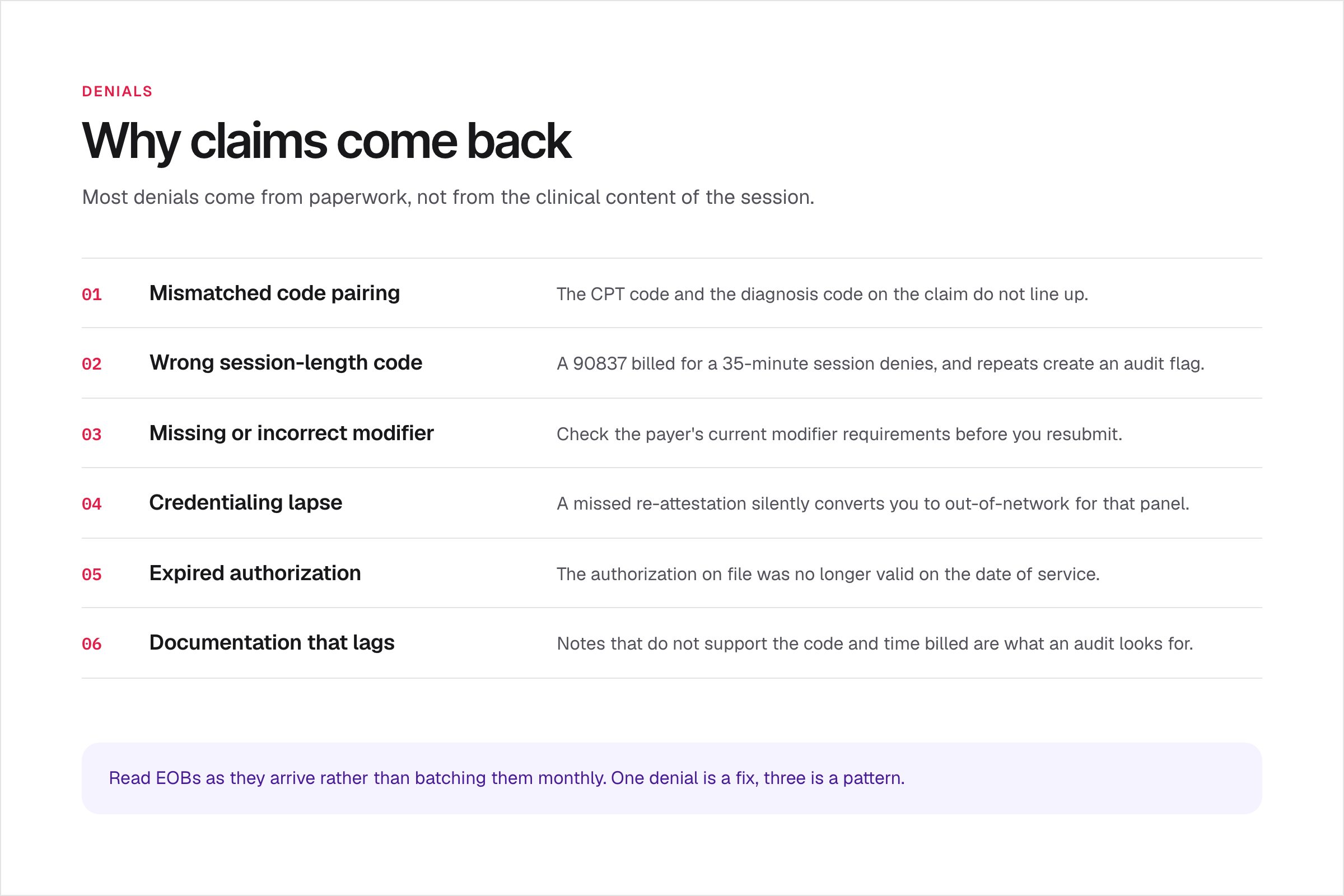
- Billing the wrong session-length code. A 90837 billed for a 35-minute session is a mismatch that both denies the claim and creates an audit flag if it happens repeatedly.
- Letting credentialing lapse. Panels periodically require re-attestation; missing this silently converts you to out-of-network for that panel.
- Inconsistent documentation. If your session notes don't support the CPT code and time billed, that's exactly what an audit is designed to catch.
- Ignoring EOBs. Denials that go unread and unresubmitted are lost revenue, not just an administrative annoyance.
FAQ
Do I need to be credentialed to bill insurance as a therapist?
Yes, you need to be credentialed with a specific insurance panel before you can submit claims directly to that insurer. Without credentialing, you can still see clients whose plans offer out-of-network benefits by providing them a superbill, but you cannot bill that panel directly as an in-network provider.
What is the difference between a superbill and a standard insurance claim?
A superbill is a receipt you give the client to submit themselves for out-of-network reimbursement, while a standard claim is submitted directly by you to an insurer you're credentialed with. Both require the same core information (CPT code, diagnosis code, NPI, and session details), but who submits it and who gets reimbursed differs.
How long does an insurance claim take to get reimbursed?
Most clean insurance claims are reimbursed within two to four weeks, though it varies by payer. Claims with errors, missing information, or credentialing issues take longer and often require resubmission, which is why catching mistakes early on the EOB matters.
The bigger picture
Insurance billing is one of the few places in private practice where a documentation gap becomes a financial gap. The codes, credentialing, and claims process are all learnable, but they only stay manageable if your session notes consistently support what you're billing.
Start free, no credit card required


![Best teletherapy platforms for therapists [2026]](https://cdn.prod.website-files.com/6328c07d72b05347cc236c49/68bb296e0a57158be728ee91_best%20teletherapy%20platform%20for%20therapists%20thumbnail.avif)