
AI therapy notes: how they work and what to look for
Every therapist knows the feeling. The session ends. The client leaves. And you have 16 minutes of documentation ahead of you before the next appointment. For a full caseload, that’s more than two hours a day spent on notes rather than on clients.
AI therapy notes exist to close that gap. This article explains what they are, how they actually work, what HIPAA compliance requires, and what to think about before choosing a tool. It is written for therapists who are curious but appropriately skeptical, about the benefits of AI therapy notes.
TL;DR
- AI therapy notes are automatically generated clinical session notes created from a recording or transcript of your session.
- The AI produces a structured note in your chosen format (SOAP, DAP, BIRP, and others). You review and sign it.
- HIPAA compliance depends on the vendor. Check for a BAA, SOC 2 Type II certification, and a clear data retention policy.
- AI notes do not replace clinical judgment. The therapist reviews, edits, and signs every note.
- Client consent is required before recording. Most good platforms include a consent workflow.
What are AI therapy notes?
AI therapy notes are clinical session notes generated automatically using artificial intelligence. They are not transcripts. A transcript is a word-for-word record of what was said. A therapy note is a structured clinical document that captures presenting issues, observations, interventions, and the plan going forward.
The AI listens to (or reads a transcript of) the session and produces a formatted note ready for therapist review. The output is in whatever clinical format the therapist uses: SOAP, DAP, BIRP, GIRP, PIRP, or others. The therapist reviews the draft, makes any edits, and signs it. That signed note becomes part of the client's clinical record.
What makes this different from a voice recorder or a transcription service is the clinical structuring. A voice recorder gives you audio. A transcription service gives you text. AI therapy notes give you a clinical document.
How do AI therapy notes actually work?
The process varies slightly by platform, but the core steps are consistent:
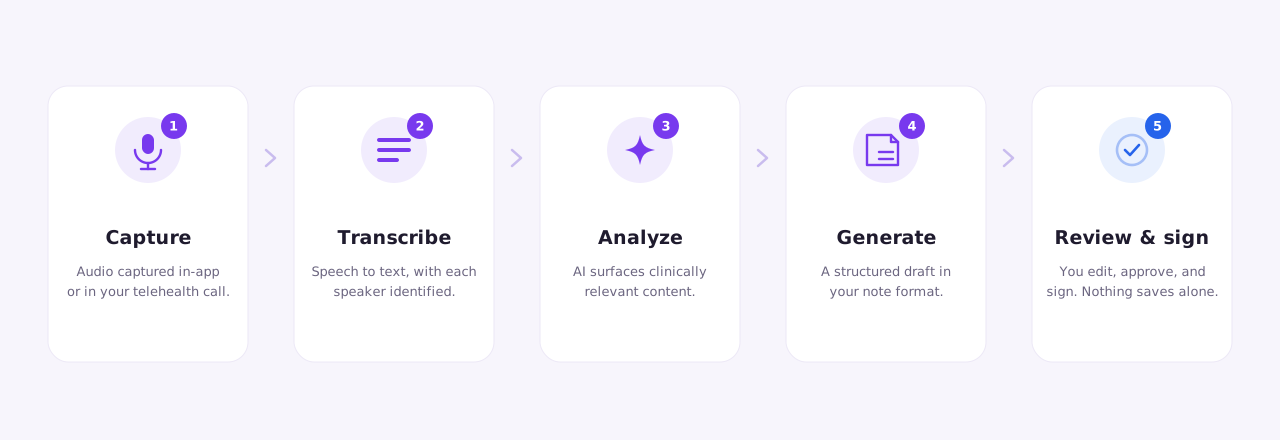
- Session capture. During or after the session, audio is captured via a mobile app, built-in telehealth, or an external platform like Zoom with a browser extension.
- Transcription. The AI converts the audio to text, identifying who is speaking: therapist vs. client.
- Clinical analysis. The AI identifies clinically relevant content: presenting issues, mood and affect observations, interventions used, client response, and progress toward treatment goals.
- Note generation. The AI produces a structured note in the therapist's chosen format, drawing on the clinical analysis and any existing client context (diagnosis, treatment goals, prior session notes, depending on the platform).
- Therapist review. The therapist reads the draft, edits anything that is inaccurate or incomplete, and signs the note. It then becomes the official session record.
No AI therapy note system creates a clinical record without human sign-off. Therapist review is not a formality. It’s the critical point.
Are AI therapy notes HIPAA compliant?
It depends on the vendor. HIPAA compliance isn’t a feature, but rather a set of requirements that a platform either meets or does not.
Before using any AI therapy notes tool, verify the following:
Business Associate Agreement (BAA). The vendor must sign a BAA before you share any protected health information with them. No BAA means no HIPAA compliance, regardless of what the marketing says.
SOC 2 Type II certification. This is an independent audit that verifies a company's security controls are functioning over a period of time, not just at a single point. SOC 2 Type II is the more meaningful certification.
Data retention policy. What happens to session recordings and transcripts after the note is generated? Some platforms delete recordings by default. Others retain them indefinitely. Know which one you are using before your first session.
Encryption. Session audio and clinical data should be encrypted both in transit and at rest.
AI training consent. Some platforms use session data to improve their AI models. This requires explicit opt-in. Check the privacy policy before you sign up.
Upheal is SOC 2 Type II certified, signs a BAA with every user, and requires explicit opt-in before any session data is used for AI training. Session recordings are deleted by default. See Upheal's privacy and compliance documentation for the full policy.
What should AI therapy notes include?
A good AI therapy note should read like a note you would write yourself, not a transcript summary. The clinical elements that need to be present are the same as in any progress note:
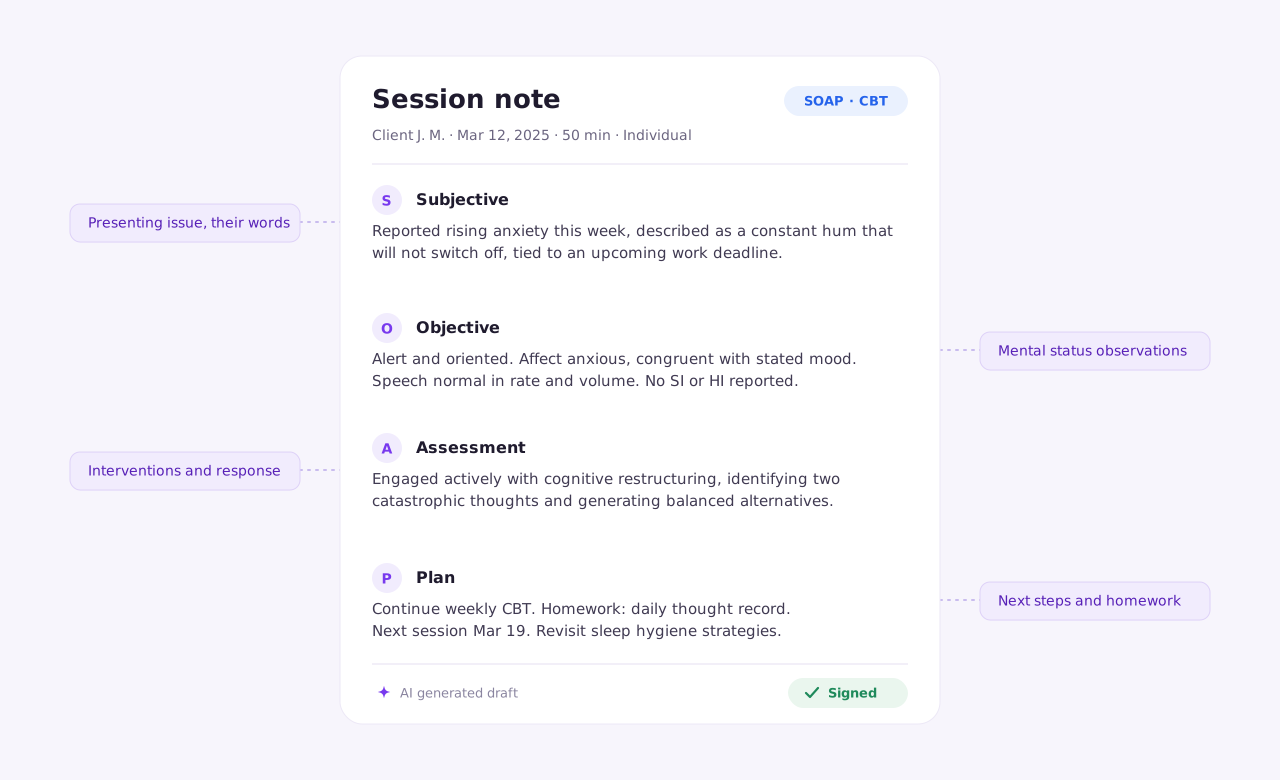
- Presenting issues. What the client brought to the session, in their language where possible.
- Mental status observations. Mood, affect, behavior, and cognitive functioning as clinically relevant.
- Interventions. What the therapist actually did: CBT techniques, EMDR processing, DBT skills practice, psychoeducation.
- Client response. How the client engaged with interventions. Specific and objective, not evaluative.
- Progress toward treatment goals. Where the client is relative to the goals in their treatment plan.
- Plan. Next steps, homework assigned, next appointment date, any safety concerns.
If the AI is producing vague or generic notes that could apply to any client, the tool is not useful. The note should be specific enough to be clinically meaningful and specific enough to hold up to an insurance audit.
In stronger platforms, the AI also connects notes to the client's treatment plan, flagging when goals have not moved or when documented interventions align with or diverge from the established approach.
See how Upheal generates session notes automatically
How do AI therapy notes compare to writing your own?
Time. Writing a therapy note from scratch takes most therapists 10 to 20 minutes per session. Reviewing and editing an AI-generated note takes 2 to 5 minutes. For a therapist seeing 25 clients a week, that’s two to three hours recovered every week.
Consistency. AI notes apply the same structure every time. Manually written notes vary in length, detail, and format depending on how tired you are at the end of the day. Consistency matters for insurance audits.
Clinical judgment. AI notes don’t replace clinical judgment. The AI does not know whether a particular client response was significant, what the silence at the 30-minute mark meant, or what the subtext was. One therapist said it this way: "I want to focus on you. When I am stressed about notes, I am not as present." AI notes address the documentation stress. What happens in the room remains the therapist's work.
Accuracy. AI notes are accurate at capturing what was said. They can miss what was not said. Therapists who use AI notes consistently report the same thing: the structure is usually right, the clinical framing sometimes needs editing. The tool handles the scaffolding. The therapist handles the meaning.
Upheal reduces documentation time from 16 minutes to under 5 minutes per session for most therapists.
How do therapists explain AI note-taking to clients?
Client AI consent is the concern that comes up most often before therapists start using AI notes. It is a real question worth preparing for, not a reason to avoid the technology.
Here’s a framework for the conversation:
When to bring it up. At intake, as part of your informed consent process. Not as a last-minute disclosure before the first session.
How to explain it. Something like: "I use an AI tool that helps me write my session notes. It listens to our session and produces a draft note that I review and edit before it becomes part of your record. Your recording is deleted after the note is generated. You can ask me not to record at any time."
What clients typically ask. Who has access to the recording? How long is it kept? Can they opt out? Have clear answers ready before the conversation.
Consent documentation. Use a written consent form that covers AI note-taking specifically. Upheal's practice forms include consent language for AI documentation.
Therapists who handle this well treat it the same way they treat any informed consent process: direct, clear, and in the client's interest. Most clients, when it is explained in plain language, do not object.
Frequently asked questions
Are AI therapy notes accurate?
Generally yes, with an important caveat. AI notes accurately capture what was said and structure it into clinical format. They are less reliable at clinical interpretation. The therapist reviews every note before it is signed. That review is not optional — it is the part that makes the note clinically valid.
Can AI replace a therapist's clinical judgment?
No. AI therapy notes handle transcription and structuring. Clinical judgment — the interpretation of what happened, the assessment of what it means, the plan for what comes next — remains the therapist's responsibility. Every note is reviewed and signed by the therapist before it enters the clinical record.
Do clients need to consent to AI note-taking?
Yes. If your AI note tool records sessions, clients must consent to the recording. This is both an ethical requirement and, in most states, a legal one. Build this into your intake and informed consent process.
How much do AI therapy notes cost?
Standalone AI note tools range from $15 to $150 per month. An EHR platform with AI notes built in, like Upheal, charge $1 per session capped at $69 per month, with AI notes included alongside scheduling, billing, telehealth, and the rest of the clinical workflow. If you are currently paying separately for an AI scribe and an EHR, an all-in-one platform is almost always less expensive.
Which AI therapy note tool is best?
The best tool produces clinically useful notes in your format, has verifiable HIPAA compliance (BAA plus SOC 2 Type II), gives you control over recordings and data, and integrates with your clinical workflow or replaces it. Upheal was built specifically for mental health practitioners, with AI notes connected to treatment plans, a compliance checker, and a full EHR in one platform.
The bottom line on AI therapy notes
AI therapy notes do not solve every problem in private practice. What they do is remove the part of documentation that is purely mechanical: the transcription, the structuring, the formatting. What remains is the part that requires clinical training: reviewing whether the note is accurate, adding interpretation where the AI missed the point, and signing off.
"It is not just a time-saving tool, it is a learning tool." That is what one Upheal user said about reviewing AI-generated notes of their own sessions. The documentation becomes a mirror.
If you are evaluating AI therapy notes, the checklist is short: verify HIPAA compliance, confirm client consent is part of the workflow, and check whether the AI connects to your clinical record or just produces standalone notes. That last difference matters more than any other feature on the spec sheet.