ICD-10 code for other recurrent depressive disorders

Recurrent depression affects millions of Americans each year, and not every case fits neatly into the standard diagnostic categories. Some clients keep coming back with depression that recurs but doesn't quite match major depressive disorder's usual criteria: atypical features, mixed symptoms, presentations shaped by culture or context. Getting the code right here isn't just a documentation exercise. It's what keeps the chart honest about what you're actually seeing.
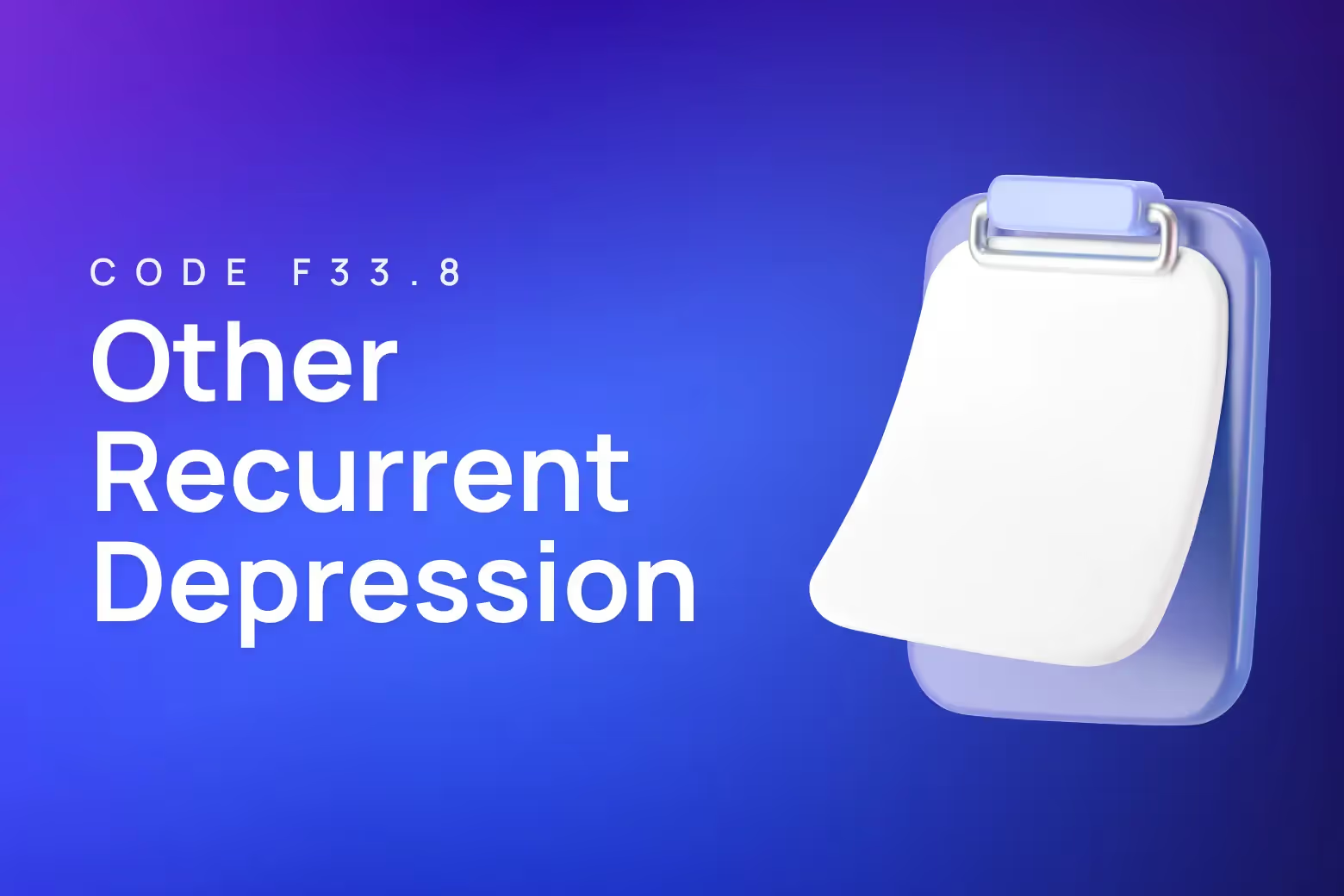
The ICD-10 code for other recurrent depressive disorders is F33.8. This diagnosis falls within the F30-F39 class for Mood [affective] disorders, alongside other well-known diagnoses such as Major Depressive Disorder and Bipolar Disorder.
F33.8 covers recurrent depressive conditions that don't meet criteria for the more commonly diagnosed recurrent depressive disorders, but are still clinically significant. Recurrence itself is common: studies indicate about 35% of people with depression experience it again within 15 years.
When to use ICD-10 code F33.8 for other recurrent depressive disorders
F33.8 is the right call when a client's depression keeps recurring but doesn't cleanly fit major depressive disorder's criteria: atypical presentations, mixed features, or culturally specific manifestations that show up again and again. The differential that actually matters here is knowing enough to characterize what you're seeing rather than defaulting to unspecified.
F33.8 only works as a code if the atypical features are actually in the note. Upheal captures them from the session so they don't get lost between the room and the chart.
F33.8 vs. related depressive disorder codes
Other ICD-10 codes for depressive disorders
- F32.8: Other depressive episodes
- F33.0: Major depressive disorder, recurrent, mild
- F33.1: Major depressive disorder, recurrent, moderate
- F33.2: Major depressive disorder, recurrent severe without psychotic features
- F33.3: Major depressive disorder, recurrent, severe with psychotic symptoms
- F33.40: Major depressive disorder, recurrent, in remission, unspecified
- F33.41: Major depressive disorder, recurrent, partial remission
- F33.42: Major depressive disorder, recurrent, full remission
- F33.9: Major depressive disorder, recurrent, unspecified
Interventions and CPT codes for other recurrent depressive disorders
Since F33.8 represents depression that falls outside standard categories, treatment plans often need to be more personalized to the specific symptoms actually present, not the textbook version of MDD.
Individual psychotherapy
Individual psychotherapy provides a safe, confidential space for patients to explore their depressive symptoms and develop coping strategies tailored to their specific presentation of depression.
- 90832: Psychotherapy, 30 minutes
- 90834: Psychotherapy, 45 minutes
- 90837: Psychotherapy, 60 minutes
Research has consistently demonstrated that psychotherapy, particularly cognitive-behavioral therapy, interpersonal therapy, and problem-solving therapy, are effective psychological treatments for depression.
Medication management
Medication management can be an essential component of treatment for recurrent depression, often used in conjunction with psychotherapy for moderate to severe cases.
- 90863: Pharmacologic management with psychotherapy
- 99213: Office/outpatient visit, established patient (15-29 minutes)’
- 99214: Office/outpatient visit, established patient (30-39 minutes)
Antidepressant medications, particularly selective serotonin reuptake inhibitors (SSRIs), can be effective for managing depression — though they should be used with caution and careful monitoring.
Crisis intervention
For acute exacerbations of symptoms, crisis intervention services may be necessary.
- 90839: Psychotherapy for crisis, first 60 minutes
- 90840: Psychotherapy for crisis, each additional 30 minutes
Supporting clients with other recurrent depressive disorders
Atypical, recurrent depression doesn't get less treatable just because it doesn't fit the standard boxes. The same evidence-based interventions apply, they just have to be tailored to whatever's actually showing up, mixed features, a culturally specific presentation, an episode pattern that doesn't match the MDD checklist.
Documentation carries more weight here than on a straightforward MDD case, since the code itself only means something if the atypical features are spelled out. The Golden Thread, connecting diagnosis, treatment plan, and progress notes into one coherent record, is what makes F33.8 hold up under review instead of reading like a shrug.
Frequently asked questions
What makes F33.8 different from F33.9?
F33.8 is for recurrent depression you understand well enough to characterize as atypical, mixed-feature, or otherwise outside standard criteria. F33.9 is reserved for cases where you don't yet have enough information for that level of specificity.
Can F33.8 apply after a single depressive episode?
No. F33.8 requires a recurrent pattern, multiple episodes over time. A single atypical episode is coded F32.8 instead.
What kind of presentations typically get coded F33.8?
Cases with atypical features, mixed depressive and other symptoms, or culturally specific presentations that recur but don't fit the standard major depressive disorder criteria.
Documenting an atypical depression presentation well means capturing the specific features that make it atypical, not just checking a box. Upheal drafts the note from your session, so that specificity comes from what actually happened, not from working backward from a code.