CAQH profile checklist for therapists: documents & setup
If you want to join commercial insurance panels, setting up your CAQH profile is often one of the first practical steps.
CAQH's Provider Data Portal gives participating health plans a central place to access much of the professional information they need during credentialing. Instead of re-entering the same license, education, work history, malpractice insurance, and practice information from scratch for every payer, you maintain it in one profile and authorize organizations to view it.
One important distinction before you start: CAQH does not credential you with insurance companies. It provides information payers can use during credentialing. You still need to apply to the insurance companies you want to join and complete any additional enrollment, contracting, or payer-specific requirements.
CAQH profile checklist, at a glance
Before you start: gather your individual Type 1 NPI, current state license information, malpractice or professional liability insurance documentation, education and training history, a complete work and practice history, practice addresses and contact information, tax and business information, other professional identifiers that apply to you, and disclosure information and supporting documents if needed.
In CAQH: create or activate your Provider Data Portal account, complete every applicable profile section, upload the documents your profile requires, review your information for consistency, authorize the appropriate organizations to access your profile, and complete Review & Attest.
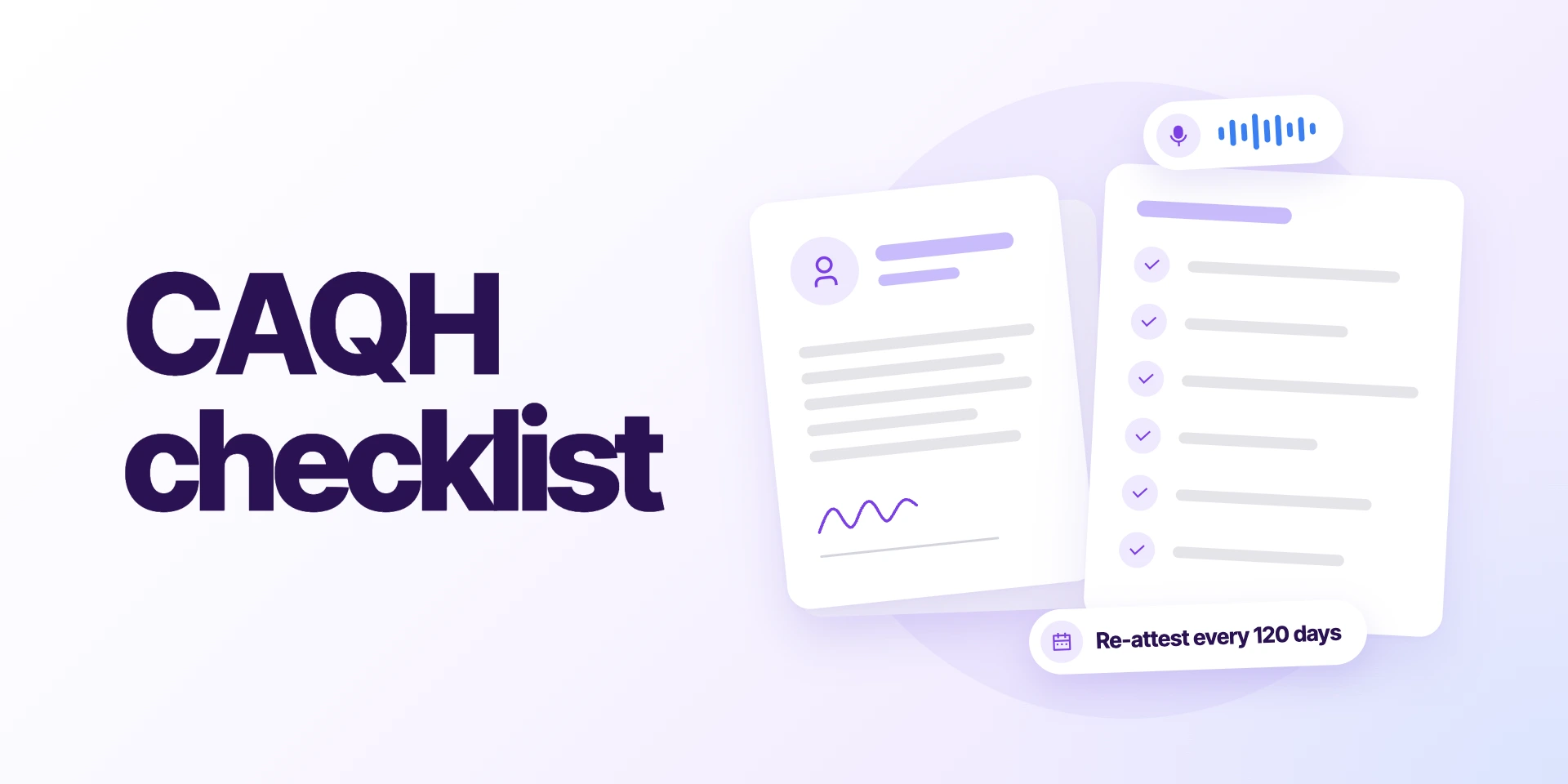
After setup: update CAQH whenever important information changes, re-attest at least every 120 days (or every 180 days if your primary practice state is Illinois), keep license and malpractice expiration dates on your calendar, and remember that CAQH maintenance and payer applications are separate tasks.
What is CAQH, and why do therapists need a profile?
CAQH operates the Provider Data Portal, a system widely used by health plans and other healthcare organizations to collect and maintain provider information. For therapists, a CAQH profile commonly becomes part of the commercial insurance credentialing process.
The profile can contain information about your:
- Professional identity
- NPI and other identifiers
- Licenses
- Education and training
- Work history
- Practice locations
- Specialties
- Professional liability insurance
- Hospital affiliations, when applicable
- Credentialing contacts
- Professional references
- Disclosure history
You maintain that information in one place and determine which participating organizations can access it. That can reduce duplicate data entry, but it does not eliminate payer-specific work. An insurer may still require a separate participation request, contract, supplemental forms, enrollment information, roster updates, or other steps before you become in network.
Documents checklist: what to gather before you start
Do this before opening the portal. Trying to complete CAQH while simultaneously hunting through old emails for license dates, insurance certificates, and employment history turns a manageable task into a frustrating one. For most therapists, start with:
Professional identifiers
- Individual Type 1 NPI
- CAQH Provider ID, if you already have one
- Medicare or Medicaid identifiers, if applicable
- Other professional or payer identifiers requested in your profile
If you own or bill through a group practice, also have the organization's Type 2 NPI, legal business name, tax information, and practice information available when relevant. Your individual CAQH profile centers on you as the practitioner, but group information may still matter to your payer enrollment.
Licenses
For each professional license you need to report, have:
- License type
- State
- License number
- Original issue date
- Expiration date
- Current status
If you practice in multiple states, make sure the information is complete for each jurisdiction that applies.
Professional liability insurance
Have your current malpractice or professional liability policy information ready, including:
- Carrier
- Policy number
- Effective date
- Expiration date
- Coverage limits
- Current policy documentation or face sheet
Check the expiration date before you upload it. If the policy is about to renew, expect to update the profile when the new policy period begins.
Education and training
Gather accurate information for your professional education and training, including, where applicable:
- Graduate institution
- Degree
- Field of study
- Graduation date
- Internship or other training information requested by CAQH
Use the institution's formal name and actual dates rather than approximating from memory.
Work and practice history
Have a complete professional history available, including:
- Employer or practice name
- Position
- Address
- Start and end dates
If CAQH asks you to explain a gap, answer accurately. Therapists' careers do not always fit neatly into a traditional medical credentialing timeline. Parental leave, contract work, associate practice, concurrent jobs, private practice transitions, or time away from clinical work can all be legitimate parts of a professional history. The goal is an accurate record, not an artificially uninterrupted one.
Practice information
Gather current information for the practice locations you need to report, such as:
- Practice name
- Street and mailing addresses
- Phone number
- Office hours
- Billing or credentialing contact information
- Whether you are accepting new patients, where requested
- Other location details requested by the portal
If you practice exclusively by telehealth, complete the location section according to your actual practice arrangement and the current CAQH instructions. Payers may also have their own requirements for virtual practices, so do not assume telehealth eliminates the need to provide practice-location information.
Other information that may apply
Depending on your credentials and profile, you may also need:
- Board certification information
- DEA or controlled-substance registration
- Hospital affiliations
- Professional references
- Credentialing contact information
- W-9 or tax information
- Supporting documents related to disclosure questions
Not every field applies to every therapist. Do not invent an answer simply because a medical credentialing form contains a section that is uncommon in outpatient behavioral health.
Step by step: setting up your CAQH profile
1. Create or activate your account
Start with the CAQH Provider Data Portal. If a participating organization has already identified you in CAQH, you may already have a CAQH Provider ID and need to activate an existing account rather than create a new record.
2. Complete the profile sections
Work through each applicable section until your information is complete. Use the documents you gathered rather than relying on memory, particularly for dates, license numbers, NPI information, addresses, employment history, and policy expiration dates.
3. Upload required supporting documents
The documents CAQH requires depend partly on the information in your profile. Use the portal's document section as the final authority for what your account still needs.
A simple file-naming system can make future updates easier. For example, Lastname_TX-License_Expires-06-2028.pdf or Lastname_Liability-Insurance_Expires-03-2027.pdf. The filename itself is not a credentialing requirement. It is simply a way to make your own maintenance easier.
4. Check for inconsistencies
Before attesting, compare your CAQH information with your other credentialing records. Pay particular attention to:
- Legal and professional name
- NPI
- License information
- Practice addresses
- Business or tax information
- Employment dates
- Malpractice coverage
Small inconsistencies can create additional questions when a payer reviews your file.
5. Authorize organizations to access your profile
CAQH lets providers control which healthcare organizations can access their data. Make sure the organizations credentialing you have the access they need.
But remember: authorizing a payer to view CAQH is not the same thing as applying to that payer. You still need to complete whatever participation process the insurer requires.
6. Review and attest
Before submitting your attestation, review the information CAQH shows you and correct anything that is inaccurate or outdated. Attestation is your confirmation that the information in the profile is complete and accurate to the best of your knowledge. That is the final step in completing the profile, and a step you will return to regularly.
How often do therapists need to re-attest CAQH?
CAQH currently requires providers to re-attest their information at least every 120 days. If your primary practice state is Illinois, the interval is 180 days.
At re-attestation:
- Review your profile.
- Update anything that changed.
- Replace outdated supporting documents when needed.
- Complete Review & Attest again.
Do not wait for the re-attestation date if something important changes before then. Update the profile when you:
- Renew or add a license
- Change practice locations
- Change malpractice carriers or renew coverage
- Change credentialing contacts
- Add or leave a group-practice affiliation
- Receive new professional identifiers
- Make other material changes to the information payers use
An overdue or outdated CAQH profile can interfere with credentialing or recredentialing when an authorized organization needs current provider information. Put the re-attestation deadline on your calendar rather than relying entirely on reminder emails.
CAQH profile vs. insurance credentialing
These are related, but they are not the same process.
| CAQH profile | Insurance credentialing | |
|---|---|---|
| What it does | Stores and shares provider information | Lets a payer evaluate whether to accept you into its network |
| Who manages it | You maintain one CAQH profile | Each payer manages its own process |
| Who decides the outcome | No network decision is made by CAQH | The insurance company |
| Does completion make you in network? | No | Credentialing is one part of becoming in network |
| Ongoing work | Updates and regular re-attestation | Recredentialing, contracting, enrollment, and payer updates |
This distinction matters because therapists sometimes complete CAQH and then wait for something to happen. Nothing necessarily will. Once CAQH is ready, you still need to apply to the payers you want to join.
CAQH for group practices
For a solo provider, CAQH maintenance is one profile. For a growing group practice, it becomes an operational process.
Each clinician has their own professional information and Type 1 NPI, while the practice may also have a Type 2 organizational NPI, tax ID, group contracts, multiple locations, credentialing contacts, and clinician-to-group enrollment requirements.
For each clinician, track at least:
- CAQH ID
- Last attestation date
- Next re-attestation due date
- License expiration
- Malpractice expiration
- Payers authorized in CAQH
- Payer applications in progress
- Credentialing status
- Contract or enrollment status
- Effective date
Do not reduce credentialing to a single status like "CAQH complete." A clinician can have a perfectly current CAQH profile and still be months away from being active with a particular payer.
Common CAQH mistakes therapists make
Assuming CAQH puts you on insurance panels
It does not. CAQH provides professional information to organizations you authorize. Each payer still has its own credentialing and contracting process.
Using the wrong NPI information
Your individual provider identifier is your Type 1 NPI. If you own or work through a group, the practice may also have a Type 2 NPI. Keep the individual and organizational identifiers straight when completing CAQH and payer enrollment.
Leaving work-history questions unresolved
If the portal asks for additional information about a period in your professional history, answer it rather than leaving the record incomplete.
Letting licenses or malpractice information become outdated
Do not wait until the next attestation if a time-sensitive credential changes. Update it when the change occurs.
Forgetting authorization settings
A complete CAQH profile is not useful to a payer that cannot access it. Check your authorization settings when you begin a new payer application.
Treating CAQH as a one-time task
The initial profile is only the beginning. CAQH becomes part of the ongoing credentialing maintenance of an insurance-based practice.
Frequently asked questions
What is a CAQH profile?
A CAQH profile is a centralized provider-data record used by participating healthcare organizations during credentialing and other provider-data processes. You maintain your professional information in CAQH and authorize appropriate organizations to access it.
Does completing CAQH mean I'm credentialed with insurance?
No. Completing CAQH gives authorized organizations access to your provider information. You still need to apply to each insurance company and complete its credentialing, contracting, and enrollment requirements.
What documents do therapists need for CAQH?
Commonly needed information includes your Type 1 NPI, professional licenses, malpractice insurance, education and training history, work history, practice locations, professional identifiers, and any supporting documents triggered by your profile. The CAQH portal itself is the final authority for which documents your particular account requires.
How often do I need to re-attest CAQH?
CAQH currently requires providers to re-attest at least every 120 days, or every 180 days if their primary practice state is Illinois. You should also update the profile whenever important professional or practice information changes.
Do I need a Type 2 NPI for CAQH?
An individual clinician uses a Type 1 NPI. A group practice or other healthcare organization may also have a Type 2 NPI. If you own or bill through an organization, you may need information from both as you complete credentialing and payer enrollment.
Do telehealth-only therapists need CAQH?
If a payer uses CAQH in its credentialing process, practicing by telehealth does not by itself eliminate that requirement. Complete your practice information according to your actual setup and the current CAQH instructions, and verify any additional virtual-practice requirements directly with the payer.
What happens after I finish CAQH?
Start or continue your applications with the insurance companies you want to join. CAQH gives them access to provider information. It does not automatically trigger an application or make you in network.
Where to start
The easiest way to complete CAQH is to do the organizational work before the data entry. Create one credentialing folder and put your NPI information, licenses, malpractice certificate, education history, employment history, practice information, business information, and other credentialing documents in it. Then complete the profile from those records.
Once CAQH is done, the sequence is: CAQH → payer applications → credentialing and contracting → confirmed effective date → insurance billing.
Once you are paneled, Upheal can handle the next part of that workflow: clinical documentation and insurance billing in the same EHR.
See how Upheal handles insurance billing
Last updated September 2026.