
The EHR that actually does the work: how Upheal Assistant replaces ChatGPT for therapists
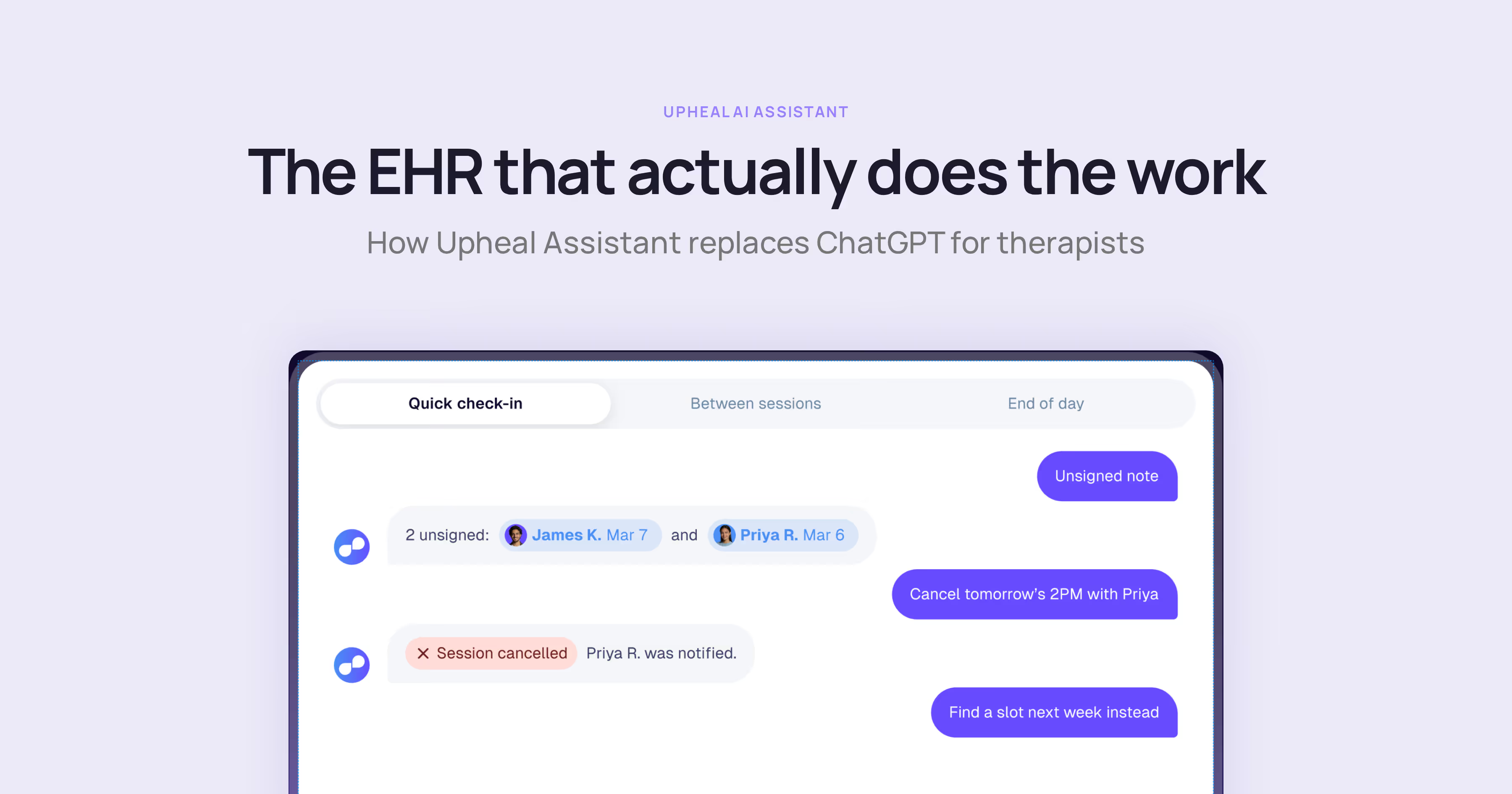
Upheal's AI Assistant is built into Upheal, the first AI-native EHR for mental health professionals. Upheal's AI assistant can draft notes, prep you for sessions, and answer questions about your caseload, working only with the practice data inside Upheal. It also acts on what it finds, scheduling appointments and drafting clinical correspondence inside the practice, so nothing has to be pasted into a separate tool, stripped of names, and copied back out.
That difference is the whole point of this page. Most therapists have tried the other version. Open a general-purpose AI tool, type out a clinical summary, remove the client's name, paste in the notes, get a reasonable response, copy it back into the EHR, reformat, move on. It works, sort of. It also asks you to maintain a second system, re-enter context every time, and do all the switching yourself. You didn't automate the work. You added a step.
Therapists don't want a smarter assistant. They want one that actually acts.
Last updated October 1, 2026.
What is the difference between an AI scribe and an AI assistant for therapists?
An AI scribe for therapists turns a session into a transcript and then into a progress note. An AI assistant for therapists does that too, but it also works across the rest of the practice: it reads the client's history, prepares the therapist for a session, drafts treatment plans and letters, manages the calendar, and answers questions about the caseload. A scribe ends when the note is signed. An assistant keeps working between sessions.
Upheal's AI Assistant is the second kind. The Assistant is free with limited monthly usage on every Upheal plan. Assistant Pro, $39 a month or included in the $99 plan, removes the monthly usage limit. Details are on the pricing page.
How much time do therapists spend on admin?
In the American Psychological Association's survey of psychology health service providers, respondents averaged 18.4 hours a week in direct client care and another 7.4 hours on administrative management. That is roughly two hours of administration for every five hours with clients, before evenings are counted. Source: APA Center for Workforce Studies.
Where the time goes is familiar to anyone running a caseload:
Session notes. Every session ends with a note that has to be clinically sound, survive an audit, and reference the treatment plan. Session notes are the single biggest driver of evening and weekend work for therapists.
Session prep. Before saying hello, the therapist reads back through the last note, recalls goals, checks for flags, and prepares an approach. Walk in cold and the client feels it.
Billing, scheduling, letters, and messages. Invoices, card follow-ups, superbills, the back-and-forth of finding a slot, the court letter that takes an afternoon of chart review, and the portal messages that eat every break. None of it requires clinical training. All of it uses the energy a therapist needs to show up for clients.
Why don't ChatGPT, Gemini, or Claude work for a therapy practice?
The most common workaround is a general-purpose tool like ChatGPT, Gemini, or Claude. These tools are capable, but for therapists they create three problems that prompting cannot fix.
Context. ChatGPT's memory feature remembers details across chats, but it is not a client record. Across 20 or 30 clients with goals, diagnoses, and ongoing themes, the therapist ends up re-explaining the caseload every time.
Compliance. The consumer versions of ChatGPT, Gemini, and Copilot are not covered by a Business Associate Agreement, which is what HIPAA requires before protected health information goes in. Anonymizing helps less than people think. Upheal wrote a full breakdown of whether ChatGPT is HIPAA compliant for the detail.
Workflow. Even a good output has to be carried back into the EHR by hand: copy, paste, reformat, re-enter. The friction doesn't disappear. It moves.
If you are still choosing a tool, Upheal's roundup of the best AI tools for mental health professionals covers the selection question. This page is about what happens when the AI lives inside the practice instead of beside it.
What admin tasks can a therapist hand off to Upheal's AI Assistant?
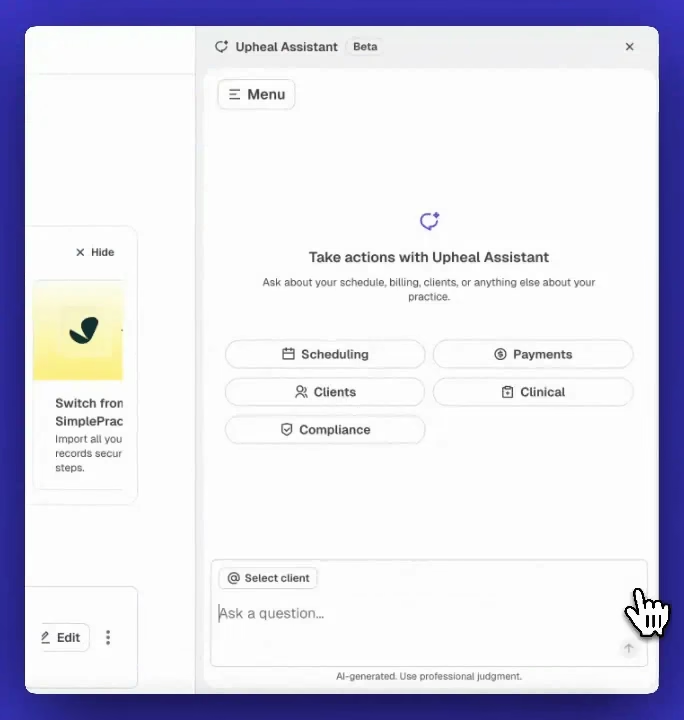
Upheal's AI Assistant has visibility into the practice's calendar, billing, invoices, client profiles, forms, session notes, and treatment plans, and can act in them when asked. The tasks a therapist can hand off today fall into seven groups.
Session prep. Ask the Assistant to prep your day and it pulls together who you're meeting, what's unsigned, what's waiting on billing, and any flags from recent sessions.
Scheduling. The Assistant schedules, reschedules, or cancels appointments without the therapist touching the calendar.
Billing. The Assistant creates, finalizes, and sends invoices, creates superbills for out-of-network clients, and identifies every client with an outstanding balance. Insurance billing is live too: check eligibility, submit claims, and match payments inside Upheal, at $0.30 per claim submission and $0.15 per eligibility check with no monthly billing fee. The Assistant can reach all of it.
Clinical correspondence. Ask for a referral letter and the Assistant pulls the client's history, diagnoses, treatment approach, and relevant notes, then drafts a complete letter in clinical tone. The same applies to discharge summaries, court letters, and progress updates. The therapist reviews, edits, and sends.
Chart lookup and clinical support. The Assistant looks up diagnoses, treatment areas, and contract details, searches across session transcripts and notes, audits a note for compliance before you sign it, and provides evidence-based clinical suggestions grounded in the client's history. Ask the Assistant about your caseload in your own words, including scheduling and attendance: which clients on a given day have missed consecutive sessions, for example.
Files, voice and the way you work. Attach a PDF, a photo, or a CSV, TXT, MD or JSON file and ask about it in the chat. Long documents, like a referral letter or an old assessment, are indexed and searchable, and answers can come back as tables and charts. Chart files imported from your previous EHR work the same way: ask about anything in a client's past records, or have the Assistant draft a treatment plan from them for you to review. With Assistant Pro, you can add a custom chart to Reports straight from the chat. You can speak to the Assistant instead of typing, including in the Upheal for Clinicians app. Skills hold your instructions for recurring tasks and are managed in Settings, and memory keeps workflow preferences and recurring topics between conversations. You can turn memory off in Settings.
Client communication. Upheal's Assistant drafts client messages from your session history and can send them on your approval. If you need to cancel a day or tell your next client you're running late, one message starts it: the Assistant drafts the notifications, cancels the sessions, writes the necessary notes, and prepares rescheduling links for you to approve.
See Upheal AI Assistant in action
What does Upheal's AI Assistant not do?
Upheal's AI Assistant does not make clinical decisions. It drafts, suggests, and acts on administrative tasks; diagnosis, treatment choices, and risk assessment remain with the therapist. Every document the Assistant produces is the therapist's to review, edit, and sign before it reaches a client, a payer, or a court.
Upheal's AI Assistant is not a general-purpose chatbot replacement. It works only with the practice data inside Upheal and any file you attach to the chat.
Upheal's AI Assistant does not run unprompted outside the routines you control. In chat it acts when asked, and the Billing wrap-up charges or invoices nothing until you tap to approve it.
Upheal's AI Assistant does not submit insurance claims on its own. Claims, eligibility checks, and payment matching live in Upheal's insurance billing workflow, which the Assistant can reach, but claim submission stays a deliberate step.
Upheal does not yet support group therapy as a documentation modality, where each member of a therapy group needs their own progress note alongside documentation of group dynamics. Couples, family and group telehealth are supported.
Is it safe to let an AI assistant schedule and communicate with therapy clients?
Yes, when the assistant runs inside a compliant EHR and the therapist approves what goes out. Upheal's Assistant drafts client messages from your session history and can send them on your approval; the therapist approves the message first.
Upheal is HIPAA, PHIPA, PIPEDA, GDPR, and DPA compliant, has completed a SOC 2 Type II audit, and is continuously externally tested. Upheal signs a BAA with every practice. Control status is published at trust.upheal.io.
Upheal does not use session data to train AI unless you and your client both choose it. Conversations with the Upheal Assistant are deleted after seven days of inactivity.
Because the Assistant lives inside Upheal, it already knows the clients' histories, treatment plans, session notes, and ongoing themes. The therapist never re-explains who they're asking about, and nothing is pasted into a tool that doesn't know the practice.
What can Upheal's AI Assistant do without being asked?
Custom Routines are tasks the Assistant runs in the background on a schedule. Write the instructions in your own words, pick a schedule such as every weekday around 9 AM, and the Assistant runs it in your profile’s timezone. Custom Routines live in the Assistant settings next to Skills, and any routine can also be run on demand.
Two routines come built in, and each can be switched off. Session Prep gets each session ready shortly before it starts. The Billing wrap-up checks every day what clients owe, what is overdue, which charges failed and which sessions are not invoiced yet, and posts a summary to Home and to a single Billing wrap-up thread. It knows whether a client attended, cancelled or didn’t show, so it won’t invoice a session that never happened. Tap “Yes, do that” and the Assistant applies the credit, charges the card on file or raises the invoice. The Billing wrap-up covers client payments only, not insurance, and is available to practices in the US and Canada that bill clients through Upheal.
The goal is the one Jeff Kashou, Upheal's Product Leader, put plainly when demonstrating the Assistant to early users: the therapist shouldn't spend their evenings doing paperwork. Everything being built is in service of that.
What changes for therapists when the admin lifts?
Upheal surveyed 996 of its own users across two independent waves eight months apart, and published the results in The Session Comes First: Mental Health Practice AI Impact Report 2026. Both groups ranked the benefits in the same order. Administrative load lifts first: 94% reported reduced cognitive burden from documentation. Capacity follows, with 90% saying the recovered time goes back into clinical work. Then presence, with nine in ten reporting they are more mentally present with clients. Then burnout, with 88% reporting it reduced. These are self-reported findings from active Upheal users.
The Assistant is the newest part of that picture. In a September 2026 survey of Upheal therapists who use the Assistant weekly, 63% said the time they spend on paperwork in a typical week had gone down, and about one in five said by three hours or more. Asked where that time goes, the most common answer was life outside work, ahead of seeing more clients. Three in four said they would be very disappointed if they could no longer use the Assistant.
Three of them described what that looks like. On session prep: "The last time I used it for session prep, the client was very happy that I remembered what we were talking about with details from the last session." On preparing quickly: "I get the general trends quickly and am ready to go." On billing: "I discovered that I had billed the wrong amount for a client over many sessions, and was dreading having to go into each session to correct that mistake. The Assistant did it for me in batches and it saved me hours!"
The admin burden doesn't just cost time. It costs energy, which is the one resource a therapist cannot run out of. Every hour spent on a compliance review at 9pm is an hour not spent recovering, reflecting, or preparing for tomorrow. Upheal exists to give that hour back.
Try Upheal free. Start free, no credit card required.
Frequently asked questions
What admin tasks can therapists realistically hand off to an AI assistant?
Session prep, scheduling and rescheduling, invoices and superbills, referral and discharge letters, and chart lookups across the caseload. Upheal's AI Assistant handles these on request, working only with the practice data inside Upheal. Clinical decisions, risk assessment, and final sign-off stay with the therapist.
Is it safe to let an AI assistant schedule and communicate with therapy clients?
Yes, when the assistant runs inside a compliant EHR and the therapist approves what goes out. Upheal's Assistant drafts client messages and sends them only on the therapist's approval. Upheal is HIPAA, PHIPA, PIPEDA, GDPR, and DPA compliant, has completed a SOC 2 Type II audit, and signs a BAA with every practice.
Is ChatGPT HIPAA compliant for use in my therapy practice?
The consumer version of ChatGPT is not covered by a Business Associate Agreement, so entering protected health information into it is not HIPAA compliant. Upheal's AI Assistant runs inside a HIPAA-compliant EHR, so client information never has to leave the practice's secure environment.
Does Upheal handle scheduling and billing, or is it only for clinical notes?
Upheal is a full AI-native EHR covering notes, treatment plans, scheduling, telehealth, client payments and insurance billing. AI notes are included in the $1 per session price, not sold as a separate add-on.
Does the Upheal Assistant keep my conversations?
Conversations with the Upheal Assistant are deleted after seven days of inactivity. Assistant conversations follow their own rule and are not session transcripts, which follow the practice's retention settings.


