Why we priced Upheal at AU$1.45 per session

You opened your EHR billing email and saw the number. You already paid it. It'll hit again next month, same amount, whether you used the tool or not.
The price increase and renewal goes through an auto-bill. The calendar keeps moving, and by Sunday night you're three chart notes behind and the charge cleared on Tuesday regardless. Meanwhile you pay for EHR, but you pay again for telehealth add-on, another for AI, and even more fees for payments.
So we settled on something simpler. You pay a AU$1.45 for every session Upheal processes, up to $100 a month. After that, the rest are on us.
Pricing should prove the promise
Every decent EHR makes a promise somewhere above the fold. Ours is simple: an EHR that does the work for you. When you finish a session, the note is written, the treatment plan reflects today, anything you need to sign off on is flagged, and the superbill is ready if you're billing insurance. By the time you close your laptop, the work that used to wait for you at 11pm is already done. That's what Upheal is for.
If that was the promise, the pricing had to match it. You should pay when the tool does real work for you. Not when you forget to cancel. Not when the seat is empty. Not when the AI add on renews quietly in the background while you're on the phone with a client.
We designed this pricing for solo therapists and small group practices, where a bad month isn't a line on a spreadsheet, it's your mortgage payment. The old EHR playbook pretended those months didn't happen. We wanted a model that admitted they do.
Before we ever touched the pricing page, we wrote that principle down. It ruled out most of the pricing models we knew.
Why tiered pricing was the first thing we ruled out
Most software pricing works like this: the features you actually need are in the tier above the one you can afford. So you pay for the bigger tier, along with everything else in it that you didn't ask for and won't use.
That's a reasonable model for a company selling project software to an ad agency. It's a bad model for a therapist.
In a solo practice, the EHR handles charting but the AI scribe is a separate AU$40 or more a month. Telehealth is sometimes included, sometimes not. Text reminders are extra. Insurance billing is either an add-on or a per-claim fee. You piece it together because every tool solved one thing, and together they're just expensive.
"Everything is a la carte and pieced together. You end up paying out the wazoo," one therapist told our sales team recently. She wasn't exaggerating. Then the base EHR goes up 63% in a single year. Another therapist in a demo last month said what everyone says eventually: "I'm really trying to get something more all-in-one."
Tiered pricing is how you end up here. It isn't a catastrophe. It's just built for the wrong shape of work.
Why pay per session was the honest answer
Here's the question we kept coming back to: what does Upheal actually do?
You finish a session. By the time you've walked back to your desk, the note is written, the treatment plan has caught up with what just happened in the room, and anything that needs your sign-off is flagged. If you're billing insurance, the superbill is waiting. If a client needs a follow up, there's a draft for you to read.
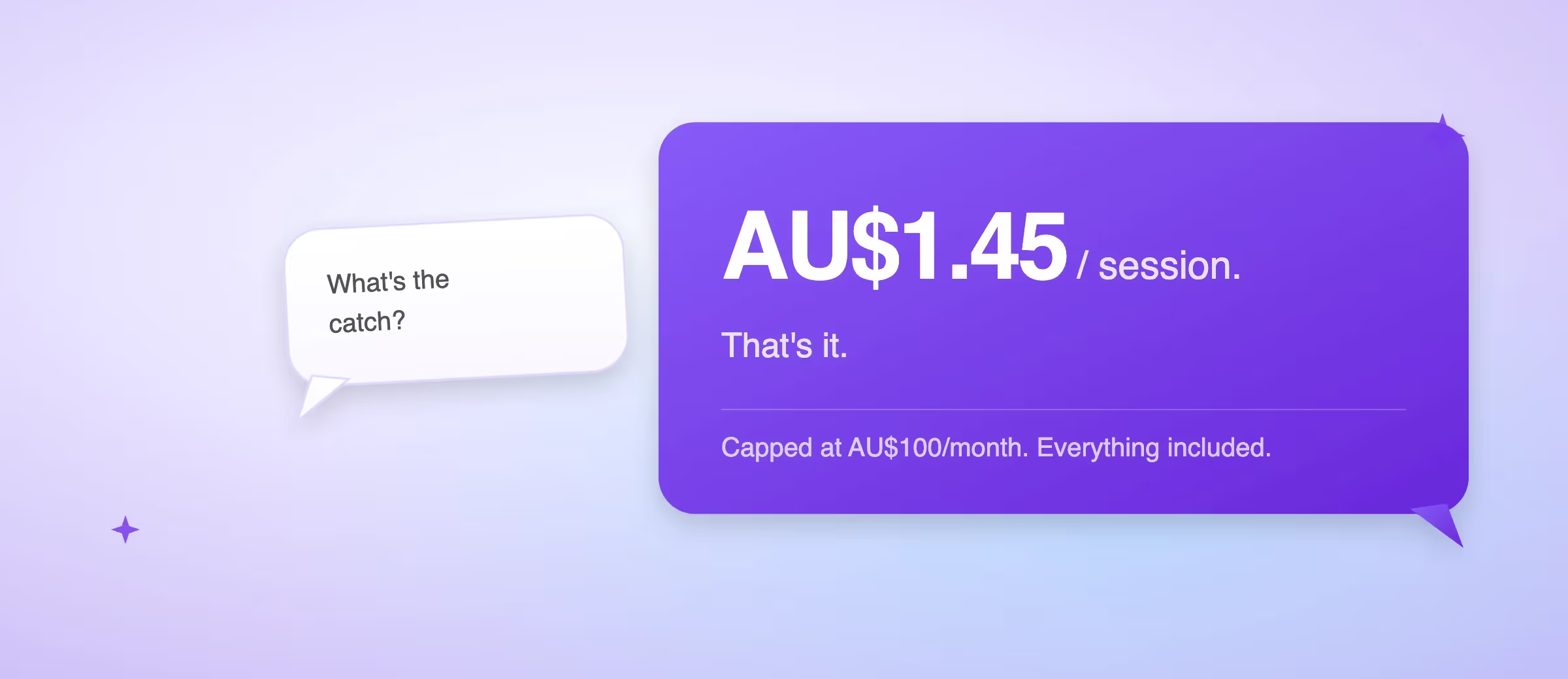
So: AU$1.45 per session. You see a client, Upheal processes the session, you owe us a dollar. You don't see a client, you don't owe us anything. You take a week off, the bill reflects it. You take a month off, the bill reflects that too. Most SaaS pricing isn't built to be explainable in a sentence.
Per session pricing has a second effect we liked: it puts our incentive on the same side of the table as yours. If Upheal gets better, more of your sessions run through it. If it doesn't, you notice and stop. We'd rather win that way than by making you forget you're subscribed.
Why there's a cap, and why it's AU$100
Per session pricing has one obvious flaw. If you see 90 sessions in a heavy month, it punishes you. Heavy caseloads aren't rare. They happen when a colleague goes on leave, when an insurance reimbursement makes you load up on paneled clients, when you're new to private practice and saying yes to everyone.
So we capped it. After AU$100 in any month, every session after that is free. You can run 70 sessions, 100 sessions, 150 sessions. The bill stays at AU$100.
That number isn't random. It's what a typical solo therapist pays for a legacy EHR alone: no AI, no scribe, no extras. We wanted the cap to sit exactly where you're already paying, so the comparison was honest. Same budget. Entire practice running on it.
If you're having a 20 session month, you pay AU$29. If you're having a 90 session month, you pay AU$100. The worst case scenario costs the same as the best case scenario for what you used to pay.
See the full pricing breakdown on our pricing page.
What's included, and what isn't
For AU$1.45 a session with a $100 ceiling, you get the entire operating system. Not a tier of it. All of it.
Included today:
- AI progress notes in your preferred format (SOAP, DAP, BIRP, GIRP, EMDR, psychotherapy, psychiatry, intake, and more), plus fully custom templates you can build with Smart Sections. All templates were created and tested by a team of clinicians, with regular feedback from customers.
- AI compliance checker that flags missing elements before you sign
- AI treatment plans that maintain the golden thread across your treatment, updating as the work in the room evolves
- Built-in AI Assistant that replaces ChatGPT for clinical and admin work, HIPAA-compliant and already loaded with your practice context so it can actually take things off your plate
- Scheduling, calendar sync, client reminders (and secure messaging, coming within weeks)
- Intake forms and custom forms
- Telehealth with encrypted video
- Client billing and payments
- Migration tools: AI-powered migration from SimplePractice and other EHRs, plus automated import of your existing note templates and forms as PDFs
Still coming:
- Insurance billing. We do superbills today. Full claim submission and ERA reconciliation are on the roadmap, not in the box yet. Explore our full roadmap here →
The reason we list what isn't included is because every therapist who's been burned by an EHR knows the real price is whatever you didn't read in the footnote. We'd rather tell you what we don't do than get an angry Reddit thread about it in six months.
The bet
Pricing is a bet. The company picks a number, and the customer decides whether it matches the value.
We picked AU$1.45 per session, $100 cap, everything included, because we think the honest answer to "what does Upheal do?" is measured in sessions, not seats. If we're wrong, you'll try us for a month and leave. If we're right, you'll stop paying four other companies and your 11pm isn't spent finishing notes anymore.
This isn't a pricing trick. There's no annual lock in. No minimum seats. No setup fee. The free plan doesn't expire. If you want to try Upheal for a month with two clients to see if the notes are any good, that's a reasonable way to evaluate us.
Let’s compare clinician pricing for a mental health EHR with an AI note taker, calendar syncing, and custom treatment plans.
Pricing that flexes with your practice
Say you start the spring off busy and strong with 100 sessions in April, you hit the cap and pay AU$100. And in July you take that two week vacation you’ve been planning for years, and only see 30 clients instead. You’ll pay just AU$43.50. There’s no calling to pause your account, no back-and-forth emails trying to get a prorated price. The bill just reflects what actually happened. You just held fewer sessions.
That flexibility matters for therapists. For the slow month after a client cohort wraps, the week you’re at a training, the month you’re easing back in after parental leave. Per seat EHRs charge you the same through all of it. Upheal doesn’t. At 50 sessions per month, Upheal is up to 50% cheaper than the stack it replaces. That’s the whole philosophy. Pay for what you use, hit the ceiling on a good month, and never get a bill that punishes you for having a busy, or slow, month.
Your practice deserves pricing that matches the work. Try Upheal free for 30 days →