
The EHR that actually does the work: how Upheal Assistant replaces ChatGPT for therapists
At some point in the last two years, many therapists have tried some version of the same thing.
Open a generic AI tool like ChatGPT or Claude, type out a clinical summary, carefully remove the client's name, paste in the notes, get a reasonable response, copy it back into the EHR, reformat, and move on to the next client.
It works, sort of. It saves some time. But standard ChatGPT is not HIPAA compliant, and that quiet anxiety about PHI data slipping through is not paranoia. It's a real risk. And even setting compliance aside, it asks you to maintain a second system, re-enter context from scratch every single time, and still do all the switching and clicking yourself.
You didn't automate the work, you just added another step.
This is the gap that almost no AI tool has actually closed for therapists: the distance between a tool that can help you think and a tool that can just do the work. After thousands of conversations with clinicians and years of building inside this problem, we're confident about one thing: therapists don't want a smarter assistant. They want one that actually acts.
Why therapist burnout starts with admin
Before we talk about the solution, let's look at the scale of the problem. Because most therapists accept it as normal, which means they've stopped questioning whether it has to be this way.
Our research, built from detailed analysis of how therapists actually spend their time, found that the average private practice clinician carries 20 to 45 hours of admin burden per week. At a conservative session rate of $120 per hour, that represents between $2,400 and $5,400 in potential session revenue lost to non-clinical work every single week.
Here's where that time actually goes:
Session notes alone consume 15 to 25 minutes per note, five to eight times a day. That's 9 to 18 hours per week spent on a single task, and that's before you factor in the compliance review that has to happen before you can sign and lock. Therapists describe it as "dread, resentment, guilt. The number one cause of evening and weekend work. A second unpaid job."
Session prep, the work you do before you even say hello to a client, costs another 2.5 to 5 hours per week. That's 5 to 10 minutes per client, every day, manually reading back through previous notes, recalling treatment goals, checking for flags, mentally preparing your approach. And that doesn’t include the emotional cost. "Anxiety about walking in cold. Guilt when you can't remember details. Pressure to look competent."
Billing and invoicing: 1.5 to 3 hours per week. Scheduling: 1 to 3 hours per week. Clinical letters: 30 to 90 minutes per week. Client communication: 2.5 to 5 hours per week. The list goes on.
None of these tasks require your clinical training. All of them use up the time and energy you need to show up fully for your clients.
When Upheal surveyed users about what changes when admin burden is removed, the results came back in three words: burnout, presence, and engagement. Less of the first, and more of the latter two.
Why generic AI tools don’t work for therapists
The most common workaround right now is to use a general-purpose AI tool like ChatGPT, Gemini, or Claude. The logic is understandable, and these tools are genuinely capable. But for therapists, they create three problems that no amount of clever prompting can fully solve.
Context. ChatGPT has a memory feature, but it was designed for personal preferences, not clinical caseloads. It stores roughly 1,500 words total across everything it knows about you. A single client's treatment history can exceed that. Across a full caseload of 20 or 30 clients, with treatment goals, session patterns, diagnoses, and ongoing themes, you'll hit the ceiling fast. And what gets remembered is decided by the tool, not by you. You're trusting an automated system to decide which clinical details matter.
Compliance. Standard versions of ChatGPT, Gemini, and Copilot are not HIPAA compliant, which means entering client information into them, even anonymized information, creates real risk. That worry isn't abstract. It follows you into sessions, into evenings, and into the back of your mind when you're trying to sleep.
Cost. A general-purpose AI subscription runs $20 a month or more. And that’s on top of everything else you're already paying for. And you get a tool that doesn't know your clients, wasn't built for clinical work, and requires you to manage the context yourself every single time. You're paying extra for a workaround.
Workflow. Even if you get a good output from a generic tool, you still have to go back to your EHR to use it: copy, paste, reformat, re-enter. The friction doesn't disappear, it just moves.
What therapists actually need is an AI that already knows their clients, lives inside their secure workflow, and can act within it rather than advising from outside it.
What Upheal’s AI Assistant can do for a therapy practice
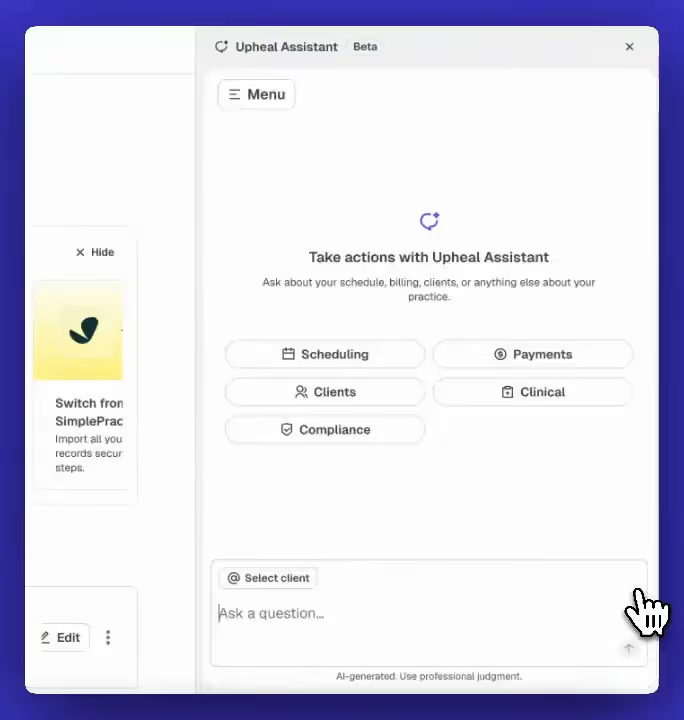
Upheal AI Assistant is a HIPAA-compliant AI assistant for therapists, built natively inside your Upheal practice. It already knows your clients, your schedule, your billing, your documentation, your treatment plans, and your session history, and now it can act on all of it.
Think of ChatGPT as a smart helper you have to brief from scratch every time you meet. Upheal’s AI Assistant already knows your practice, and it doesn't just answer questions. It acts.
AI Assistant reasons across your entire practice data, connects the dots between scheduling, billing, and documentation, and takes action on your behalf.
Starting the day prepared, not catching up
Type "prep me for my day" and the Assistant pulls together everything you need before you see your first client: who you're meeting, what's unsigned, what's waiting on billing, any flags from recent sessions. No more manually opening five client charts, scanning the last note, trying to remember the homework you assigned three weeks ago. You arrive at your first session focused rather than catching up.
Clearing the billing backlog
Ask about outstanding balances, tell it how far back to look, and the Assistant identifies every client who owes money and can send them a reminder. A task that used to take 30 minutes of cross-referencing and drafting individual messages happens in seconds, inside your secure environment, using the client data you've already entered.
Writing clinical correspondence
Request a referral letter for a client and the Assistant pulls their clinical history, diagnoses, treatment approach, and relevant session notes, then drafts a complete, professional letter in the tone and structure appropriate for clinical correspondence. You review it, adjust anything that needs adjusting, and send. A task that typically takes 30 to 90 minutes of chart review and drafting takes a few minutes. The same applies to discharge summaries, court letters, clinical progress updates, and any other formal documentation your practice requires.
Handling the unexpected
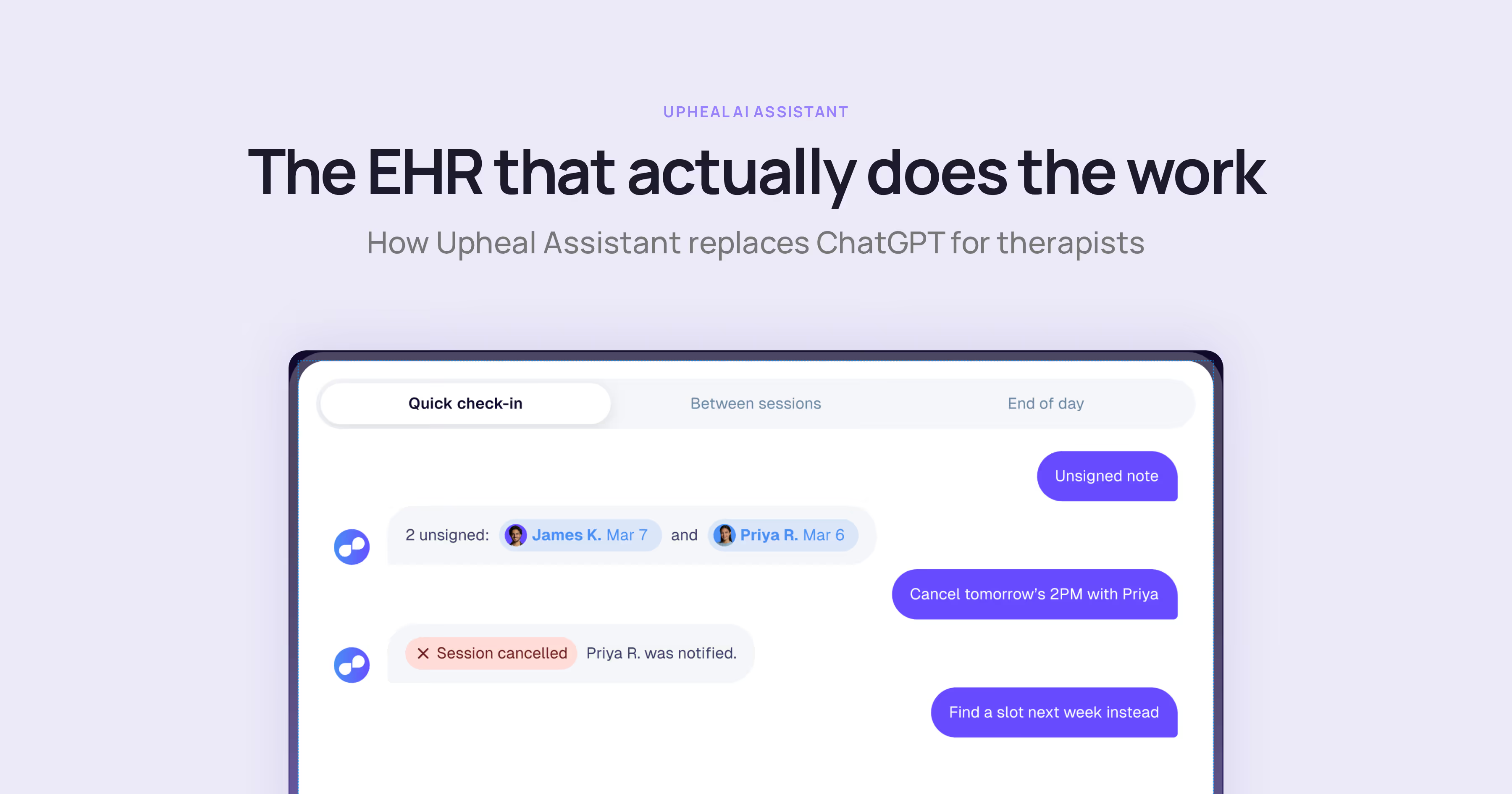
If you need to cancel your day or let your next client know you're running late, a single message takes care of it. The Assistant notifies your clients, cancels sessions in the system, writes the necessary notes, and sends rescheduling links. The kind of crisis logistics that used to mean interrupting a session, frantically texting clients, and burning 30 minutes on admin collapses into a few seconds.
Staying on top of your caseload
Ask which clients haven't been scheduled and the Assistant identifies recently seen clients without a next appointment and can send them a booking link or outreach message. It can also analyze session gaps, cancellation patterns, and engagement signals to flag clients who may be at risk of disengaging, before they've already drifted away.
The workflows Upheal’s AI Assistant handles today
The Assistant has full visibility into your calendar, billing, invoices, client profiles, forms, session notes, and treatment plans. It can take action in any of those areas at your request.
This is just some of what it can do. What it will do is still being discovered. If you have a specific workflow or a use case we haven't listed, try it. The Assistant tends to handle more than people expect.
- Schedule, reschedule, or cancel appointments, without touching the calendar manually
- Create, finalize, and send invoices, or create superbills for insurance reimbursement
- Draft referral letters, clinical correspondence, and other documents
- Send forms or reminders to clients
- Look up client diagnoses, treatment areas, and contract details
- Search across session transcripts and notes
- Provide evidence-based clinical suggestions grounded in your client's history and clinical research
- Identify clients with outstanding balances and trigger follow-up
- Audit notes for compliance before billing
- Flag clients who haven't been scheduled or who show signs of disengagement
- Generate discharge summaries pulling directly from session notes
See Upheal AI Assistant in action
What makes Upheal’s AI Assistant safe for clinical use?
It's worth being explicit about the foundation that makes all of this possible, and trustworthy.
HIPAA, GDPR, and PHIPA compliant on every plan. The Assistant runs inside your secure Upheal environment. Your client data never leaves that environment, never passes through an unsecured third party, and is never used to train AI models without your explicit consent.
Full clinical context, every time. Because the Assistant lives inside Upheal, it already knows your clients' histories, treatment plans, session notes, and ongoing themes. You never have to re-explain who you're asking about. The cognitive setup work that consumes so much time with generic tools simply doesn't exist.
Designed to support, not replace, clinical judgment. The Assistant drafts, suggests, and acts on administrative tasks. Clinical decisions remain yours. Every document it produces is yours to review, edit, and sign off on. It is a capable, informed colleague, not a replacement for the therapist.
What's coming to Upheal’s AI Assistant
The current release is the foundation. What the team is building toward goes deeper into the operational complexity of running a practice.
That means deeper practice management capabilities like insurance billing and claims workflows. Recurring tasks that run in the background without you triggering them, like checking payment status every Friday and drafting a follow-up to any client with an outstanding balance, automatically. A smoother experience when you are taking multiple actions in a single conversation, so the Assistant feels less like a tool you operate and more like a workflow that just moves.
The goal is the same one Jeff Kashou, Upheal's Product Leader, put plainly when demonstrating the Assistant to early users: the therapist shouldn't have to spend their evenings doing paperwork. Everything being built is in service of that.
Getting back to why you became a therapist
When Upheal surveyed users about the impact of removing admin burden from their practice, the themes that emerged were consistent: more presence with clients, less resentment toward the work, and a renewed sense of engagement with the clinical practice they chose.
The admin burden doesn't just cost time, it costs energy, which is the one resource a therapist cannot afford to run out of. Every hour spent on a compliance review at 9pm is an hour not spent recovering, reflecting, or preparing for tomorrow's sessions. It compounds over time and sits among the most cited drivers of therapist burnout, which also makes it one of the most solvable.
The shift Upheal AI Assistant represents is not about AI for its own sake. It is about giving therapists back the resource the current model systematically drains: their time, their evenings, and their energy for the work that actually matters. Mental health professionals need their energy more than most. Upheal exists to give it back.


