
Mentalyc vs Upheal: AI documentation tool vs mental health EHR
Mentalyc and Upheal are both built for therapists. That's where most of the similarity ends.
Mentalyc is an AI documentation platform. It records sessions, generates notes, and stores client records with session history, safety plan documentation, and session analytics. Their Alliance Genie feature tracks therapeutic alliance over time — a genuine differentiator for therapists who want that kind of clinical insight. What it doesn't have: scheduling, billing, telehealth, or a client portal. Mentalyc explicitly positions itself as a layer that works alongside your existing EHR — their own navigation has a dedicated "Mentalyc & EHR" page. Plans are capped at 40–330 notes per month.
Upheal is an AI-native EHR. Notes connect to treatment plans and the client's full clinical history. The compliance checker audits documentation before you sign. The AI assistant handles scheduling, billing, and the administrative work between sessions. If you're using Mentalyc alongside a separate EHR, Upheal replaces both.
Mentalyc vs Upheal at a glance
Input flexibility and session capture
Upheal offers flexible options for session capturing through their integrated video platform, in-person or virtual sessions, text and dictation features, and manual uploads. The platform integrates with all EHR and telehealth solutions while creating detailed session analytics and insights, with support for individual, couples, and family therapy formats.
Mentalyc offers dictation, text input, file uploads, and session recording options. This flexibility allows therapists to adapt the tool to their existing workflows without requiring significant changes to their practice setup.
AI documentation
Both platforms understand therapy-specific note formats, like SOAP, DAP, BIRP, EMDR, and others. Both offer customizable templates. Mentalyc has a broad template library covering many modalities.
The key differences:
Notes and treatment plans
Upheal's Golden Thread auto-links every session note to treatment goals, creating a continuous clinical narrative from assessment through discharge. Goals connect to interventions, interventions connect to progress notes. The documentation tells a coherent story of care rather than a series of isolated entries.
Note customization
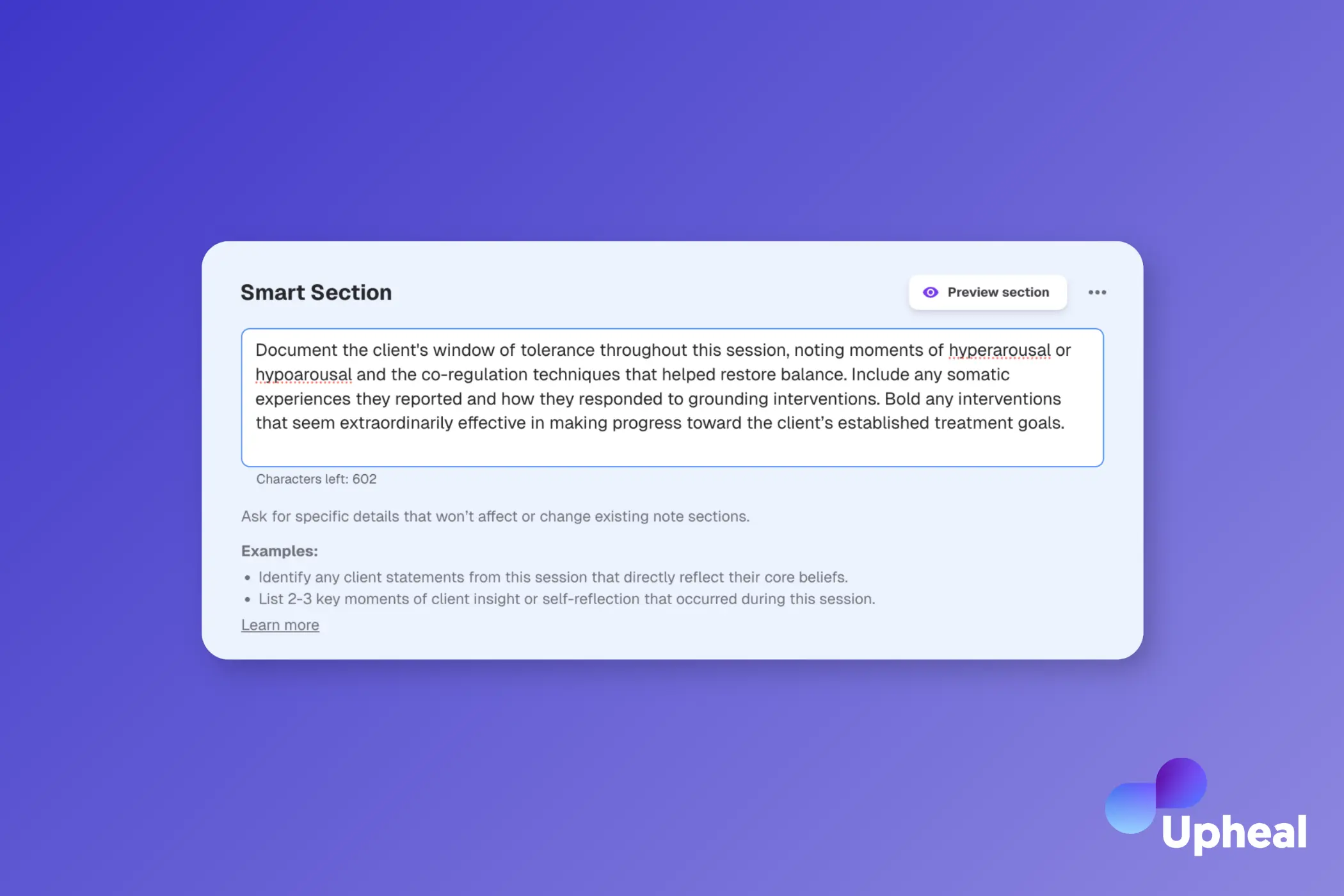
Upheal's Smart Sections let you build custom AI-powered sections using your own prompts at the section level. Write an instruction like "always capture the DBT skill practiced and the client's response" or "flag any mention of avoidance behaviors in this section" and the AI follows it every time. Mentalyc offers a broad template library you can choose from. The difference is direction: Mentalyc gives you structure to pick from, Upheal lets you define what the AI captures.

The result is a customized template that always writes in the clinician’s preferred style and format.
Compliance checking
Upheal audits notes against Aetna and Optum standards before you sign. Mentalyc has no equivalent.
The AI assistant is where the gap is widest. Upheal's AI assistant handles scheduling, billing, admin, and clinical documents between sessions. Mentalyc handles documentation. That's it.
Analytics and treatment planning
Upheal distinguishes itself with advanced session analytics, offering therapists detailed insights into client interactions, session patterns, and progress tracking through their "Golden Thread" feature that links interventions to treatment plans.
Mentalyc includes their Alliance Ginie™ analytics system, which focuses on therapeutic alliance measurement and provides treatment plan generation, though with less emphasis on deep session analytics. xMentalyc’s analytics do not currently work with group, couples, or family sessions.
Privacy and ethics: The critical differentiator
The most significant distinction between these platforms lies in their approach to data privacy and client consent—areas where therapists rightly have the highest concerns.
Where Upheal goes further
The AI assistant
Mentalyc handles documentation. Upheal's AI assistant handles documentation plus the work that builds up around it. Before your next client, it pulls their history, open goals, and what hasn't shifted. It drafts discharge summaries, referral letters, and client messages from the actual clinical record. Between sessions it handles scheduling changes, billing admin, and anything you'd otherwise spend your evening on. Mentalyc doesn't do any of this.
The full EHR scope
Mentalyc is explicit about this on their own website: it's designed to work alongside your existing EHR. That means a second subscription, a second login, and two systems that don't share data. Upheal is the EHR. Scheduling, billing, telehealth, client portal, intake forms with AI import, and AI notes all in one platform.
Note caps
Every Mentalyc plan has a monthly limit: 40 notes on Mini, 100 on Basic, 160 on Pro, 330 on Super. A therapist seeing 25 clients a week reaches 100 sessions a month — that's the Basic cap. Upheal's paid plan includes unlimited notes regardless of caseload size.
Pricing
Mentalyc plans range from $14.99/month (Mini, 40 notes, billed annually) to $99.99/month (Super, 330 notes, billed annually). Monthly billing is higher: $19.99–119.99/month. Add a separate EHR for scheduling and billing at $49-99/month and total practice cost climbs quickly.
Upheal is CA$1/session capped at CA$69/month, with unlimited notes, scheduling, billing, treatment plans, compliance checking, and client messaging all included. A lighter caseload pays less.
Insurance billing is coming soon. If that's part of your practice, now is a good time to get started on the free plan and be ready when it goes live.
What therapists think about Upheal and Mentalyc
The conversation among mental health professionals reveals nuanced perspectives about both platforms, with privacy concerns and note quality consistently at the forefront.
“I randomly checked some of my Mentalyc notes from last month and found multiple sessions where it said my client said things that I actually said 😨. Like straight up wrong speaker attribution. […] Now I’m spiraling about every note I’ve submitted. One transcription had ‘anxious about work’ as ‘anxious about worth’ which is completely different clinically.” via Reddit
Cost concerns also emerge frequently in discussions, with therapists split on being able to justify the cost of a more premium product.
“Upheal is more expensive than some other similar programs but it's well worth the money. I paid for a year's subscription for Mentalyc but couldn't figure out how to use it even after spending 45 minutes with a team who tried to help me.” - Lisa Talcott
Is Mentalyc right for private practice therapists?
Choose Mentalyc if:
- You want a mental health-specific documentation tool and are comfortable keeping a separate EHR
- Session analytics and therapeutic alliance tracking are central to your practice
- You see fewer than 100 sessions a month and the note caps aren't a constraint
- You're not looking to change your practice management setup
Choose Upheal if:
- You want AI documentation and a complete EHR in one platform
- You want notes that connect to treatment goals and prior clinical history
- You want a compliance checker that catches documentation gaps before the payer does
- You want unlimited notes regardless of caseload
- You want to stop paying for two systems that don't share data
Mentalyc at $15-100/month plus a separate EHR at $49-99/month puts you at $64-199/month for two systems that don't share data. Upheal is CA$69/month for notes and the EHR. It replaces both—and the notes don't stop at 330.
Frequently asked questions
Is Mentalyc an EHR?
Not quite. Mentalyc has client records, treatment plans, progress tracking, and session analytics. It’s more than a basic notes tool, but it has no scheduling, billing, or telehealth, and explicitly positions itself as working alongside your existing EHR. Upheal is a full EHR that replaces both Mentalyc and whatever practice management system you're currently using.
How does Mentalyc pricing compare to Upheal?
Mentalyc plans range from $14.99/month (Mini, 40 notes) to $99.99/month (Super, 330 notes) billed annually. Upheal is CA$1/session capped at CA$69/month with unlimited notes, scheduling, billing, treatment plans, compliance checking, and telehealth included.
Does Mentalyc integrate with EHRs?
Yes. Mentalyc is designed to work alongside your existing EHR — their website has a dedicated "Mentalyc & EHR" section. Notes are generated in Mentalyc and copied into your EHR manually or via their integration tools. Upheal is a full EHR, so there's nothing to copy into — the notes, records, billing, and scheduling all live in the same platform.
Can Upheal replace Mentalyc and my current EHR?
Yes. Upheal covers AI session notes, treatment planning, scheduling, billing, intake forms, telehealth, and client records in one platform.