
What are therapy session insights? A therapist's guide
Therapy session insights are AI-generated measurements and patterns pulled from a therapy session, things like talking ratio, cadence, and sentiment, tracked along a timeline of the session itself. They're built to show you what happened in a session at a glance, without you having to re-listen to it or rely on memory alone.
TL;DR
- Therapy session insights are AI-generated measurements pulled from a session: talking ratio, cadence, sentiment, and a timeline view of how the session unfolded
- They're separate from the progress note itself; insights show patterns, the note documents clinical content
- They're most useful for self-supervision and spotting patterns across sessions that are hard to catch in the moment
- They don't replace clinical supervision or your own clinical judgment
- Upheal generates session insights automatically alongside your AI note, as part of the $1-per-session Premium plan (capped at $69/month)
What's actually measured in a session insights report?
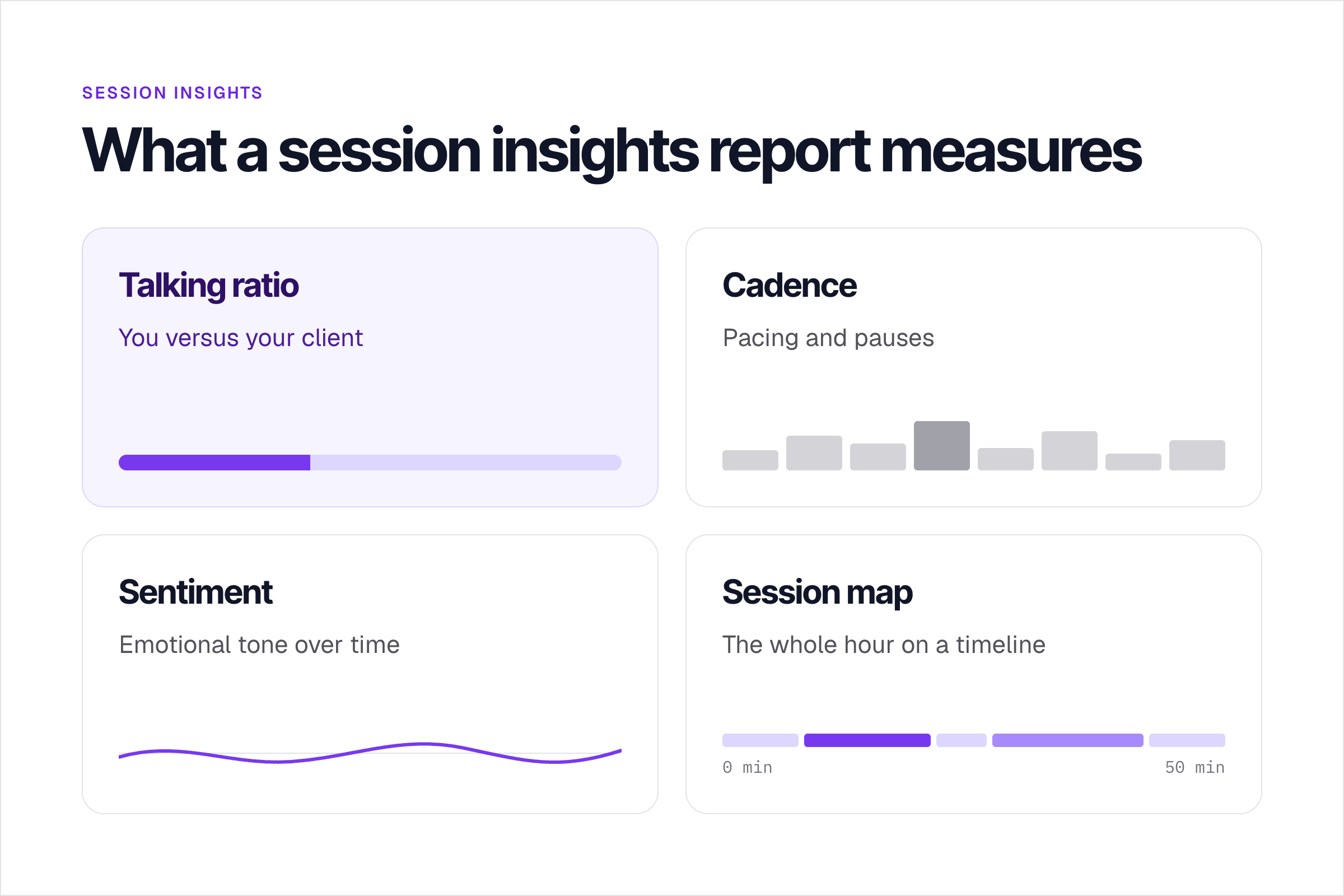
A session insights report typically measures a handful of concrete signals pulled directly from the session recording or transcript: talking ratio (how much you spoke versus your client), cadence (pacing and pauses), sentiment (emotional tone over time), and a session map that lays these out along the session's actual timeline.
None of this replaces the clinical content of the session. It's a layer on top: a way to see the shape of a session, not just what was said in it.
See Upheal's session analytics in action
Why should therapists care about session insights?
Session insights matter because they surface patterns that are genuinely hard to notice while you're the one running the session. You can't watch your own talking ratio in real time while you're also tracking clinical content, managing rapport, and thinking three steps ahead.
A few concrete uses:
- Self-supervision. Noticing that you talked more than usual in a session where a client seemed disengaged, without needing a supervisor to flag it.
- Pattern-spotting across sessions. A sentiment dip that shows up at the same point in session after session might point to a recurring topic worth naming directly.
- Treatment plan alignment. If a client's engagement consistently drops during a specific type of intervention, that's useful information for adjusting the plan.
Session insights are a supplement to clinical judgment, not a substitute for it. They tell you what happened, they don't tell you what it means
How AI generates session insights
AI processes the session's audio or transcript and extracts measurable signals: who spoke when, for how long, at what pace, and with what emotional tone, based on vocal and linguistic patterns. That data gets organized into a timeline so you can see how the session moved, not just a single end-of-session score.
This is pattern detection, not interpretation. The AI doesn't diagnose a session or tell you what a talking-ratio spike means clinically; it shows you the pattern and leaves the reading of it to you.
How to use session insights in practice
- Check insights after sessions that felt off. If a session felt harder to read than usual, the data can confirm or challenge your instinct.
- Look for patterns across sessions, not just one. A single unusual talking ratio means little. The same pattern across five sessions with the same client means more.
- Bring notable patterns into supervision. Session insights give you something concrete to discuss, rather than a vague sense that "something felt different."
- Don't over-index on any one metric. A high talking ratio isn't automatically a problem; context (a psychoeducation-heavy session, for instance) matters more than the number itself.
Frequently asked questions
Are session insights the same as a session note?
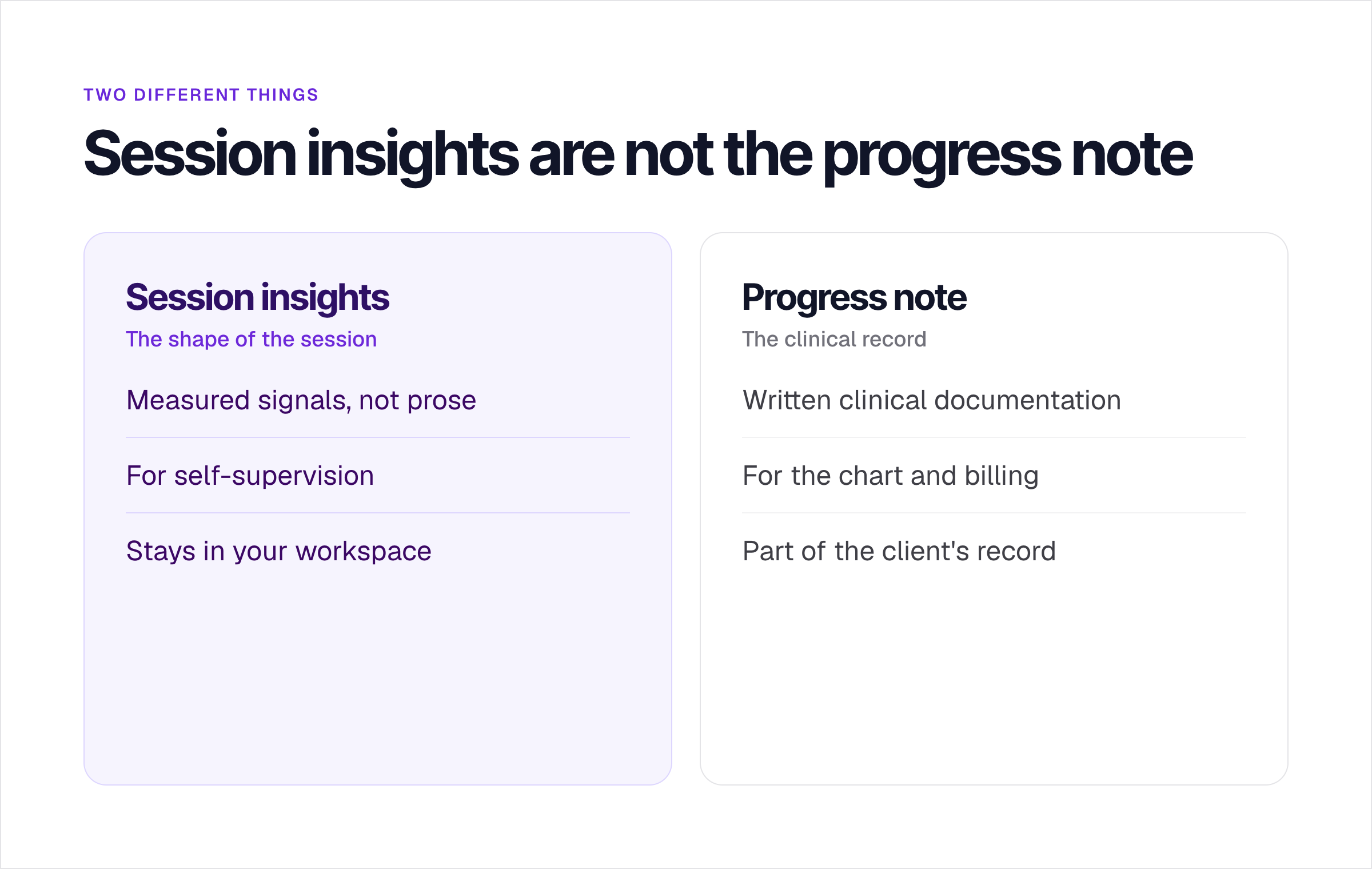
No. A session note documents the clinical content of the session: what was discussed, assessed, and planned. Session insights are a separate layer of measurements, like talking ratio and sentiment, that show the shape of the session rather than its clinical content.
Can clients see their own session insights?
That depends on the platform and your own sharing settings. On Upheal, insights are part of the clinician's workspace by default; whether to share any of it with a client is a clinical judgment call, not something the platform decides for you.
Do session insights replace clinical supervision?
No. Session insights surface patterns worth discussing, but interpreting what those patterns mean clinically is still the role of supervision and your own clinical judgment.
Is session insight data used to train AI models?
Not without explicit permission. On Upheal, sessions are never used to train the underlying AI without consent from you and your client, per Upheal's privacy and compliance policy. Check any platform's specific data policy directly, since practices vary.
The bigger picture
Session insights won't tell you how to be a better therapist. What they do is make visible a few things that are otherwise invisible in the moment: how much space you took up, how the emotional tone of a session moved, whether a pattern is a one-off or a trend. That's a small, useful addition to the clinical judgment you already bring into the room.