
Mental status exam: a therapist's guide
TL;DR
- A mental status exam (MSE) is a structured clinical observation of a client's psychological state at the time of the encounter
- The MSE covers nine domains: appearance, behavior, speech, mood, affect, thought process and content, cognition, insight, and judgment
- Mood and affect are documented separately: mood is what the client reports, affect is what you observe
- Perceptual disturbances (hallucinations, derealization) are documented within thought process and content
- The mini mental status exam (MMSE) is a separate, standardized cognitive screening tool, not the same as an MSE
- Upheal generates MSE notes automatically from session recordings
A mental status exam is a structured clinical assessment that documents a client's psychological state at the time of the encounter. It gives therapists a consistent, reproducible format for observing and recording how a client is presenting: their emotional state, thought patterns, and cognitive functioning.
The mental status exam is used at intake, discharge, crisis assessment, and any time the clinical picture shifts significantly. Because it captures a snapshot in time rather than a cumulative score, it is an effective tool for tracking change across sessions and communicating clearly with other providers.
This guide covers what the MSE includes, how to conduct one during a therapy session, and how to document it accurately in clinical notes.
What is a mental status exam?
A mental status exam (MSE) is a clinical tool used to observe and document a client's current mental and emotional state. It’s not a standardized test like the PHQ-9 or GAD-7. Instead, it is a structured clinical observation: a systematic way of recording what the therapist notices during a session about the client's presentation, mood, thinking, and behavior.
The MSE is not administered as a separate interview. It runs continuously alongside a standard therapy session as the clinician observes and notes findings throughout the encounter.
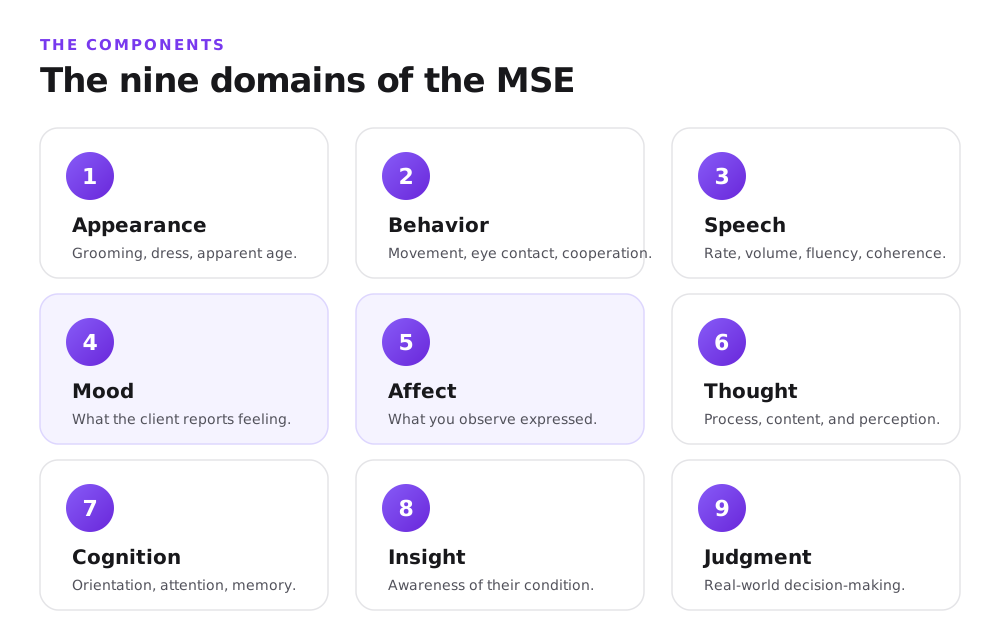
The nine core domains of the MSE are: appearance, behavior and psychomotor activity, speech, mood, affect, thought process and content, cognition, insight, and judgment. You may see other sources list anywhere from 8 to 13 components depending on how granularly they separate paired domains — the framework here matches Upheal's MSE template and reflects how most outpatient clinicians document in practice.
The components of a mental status exam
Appearance
Appearance captures how the client presents physically: grooming, hygiene, dress, and whether apparent age matches chronological age. Clinicians note whether a client appears disheveled, well-groomed, or dressed in a way that is unusual for the context. Significant changes from one session to the next can indicate clinical deterioration or improvement.
Example documentation: Client appeared well-groomed and appropriately dressed for the weather. Appeared stated age.
Behavior and psychomotor activity
Behavior covers observable movement and activity during the session: restlessness, pacing, psychomotor agitation (increased motor activity), or psychomotor retardation (slowed movement and reduced activity). Eye contact, posture, and the client's level of cooperation with the interview are also noted here.
Example documentation: Client maintained intermittent eye contact. Mildly restless, shifting position frequently throughout the session. Cooperative.
Speech
Speech is documented in terms of rate (fast, slow, normal), volume (soft, loud, normal), fluency, and coherence. Pressured speech, which is rapid and difficult to interrupt, is associated with elevated mood states. Poverty of speech, characterized by very little output and long latencies before responding, may indicate depression or psychosis.
Example documentation: Speech was normal rate and volume, spontaneous, and goal-directed.
Mood
Mood is the client's subjective description of their emotional state, reported in their own words. Documenting mood in the client's exact phrasing is more clinically precise than paraphrasing: "stressed and a little hopeless" tells the next clinician more than "dysphoric."
Example documentation: Client reported mood as "stressed and a little hopeless."
Affect
Affect is the therapist's objective observation of the client's emotional expression during the session. It is described along four dimensions: range (full, restricted, blunted, flat), intensity (normal, elevated, diminished), quality (euthymic, dysphoric, euphoric, anxious, irritable), and congruence with the client's reported mood. Mood and affect may or may not align: a client can report feeling "fine" while presenting with flat, restricted affect.
Example documentation: Affect was constricted and dysphoric, congruent with reported mood.
Thought process and content
Thought process describes the organization and flow of the client's thinking. Common descriptors include: logical, goal-directed, circumstantial (tangentially connected but eventually returns to the point), tangential (departs from the topic and does not return), loose associations (connections between ideas that do not follow logical sequence), and flight of ideas (rapid movement between loosely connected thoughts).
Thought content describes what the client is thinking about. The most clinically significant content to assess includes suicidal ideation (passive or active, with or without plan, intent, or means), homicidal ideation, delusions (fixed false beliefs that are paranoid, grandiose, or somatic), obsessions, and phobias.
Perceptual disturbances are documented here as well: hallucinations (perceiving something that is not present, whether auditory, visual, tactile, or olfactory), illusions (misinterpreting a real stimulus), derealization, and depersonalization. Most outpatient clients will have none, but documenting their absence is clinically and legally meaningful.
Example documentation: Thought process was logical and goal-directed. Client endorsed passive suicidal ideation without plan or intent. No homicidal ideation, delusional thinking, or perceptual disturbances reported or observed.
Cognition
Cognition covers orientation, attention, and memory. Orientation is typically documented across four dimensions: person (knows who they are), place (knows where they are), time (knows the date or general time period), and situation (understands the current context). Attention and concentration can be assessed through direct tasks or clinical observation during the session.
Example documentation: Client was oriented to person, place, and time. Attention and concentration appeared grossly intact throughout the session.
Insight
Insight refers to the client's awareness and understanding of their condition: whether they recognize that they are experiencing symptoms, understand the nature of their diagnosis, and appreciate the need for treatment. It is typically described as none, poor, partial, good, or full. Insight can shift meaningfully across treatment and is worth tracking across sessions.
Example documentation: Insight was partial. Client acknowledged distress but minimized its impact on daily functioning.
Judgment
Judgment refers to the client's ability to make sound decisions. Unlike insight, which reflects self-awareness, judgment reflects real-world decision-making capacity. It is assessed through the client's reported recent choices or their response to a hypothetical situation ("What would you do if you smelled smoke in your home?").
Example documentation: Judgment appeared fair based on reported recent decisions.
Upheal's AI clinical notes include an MSE template that populates automatically based on session content. Therapists using Upheal reduce documentation time from 16 minutes to under 5 minutes per session, so you can stay present with your client rather than catching up on notes after.
How to conduct a mental status exam
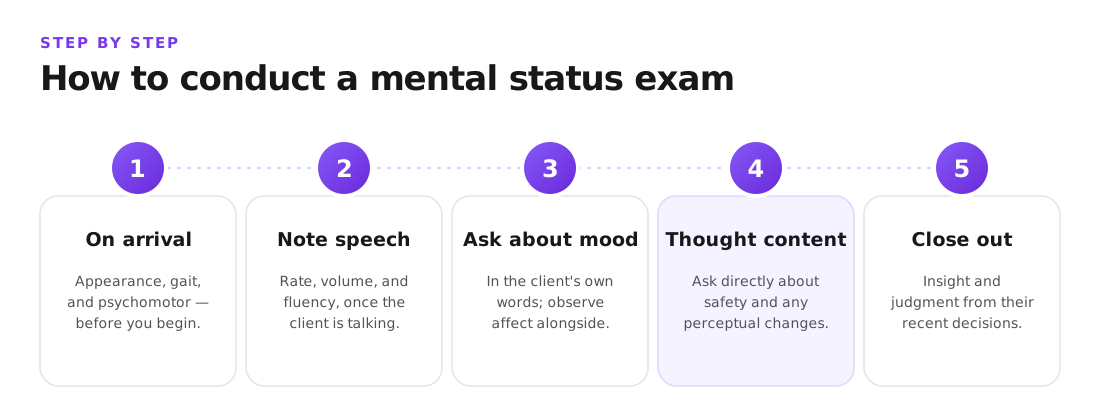
The MSE is not a separate clinical interview. It runs continuously alongside a standard therapy session. Therapists observe and note findings throughout the encounter rather than stopping to administer a discrete test.
Here is a practical approach:
- Observe from the moment the client arrives. Appearance, gait, and psychomotor activity are best assessed before the session formally begins.
- Note speech patterns early in the session. Rate, volume, and fluency become easier to characterize once the client has been talking for a few minutes.
- Ask about mood directly. "How would you describe your mood today?" gives you the client's subjective report. Your observation of their affect throughout the session provides the objective counterpart.
- Assess thought content explicitly. Safety assessment for suicidal and homicidal ideation should be a deliberate part of every session, not assumed from general presentation. Ask directly. Include a brief check for perceptual disturbances: "Have you been experiencing anything unusual, like hearing sounds or seeing things others don't?"
- Close with insight and judgment. The client's understanding of their situation and their recent decision-making often emerges organically from a reflective close to the session.
For routine outpatient therapy, a brief MSE covering appearance, mood, affect, thought process, and safety assessment is standard in each session note. A comprehensive MSE across all nine domains is more typical at intake, during crisis assessment, and at treatment plan review intervals.
How to document a mental status exam in therapy notes
MSE findings are typically documented in the objective section of a progress note. In SOAP note format, the MSE belongs in the O (Objective) section — it captures clinical observations, not clinical interpretation. Some note formats include a dedicated MSE section with separate fields for each domain.
Good MSE documentation is:
- Specific and observable. Document what you saw and heard, not your interpretation. "Speech was pressured" is more useful than "client seemed hypomanic."
- Concise. A few sentences per domain is sufficient for routine sessions.
- Comparative where relevant. "Affect more restricted than last session" communicates change clearly and supports continuity of care.
- Complete on safety. Always document the presence or absence of suicidal and homicidal ideation, even when the answer is negative. Absence of documentation is not evidence of absence of inquiry.
Upheal's documentation hub includes templates for SOAP, DAP, BIRP, and other note formats, all of which can incorporate MSE findings.
For ethical and legal standards governing clinical record-keeping, see the APA's record-keeping guidelines. [add rel=nofollow on publish]
If you use Upheal, the MSE fields in your session note populate automatically from the recording. You review each field and sign. The conducting observation doesn't change — Upheal handles what comes after.
Mental status exam example
The following is an illustrative MSE. It is not a real client record and should not be used as a clinical template without therapist review and customization.
Mental status exam
Appearance: Client appeared casually dressed and well-groomed. Appeared stated age of 34.
Behavior/Psychomotor: Cooperative throughout session. No psychomotor agitation or retardation observed. Maintained intermittent eye contact.
Speech: Normal rate and volume. Spontaneous and coherent.
Mood: Client reported mood as "better than last week, but still anxious."
Affect: Mildly anxious, appropriate range, congruent with reported mood.
Thought process and content: Logical and goal-directed. Mild circumstantiality when discussing work stressors; returned to topic without redirection. No suicidal ideation, homicidal ideation, delusional thinking, or perceptual disturbances. Client described persistent worry about job performance.
Cognition: Oriented to person, place, and time. Concentration intact throughout session.
Insight: Good. Client acknowledged anxiety symptoms and their impact on daily functioning.
Judgment: Good. Recent decisions reported as thoughtful and consistent with treatment goals.
MSE vs. mini mental status exam: what's the difference?
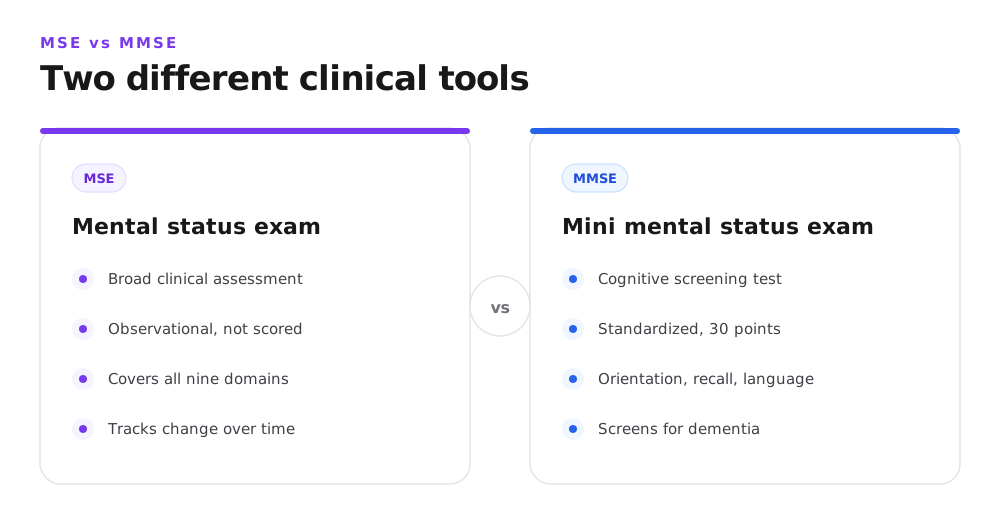
The mental status exam (MSE) and the mini mental status exam (MMSE) are two different clinical tools that are frequently confused.
The MSE is a broad clinical assessment of overall psychological functioning. It is observational, not standardized, and covers nine domains including mood, affect, thought process and content, cognition, insight, and judgment. Therapists use it throughout treatment to track change and document clinical presentation.
The MMSE (also called the Folstein MMSE) is a standardized 30-point cognitive screening test used primarily to identify dementia and cognitive impairment. It focuses narrowly on orientation, registration, attention, recall, and language. It does not assess mood, affect, thought content, or judgment.
A therapist might administer the MMSE as part of a cognitive assessment while simultaneously documenting a full MSE. They serve different clinical purposes and are not interchangeable.
For ICD-10 codes related to cognitive and mental status presentations, see Upheal's ICD-10 code reference.
Frequently asked questions about the mental status exam
What is a mental status exam?
A mental status exam is a structured clinical assessment used to document a client's psychological state at a given point in time. It covers nine domains: appearance, behavior, speech, mood, affect, thought process and content, cognition, insight, and judgment.
What does MSE stand for in mental health?
MSE stands for mental status exam (or mental status examination). The MSE is a standard component of psychiatric and therapy documentation used to capture a client's clinical presentation at the time of each encounter.
What are the components of a mental status exam?
The nine core components of the MSE are: appearance, behavior and psychomotor activity, speech, mood, affect, thought process and content, cognition, insight, and judgment. Mood and affect are documented separately because mood is the client's subjective report and affect is the therapist's objective observation. Perceptual disturbances are documented within thought process and content.
When should a therapist conduct a mental status exam?
A full MSE is standard at intake and discharge, and during crisis assessment or significant clinical changes. For routine outpatient sessions, a brief MSE covering safety, mood, affect, and thought process is typically documented in every progress note.
How long does a mental status exam take?
The MSE does not require additional session time. It runs alongside a standard session as the therapist observes and notes the client's presentation. Documenting the findings in a progress note typically takes five to ten minutes.
Is a mental status exam the same as the MMSE?
No. The MSE is a broad clinical assessment of overall psychological functioning covering nine domains. The MMSE is a standardized 30-point cognitive screening test used to identify dementia and cognitive impairment. They serve different clinical purposes.
How is a mental status exam documented?
MSE findings are documented in the assessment section of a progress note, either as a brief narrative or in a structured format with fields for each domain. Safety assessment, including suicidal and homicidal ideation, should always be explicitly documented, including when the result is negative.