
How to write therapy notes — examples, templates, and best practices
A therapy note is a clinical record of what happened in a session: what the client presented, what interventions you used, and what the plan is going forward. Writing good therapy notes protects your clients, supports your clinical thinking, and keeps your practice audit-ready.
This guide covers everything you need to write therapy notes efficiently and accurately, including real examples in SOAP, DAP, GIRP, and progress note formats, plus practical tips for reducing documentation time.
TL;DR
- A therapy note documents the presenting issue, clinical observations, interventions used, and the treatment plan.
- The most common formats are SOAP, DAP, GIRP, BIRP, and progress notes. Choose based on your practice setting and payer requirements.
- AI therapy notes, like those generated by Upheal, can reduce documentation time from 16 minutes to under 5 minutes per session while maintaining clinical accuracy.
- Clinical examples in this guide are illustrative only and should not be used as real client records without therapist review.
What are therapy notes?
Therapy notes are clinical records that document the content and progress of psychotherapy sessions. They serve three purposes: supporting clinical continuity (so you remember what happened and what comes next), meeting legal and ethical documentation requirements, and providing evidence for insurance billing and reimbursement.
Most licensing boards and payers require therapy notes to be written within a specific timeframe after each session, typically 24 to 72 hours. The exact requirements depend on your state, your license, and your payer contracts.
What every therapy note must include
Regardless of the format you use, a complete therapy note should document:
- Date and duration of the session. Include the exact session length, especially if billing by time.
- Presenting issues. What the client brought to the session. Use the client's language where possible.
- Mental status observations. Mood, affect, appearance, behavior, and cognitive functioning as clinically relevant.
- Interventions used. What you actually did in the session: CBT techniques, EMDR, motivational interviewing, psychoeducation, and so on. Be specific.
- Client response. How the client engaged with the interventions. Objective observations, not judgments.
- Progress toward treatment goals. Where the client is relative to the goals in their treatment plan.
- Plan. What happens next: homework assigned, topics to address, next appointment date, any safety concerns.
For insurance-billed sessions, you also need the correct CPT code, diagnosis code (ICD-10), and session type.
The most common therapy note formats
The format you use depends on your practice setting, payer requirements, and personal preference. Here are the five most widely used formats.
SOAP notes
SOAP stands for Subjective, Objective, Assessment, and Plan. It is one of the most widely used formats in healthcare and is accepted by most insurance payers.
- Subjective: What the client reported. Their words, their experience, their self-assessment.
- Objective: Your clinical observations. Mental status, behavior, appearance, engagement level.
- Assessment: Your clinical interpretation. How the client is progressing, what the data suggests, any changes to the diagnosis or treatment focus.
- Plan: What comes next. Interventions planned, homework assigned, next appointment.
See Upheal's SOAP note templates and examples
DAP notes
DAP stands for Data, Assessment, and Plan. It is popular in outpatient mental health settings and streamlines the subjective/objective distinction into a single Data section.
- Data: Both subjective (client's report) and objective (your observations) combined.
- Assessment: Your clinical interpretation of the data.
- Plan: Next steps, interventions, homework, appointment date.
DAP notes are faster to write than SOAP notes and work well in settings where the subjective/objective distinction is less clinically relevant.
See Upheal's DAP note templates
GIRP notes
GIRP stands for Goals, Interventions, Response, and Plan. This format keeps every note anchored to the client's treatment goals, making it useful for demonstrating medical necessity to insurers.
- Goals: Which treatment goals this session addressed.
- Interventions: What techniques and approaches you used.
- Response: How the client responded to the interventions.
- Plan: What happens next.
BIRP notes
BIRP stands for Behavior, Intervention, Response, and Plan. It is similar to GIRP but leads with the client's presenting behavior rather than the treatment goal.
- Behavior: What the client presented with at the start of the session.
- Intervention: What you did clinically.
- Response: How the client responded.
- Plan: Next steps.
Progress notes
Progress notes are a shorter, narrative format often used in community mental health, residential settings, or for brief check-ins. They summarize session content in paragraph form rather than following a rigid structure.
Progress notes are faster to write but provide less structure for billing documentation. If you bill insurance, confirm your payer accepts progress notes before using them exclusively.
See Upheal's progress note templates
Real therapy note examples
The following examples are illustrative only. They should not be used as real client records without therapist review and customization to the individual client.
SOAP note example
S: Client reports increased anxiety this week following a difficult conversation with their partner. States, "I keep replaying the argument in my head and can't let it go." Reports sleep disruption (4–5 hours per night) and difficulty concentrating at work.
O: Client presented as mildly dysregulated on arrival, with increased speech rate and visible tension. Affect was congruent with reported mood. Client engaged well with session and was able to slow down with grounding intervention.
A: Client continues to demonstrate anxious rumination patterns consistent with GAD diagnosis. Cognitive distortions (catastrophizing, mind-reading) present in self-report about partner conflict. Sleep disruption is likely both a symptom and a maintaining factor for anxiety. Progress toward treatment goal (reduce anxious rumination frequency) is moderate.
P: Introduced thought record for rumination. Assigned practice with 5-minute daily thought records before bed. Discussed sleep hygiene strategies. Next session: review thought records, continue CBT for rumination. Follow-up in one week.
DAP note example
D: Client reported feeling more stable this week following last session's work on emotion regulation. Practiced the TIPP skill twice and noted it "actually helped." Mental status: calm affect, good eye contact, organized thought process. Engaged actively throughout session.
A: Client showing clear progress in applying DBT skills outside of session. Increased self-efficacy noted in self-report. Movement toward treatment goal: improve emotion regulation in conflict situations.
P: Continued DBT skills work. Introduced DEAR MAN for interpersonal effectiveness ahead of family conversation next week. Assigned DEAR MAN practice script. Next appointment in one week.
How to write therapy notes quickly without burning out
Documentation is one of the leading drivers of therapist burnout. The average therapist spends 16 minutes per session on notes. For a full caseload, that is over two hours of documentation per day.
Here are practical strategies to reduce that time:
Write notes immediately after each session. The longer you wait, the more you have to reconstruct from memory. A note written right after a session takes a fraction of the time of one written at the end of the day.
Use a consistent format. Once you have internalized a format (SOAP, DAP, or another), each section becomes a prompt rather than a blank page. Consistency reduces cognitive load.
Use templates for recurring note elements. Diagnosis, treatment goals, and standard interventions can be templated. Customize the client-specific content and save significant time.

Be specific, not comprehensive. A good therapy note captures what is clinically relevant, not everything that was said. Three specific sentences beat three vague paragraphs.
Consider AI therapy notes. Upheal's AI clinical notes generate a complete session note from your session audio, in the format you choose, in under a minute. Therapists using Upheal reduce documentation time from 16 minutes to under 5 minutes per session.
What are AI therapy notes?
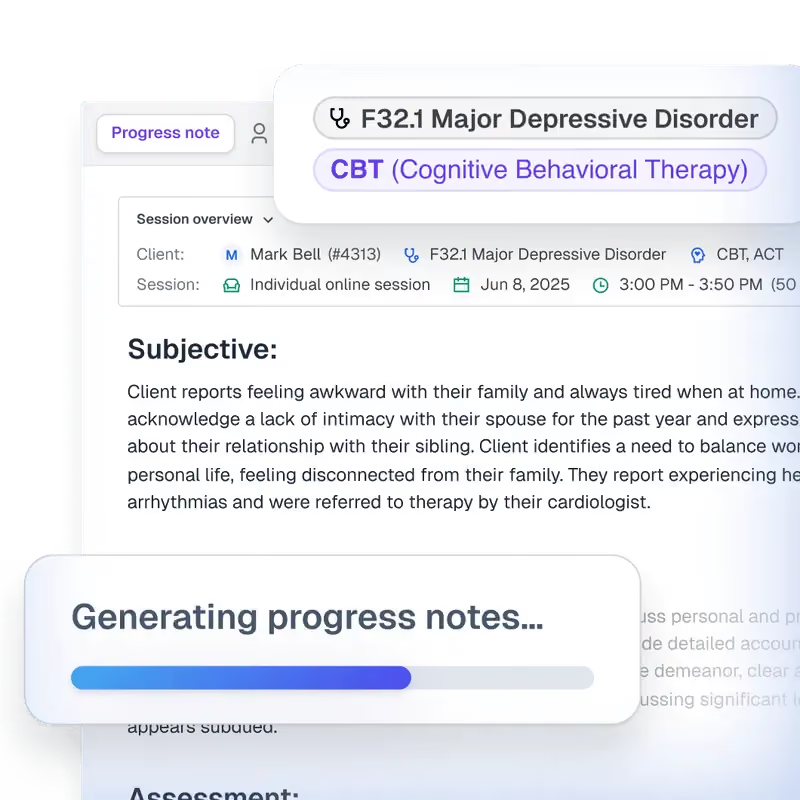
AI therapy notes are clinical session notes created automatically using AI during or after a therapy session. The AI listens to the session (with client consent), identifies clinically relevant content, and generates a structured note in the therapist's chosen format.
When built into a HIPAA-compliant EHR like Upheal, AI therapy notes meet the same documentation requirements as manually written notes. The therapist reviews and approves the note before it becomes part of the clinical record. AI does not replace clinical judgment: it handles the transcription and structuring work so the therapist can focus on reviewing and refining rather than writing from scratch.
AI therapy notes are not appropriate for every therapist or every clinical situation. They work best for therapists with a full caseload who want to reduce documentation time without compromising clinical accuracy.
Ready to spend less time on notes? Start free, $1 per session
Frequently asked questions about writing therapy notes
How long should a therapy note be?
A therapy note should be as long as it needs to be to document what is clinically relevant. In practice, most progress notes run two to four paragraphs. SOAP and DAP notes for a 50-minute session typically run 200 to 400 words. Length matters less than specificity.
What should you not include in therapy notes?
Do not include personal opinions, judgments, or speculation unrelated to clinical assessment. Avoid vague language ("client did well") in favor of specific behavioral observations. Do not include information that could harm the client if the record were subpoenaed or accessed by insurance reviewers.
How soon should therapy notes be written after a session?
Most licensing boards require notes to be completed within 24 to 72 hours of the session. Many payers require same-day or next-day documentation. Best practice is to write notes immediately after each session while the content is fresh.
What is the difference between process notes and therapy notes?
Process notes (sometimes called psychotherapy notes under HIPAA) are personal notes a therapist keeps for their own clinical use. They are separate from the official medical record, are not shared with insurers, and have stronger privacy protections under HIPAA. Therapy notes (or progress notes) are part of the official medical record, may be shared with insurers, and are subject to standard record-keeping requirements.
Can AI write therapy notes?
Yes, with therapist review and approval. AI tools like Upheal generate therapy notes from session audio, in the format the therapist chooses. The therapist reviews the note for accuracy before it becomes part of the client record. AI handles the structural and transcription work; clinical judgment remains with the therapist. Research published in peer-reviewed journals supports the use of AI-assisted documentation when human oversight is maintained. [add rel=nofollow on publish]
How do I write therapy notes that hold up to an insurance audit?
Insurance-compliant therapy notes must document medical necessity: the diagnosis, the functional impairment it causes, and the specific interventions used to address it. Vague notes ("supportive therapy provided") are the most common audit failure point. Every note should connect the session content to a treatment goal and demonstrate clinical reasoning.
How to write therapy notes
Good therapy notes are not about perfection. They are about documenting what happened, why it matters clinically, and what comes next. A well-written note takes 5 to 10 minutes. A vague note takes the same time and protects no one.
If documentation is taking up hours of your day, the problem is usually one of two things: waiting too long to write notes, or writing more than is clinically necessary. A consistent format and the discipline to write immediately after each session solves most documentation overload.
For therapists who want to reduce documentation time further, Upheal generates a complete, review-ready therapy note from every session, in your chosen format, in under a minute.